Caught between the US and China, squeezed Europe strives to find its way
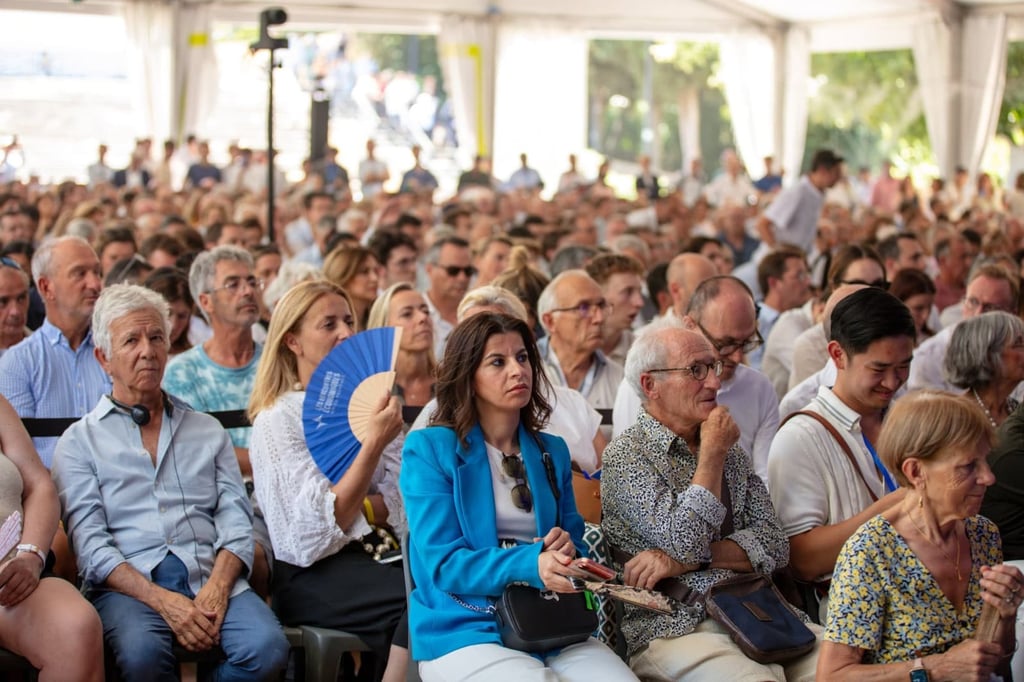
At France’s annual economic forum, Europe’s economic and political leaders addressed the continent’s problems – and what to do about them

The diagnosis was near-universal: Europe has big problems. Caught between the United States and China, it risks being squeezed on every front – security, technology, democracy and industry.
On what exactly Europe should do, a few policy options emerged from the usual cacophony: move much faster – even if that meant a few willing countries pressing ahead without the rest – and finally build a genuine capital markets union that would put Europe’s vast savings to work.
Perhaps no one summarised the situation better than Édouard Philippe, the former French prime minister.
“When the Chinese discuss trade with Europe, I don’t think they underestimate Europe at all. I think they read us perfectly,” Philippe said. “They see it [Europe] as weak. And in a way, vis-a-vis our Chinese partners, it is weak.”
The US, too, sees Europe as it is: not as a continental power, but as an ally that Washington can “walk all over”, he said, citing EU Commission President Ursula von der Leyen’s trip to Scotland last year for trade discussions with US President Donald Trump as a modern-day Canossa. Recalling Holy Roman Emperor Henry IV’s 1077 journey to the Italian village to submit to Pope Gregory VII, it was seen as the ultimate humiliation.
Philippe, a centrist front-runner to succeed French President Emmanuel Macron next year, urged Europe to defend its market and compel trade partners such as China to produce in Europe in exchange for market access. The key was to act quickly as he warned that Europe, producing at higher costs with older technologies than China, was taking a slap in the face that would soon turn into a knockout punch.
The need for speed was raised repeatedly throughout the event with Olivier Scalabre, head of BCG France, lamenting that Europe had only achieved 30 per cent of the reforms demanded by the Draghi report after two years.
The European Union would not be able to move fast enough with all 27 members on board, Scalabre argued. Instead, he proposed that five to seven member states agree to push forward reforms in key areas – energy, technology and capital – a “coalition of the willing” already permitted under existing EU treaties through a mechanism known as enhanced cooperation.
On the issue of capital, Europe’s financial chief described the fragmented reality of the continent’s financial market. The bloc has 295 trading platforms, 14 central counterparties, and 32 central securities depositories (CSD), many of which were “anchored in national prerogatives” that block the free flow of capital within the EU, according to Christine Lagarde, president of the European Central Bank (ECB).
In comparison, the US only has two security clearing houses and one CSD, per the ECB’s own count.
“Everything starts with financing: with the funds that need to be put in place to finance innovation, to finance the energy transition, and to finance defence,” Lagarde said.
This was a point that resonated with European Council President Antonio Costa, who stressed the need to build a “real capital market” and fully mobilise European savings as the bloc sought to double investment in research and competitiveness in the EU’s next long-term budget from 2028 to 2034.
To fully unleash the potential of European savings, corporate leaders also hinted at the need for European governments to reduce their public debt levels.
Europe’s long-term savings, held by banks and insurers, largely go to finance public debt and reducing public borrowing could free up this capital, according to Thomas Buberl, CEO of AXA.
At the end of the day, Europe has everything it needs – the money and the talent. But the problem, he argued, is that both keep leaving.
“We need to rally around our strengths,” Buberl said. “We need to create a new European narrative – and do for Europe what we did in France with Notre-Dame and the Olympic Games: a new project with strong ambition, and with a process and power of execution outside the bureaucracy.”


No comments:
Post a Comment