"I am the Way, the Truth, and the Life"

Father God, thank you for the love of the truth you have given me. Please bless me with the wisdom, knowledge and discernment needed to always present the truth in an attitude of grace and love. Use this blog and Northwoods Ministries for your glory. Help us all to read and to study Your Word without preconceived notions, but rather, let scripture interpret scripture in the presence of the Holy Spirit. All praise to our Lord and Saviour Jesus Christ.

Please note: All my writings and comments appear in bold italics in this colour

Wednesday, December 27, 2017

Price of Cancer Drug Jumps >1500% - Merry Christmas Big Pharma

It just can't be that hard to write a law making it illegal to significantly raise prices of drugs without substantial improvement in those drugs. It might be easier if lawmakers weren't in the pockets of Big Pharma.

Price gouging? Cancer drug price spikes from $50 to $768 per pill after change of owner

© Global Look Press

A long-standing medication for cancer has become almost unaffordable for most of patients, as its price has skyrocketed 1,500 percent over four years. The company behind the drug is under fire.

The remedy for brain tumors and Hodgkin lymphoma was introduced 42 years ago, and the highest dose was sold for $50 per capsule. The drug, called lomustine had no generic alternative and was branded as CeeNU.

In 2013, the brand’s owner Bristol Myers Squibb sold lomustine to a Miami startup called NextSource. The new owner rebranded the drug, giving it a new name – Gleostine, and multiplied the price by almost sixteen times. Now, the same treatment costs $768 for a single capsule.

According to an analysis done for the Wall Street Journal by Truveen Health Analytics and Elsevier, the company raised the price for Gleostine by 12 percent in November following a 20 percent increase in August.

Dosage is assigned by a patient’s weight with some of them needing more than one pill. That makes the medication’s price point entirely out of reach.

Any government that would allow these obscene price hikes to stand has no interest in the welfare of the lower or middle classes regardless of what they say. This can be dealt with and must be dealt with. It is obvious that free-enterprise doesn't work where one's life and health is on one side and greedy, soulless, selfish jerks are on the other.

NextSource sets prices based on the costs it bears to develop the medication and to pay regulatory agency fees, as well as on the benefits it provides patients, according to the company’s CEO Robert DiCrisci, as quoted by the media. The firm reportedly provides discounts and financial assistance to those who can't afford its cost.

Though the medicine has been in use since 1976, oncologists along with pharmacies have a renewed interest in it, as government-funded research revealed that Gleostine combined with chemotherapy can help patients struggling with brain tumors to live longer.

The US Food and Drug Administration (FDA) has reportedly started a campaign to provide a more competitive field for the medicines that have no current generics. Approving generic drugs is a top priority for the FDA. Earlier this week, the agency’s commissioner Scott Gottlieb said the FDA had approved a record number of generic drugs.


Tuesday, December 26, 2017

Despite Health Risks for Babies, Pregnant Women are Using More Pot

Pot use among pregnant women of all ages continues rise – study

© Mark Leffingwell / Reuters

More than one-fifth of American teenagers are using marijuana during pregnancy, a new study finds. Use of the drug, found to impair an infant’s brain development and function, is on the rise with pregnant women of all ages.

The number of women who self-reported using marijuana during their pregnancy rose from 2.4 percent in 2009 to 3.9 percent in 2016, according to a new study published Tuesday by the Journal of the American Medical Association.

From 2009 to 2016, prenatal use of marijuana increased most significantly for women under the age of 25. In 2016, more than one-in-five (21.8 percent) women under the age of 18 reported to using the drug in the past month, up from 12.5 percent in 2009. Use among women between the ages of 18 and 25 nearly doubled during that time, from 9.8 percent in 2009 to 19 percent in 2016.

The study notes that marijuana is “the most commonly used illicit drug during pregnancy,” adding that use of the drug has been increasing.

Prenatal marijuana use also increased among women of all ages. Last year, 5.1 percent of women between the ages of 25 and 34 years old reported to using marijuana while pregnant, up from 3.4 percent in 2009. A total of 3.3 percent of women older than 34 also reported to using the drug during their pregnancy in 2016, an increase from 2.1 percent in 2009.

Statistics are underreported

Researchers relied on self-administered questionnaires completed by 279,457 women eight weeks into their pregnancy. The women were treated at Kaiser Permanente facilities that had screening for marijuana use as part of standard prenatal care.

I wonder why they surveyed women so early in their pregnancies? That, in itself, would certainly reduce the numbers.

However, the study notes that some of the patients who did not say they used marijuana on their questionnaires, later tested positive on a cannabis toxicology test, leading researchers to state their data was “likely” underreported. The study adds that prenatal use may increase even more in 2018, after recreational use of marijuana is set to become legal in California.

Health risks for babies

While studies on pregnant women who use marijuana have been limited, the researchers state that prenatal use of marijuana may impair fetal growth and neurodevelopment.

In October, the American College of Obstetricians and Gynecologists (ACOG), which discourages marijuana use among pregnant or breastfeeding women, said that prenatal marijuana use could cause harm to an infant’s brain development and function.

Citing studies, the ACOG warns that “children who were exposed to marijuana in utero had lower scores on tests of visual problem solving, visual-motor coordination, and visual analysis than children who were not exposed to marijuana in utero.”

Obstetrician–gynecologists should be discouraged from prescribing or suggesting the use of marijuana for medicinal purposes during preconception, pregnancy, and lactation,” The ACOG committee wrote in an opinion. “Pregnant women or women contemplating pregnancy should be encouraged to discontinue use of marijuana for medicinal purposes in favor of an alternative therapy for which there are better pregnancy-specific safety data.”

The Centers for Disease Control and Prevention (CDC) also warns pregnant mothers against using marijuana to ease nausea and other pregnancy symptoms, saying that the drug can cause problems in newborns, including low birth weight, and developmental problems.

Recreational marijuana use is now legal in eight US states and the District of Columbia. A total of 23 states have laws that allow the use of marijuana for medicinal purposes to some extent. However, on a federal level, it is still illegal to possess, use, buy, sell, or cultivate marijuana.

Locations that sell marijuana should be required to display large signs indicating the dangers of pot to prenatal children and thoroughly discourage pregnant woman from purchasing it.

There is probably not enough research available to tell whether children born of a mom who uses pot is more susceptible to Schizophrenia or not. We know that teens who use pot are much more susceptible, especially those in their early teens. This needs to be studied.


Thousands Protest in Peru After 'Grateful' Ex-President Pardoned

Corruption is Everywhere - Including Peru

By Susan McFarland  

Riot police officers block passage of protesters during a demonstration against the pardon to ex-president Alberto Fujimori, in Lima, Peru on Monday. Photo by Eduardo Cavero/EPA-EFE

UPI -- Police in Peru fired tear gas at crowds of angry Peruvians during a protest over President Pedro Pablo Kuczynski's decision to pardon and release former President Alberto Fujimori from prison.

Crowds chanted, "traitor" and, "the pardon has got to go" during the clash on the streets of Lima.

Fujimori, who'd been serving a 25-year sentence for human rights abuses, was released Sunday for health reasons. He was Peru's leader from 1990 to 2000.

From his hospital bed, Fujimori thanked Kuczynski and said in a Facebook video he was "deeply grateful." He added that hearing the news had "a strong impact on me, a mix of extreme happiness as well as sorrow".

"I'm aware that the results produced by my government were well received by some," Fujimori said. "But I recognize that I have let down others. Those I ask for forgiveness from the bottom of my heart."

Fujimori's term began in 2007 with a six-year sentence for bribery and abuse of power. Two years into that sentence, Fujimori was given another 25 years for human rights abuses that included authorizing death squad killings.

Kuczynski said reason for clemency was because Fujimori has low blood pressure and an irregular heartbeat. A statement by Kuczynski said he is "convinced that those of us who consider ourselves democrats cannot allow Alberto Fujimori to die in prison."

"Justice is not vengeance. All pardons are by nature controversial," he added. "My decision is especially complex and difficult, but it is my decision. I can not only be the president of those that voted for me, I need to be it for all Peruvians."

Kuczynski denies pardoning Fujimori is part of a deal with his party to distract from a corruption probe involving Brazil-based conglomerate Odebrecht.

Peruvian lawmakers Vicente Zeballos, Alberto de Belaunde and Gino Costa all said they plan to resign in protest of the presidential pardon.


Sunday, December 24, 2017

Harrisburg Shooting Spree was a ‘Terror Attack’ – Department of Homeland Security

Ahmed Aminamin El-Mofty, suspect in December 22 shootings in Harrisburg, Pennsylvania
© Dauphin County District Attorney's Office

The Department of Homeland Security describes the shooting spree in Harrisburg, Pennsylvania, which took place on Friday, as “a terror attack.” The gunman opened fire and targeted police in several locations in the city.

“Department of Homeland Security can confirm the suspect involved in a terror attack in Harrisburg Pennsylvania” was a beneficiary of “extended family chain migration,” Tyler Q. Houlton, the acting press secretary for the Department of Homeland Security, said in a tweet.

Ahmed Amin El-Mofty fired several shots at a Capitol police officer in downtown Harrisburg on Friday afternoon; one shot “went very close to hitting [the officer],” police earlier reported. Half an hour later, the attacker fired shots at a Pennsylvania State Police trooper. One of the shots hit the trooper. She is expected to make a full recovery.

El-Mofty then opened fire on local officers with two handguns. The officers, none of whom were injured, fired back, killing the attacker.

El-Mofty was “a naturalized US citizen who was admitted to the US from Egypt on a family-based immigrant visa,” Houlton wrote, adding that “the long chain of migration that led to the suspect’s admission into the US was initiated years ago by a distant relative of the suspect.”

Earlier, Dauphin County District Attorney Ed Marsico said there was no doubt that El-Mofty “was directly targeting police officers.”

But for the fact that he was a poor shot, several officers might have been wounded or killed.

“This could have been a really tragic incidence with this individual firing many shots at police cars in downtown Harrisburg in the midst of rush hour traffic on a Friday afternoon and then coming up here in a residential neighborhood and firing again many shots,” Marsico said.

Ahmed Soweilam, a relative of El-Mofty, told PennLive.com that the attacker worked as a security guard and had no history of violence or mental illness. He moved back to Egypt but returned a few months ago. “He’s not the perfect guy, but he’s not an aggressive person,” Soweilam said. 


Saturday, December 23, 2017

New Documents: Tiananmen Square Protest Death Toll was 10,000

By Allen Cone 

People visit Tiananmen Square, the site of the deadly 1989 student protests, in Beijing on July 14. The
death toll in the Chinese army crackdown on the 1989 Tiananmen Square protests was 10,000 people,
according to newly released documents. Photo by Stephen Shaver/UPI | License Photo

UPI -- The death toll in the Chinese army crackdown on the 1989 Tiananmen Square protests was 10,000 people, according to newly-released documents.

China's government has said between 200 and 300 civilians died in the pro-democracy uprising on June 4, 1989. The political protests had lasted seven weeks until the army, which included 27 armored personnel carriers, was sent in.

But recently unsealed U.K. diplomatic cables sent at the time of the uprising now shed doubt on those estimations.

"Minimum estimate of civilian dead 10,000," reads the final sentence of a secret diplomatic cable: written on June 5 from Alan Donald, Britain's ambassador to China at the time. He said the figure was based on someone who "was passing on information given him by a close friend who is currently a member of the State Council."

The council is run by the premier.

The cables, held at the National Archives in London, were declassified in October, They were seen by the HK01 news site.

The document describes in detail the massacre. Wounded female students begging for their lives were allegedly were bayoneted, human remains were "hosed down the drains" and one mother was shot attempting to help her injured 3-year-old daughter.

"Students understood they were given one hour to leave square but after five minutes APCs attacked," he wrote. "Students linked arms but were mown down including soldiers. APCs then ran over bodies time and time again to make 'pie' and remains collected by bulldozer. Remains incinerated and then hosed down drains."

Activists in Hong Kong and Taiwan commemorate the anniversary date each year.

All activists' commemorations of the event are banned in mainland China. The government also regulates online discussion of the incident, including censoring criticism.

In November 2016, a peaceful pro-democracy march that drew thousands of people in Hong Kong turned violent. They had marched 2 1/2 miles across town to oppose Beijing's decision to determine the fate of two lawmakers who called for outright independence of Hong Kong from China.


Thursday, December 21, 2017

'Devastating’: Yemen’s Cholera Endemic Hits 1 Million Mark

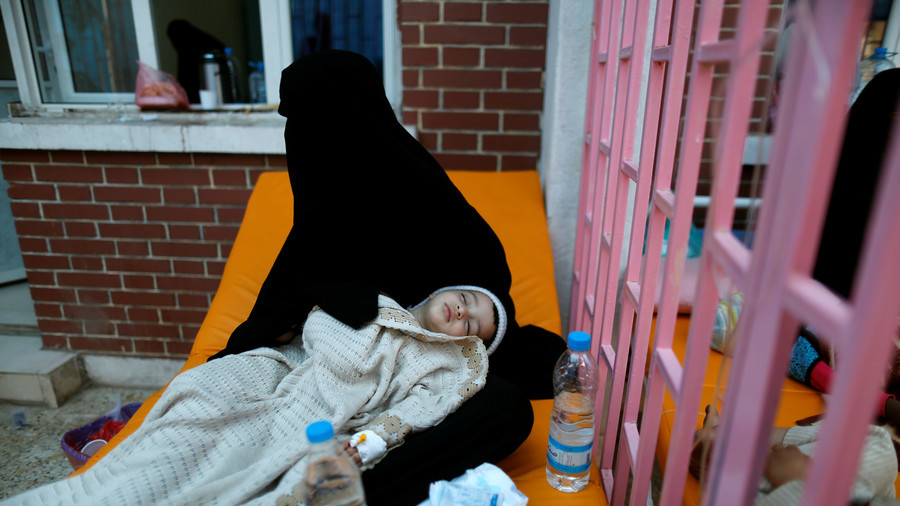
A woman holds her son who is suspected of being infected with cholera in Sanaa. © Khaled Abdullah / Reuters
Yes, there is a woman in this photo - she's invisible, as are all women in devout Islam

Yemen’s cholera outbreak has surpassed the 1 million mark while 300 cases of diphtheria have been reported as civilians in the war-ravaged country continue to face starvation and a crippling blockade. “We can confirm that the country has now reached 1 million suspected cases of cholera,” the International Committee of the Red Cross said. “This is devastating.”

The World Health Organization has recorded 2,226 deaths since the epidemic began in April. Cholera causes severe diarrhea and dehydration and is spread by dirty water and the contamination of food with feces. It can cause death within hours if untreated.

The ICRC also said over 80 percent of Yemen is in need of food, clean water, healthcare and fuel.

The country is in the grips of a brutal war, with a Saudi-led coalition of nine countries conducting airstrikes against the Houthi rebels in support of President Abdrabbuh Mansour Hadi, who fled the country in 2015.

The Houthis were in alliance with long-running former President Ali Abdullah Saleh, who they killed in December after indicating he was changing sides and seeking dialogue with the Saudis.

The Houthi rebels are supported by Iran, which is also accused of supplying weapons to the group, a charge which Iranian Foreign Minister Mohammad Javad Zarif described as “baseless accusations,” on Wednesday.

Saudi Arabia has imposed a blockade on the country, which has further intensified the food and aid shortage. On Wednesday, it said it would keep the rebel-controlled port of Hodeidah open for 30 days to allow humanitarian deliveries to get into the country.

In January, the UN Office for the Coordination of Humanitarian Affairs said the civilian death toll had reached 10,000, citing data gathered by health facilities, and said the actual number could be much higher.  

The United Nations on Tuesday said coalition airstrikes had killed at least 136 civilians between December 6 and 16.

“We urge all parties to the conflict to respect their obligations under international humanitarian law, including their obligation to respect the principles of distinction, proportionality and precaution,” Rupert Colville, spokesperson for the Office of the UN High Commissioner for Human Rights (OHCHR) said.“They should take all feasible precautions to avoid, and in any event to minimise, the impact of violence on civilians.”

Meanwhile, MSF announced in Geneva on Thursday the country also faces a diphtheria outbreak, with more than 300 cases reported. “In Yemen, the last diphtheria case was recorded in 1992, and the last outbreak in 1982,” MSF Emergency Coordinator said. “The ongoing war and blockade is sending Yemen’s health system decades back in time.”


At about the same time as the above report came out,
the Pentagon confirms ‘multiple ground ops & 120+ strikes’ in Yemen 

Why is the US in Yemen?

A man walks past a graffiti, denouncing strikes by U.S. drones in Yemen, painted on a wall in Sanaa, Yemen
on November 13, 2014. © Khaled Abdullah / Reuters

The Pentagon has disclosed that it carried out “multiple ground operations” in Yemen this year. The confirmation sheds new light on largely covert US military activities in the region.

US forces have conducted “multiple ground operations and more than 120 strikes in 2017,” according to a statement released by US Central Command in Tampa, Florida. The US military hopes to prevent Al-Qaeda in the Arabian Peninsula (AQAP) and Islamic State from using Yemen “as a hub for terrorist recruiting, training and base of operations to export terror worldwide,” the statement reads.

The 120 claimed strikes against targets in Yemen would mark a 3-fold increase compared to the number of airstrikes from last year.


Before Wednesday’s statement, there had been few official disclosures of the extent of US military involvement in Yemen. In sharp contrast to the fight against IS in Syria and Iraq, the Pentagon has avoided holding regular briefings or updates on ground or air operations in Yemen.

However, there are sporadic reports of US military activity in the country. US Central Command said earlier this month that five Al-Qaeda militants had been killed in a US airstrike that took place on November 20 in Yemen’s Bayda Governorate.

The Pentagon previously acknowledged that the US “has people on the ground” in Yemen. According to media reports, in April, US special operations forces stepped up ground operations in Yemen, but military officials did not elaborate on the matter. It is still unclear exactly how many US boots are on the ground in Yemen. A White House report submitted to Congress last week detailing US military operations worldwide failed to disclose the number of US troops stationed in Yemen.

In February, it was revealed that a botched US raid in the country had left at least 25 civilians and one Navy SEAL dead. Inquiries into the disaster found that the raid yielded no significant intelligence, but the Trump administration nonetheless praised the mission as a success. Apart from the deaths, a $70 million military helicopter was also destroyed.

The latest acknowledgement of US ground operations in Yemen raises questions about the legality of such activity with respect to Yemen’s sovereignty.

Kim Sharif, director of Human Rights for Yemen, said in March, “the Yemeni people are saying: ‘Where are the other powers in the Security Council? Why aren’t they standing up for the sovereignty of Yemen, when clearly it is in their best interest as well to do so, because they surely must have business interest, commercial interest to protect and preserve the sovereignty of Yemen for the purpose of preserving that international passage for the benefit of all.’”


Wednesday, December 20, 2017

Park Geun-hye Confidante: I Purchased German Hotel with Samsung Funds

Corruption is Everywhere - Certainly in South Korea

By Elizabeth Shim 

Choi Soon-sil, the South Korean defendant at the center of a presidential scandal involving corruption and bribery, denied Wednesday she took bribes from Samsung. Photo by Yonhap

UPI -- A confidante of former South Korean President Park Geun-hye said she used money from conglomerate Samsung to purchase a hotel in Germany -- but denied receiving bribes to buy a horse for her equestrian daughter.

Choi Soon-sil, who used her friendship with Park to solicit donations and funding for her two foundations, said Wednesday during her 15th hearing of the appeals trial of Samsung Electronics Vice Chairman Lee Jae-yong money from Samsung was used to purchase a hotel near Frankfurt.

Samsung donated the money to Choi around 2015, which the conglomerate sent to fund the activities of KOA Sports, one of Choi's entities, South Korean television network JTBC reported.

Asia Business reported Choi said Samsung did not know she had used the money to buy real estate in Germany.

Samsung was not consulted, and Choi testified that the company was not informed because "there was no opportunity to meet with Samsung, and the hotel was on the market at a low price."

"I felt I had to purchase quickly," Choi said, adding the real estate acquisition was not for her personal enrichment, but rather for athletes' use.

Choi allegedly oversaw the training of South Korean equestrians in Germany, and wanted to use the hotel as a dormitory, according to her testimony.

Funds that were reportedly sent to Choi for building the equestrian team were sent from Samsung.

According to local press, a fund transfer of about $2 million to Choi from Samsung may have been used exclusively for Chung Yoo Ra, Choi's daughter.

That story has gained traction because Choi never assembled an equestrian team as she had planned, Asia Business reported.

Choi also said she used a mobile phone under a borrowed name to communicate with Park during her presidency.

Samsung Electronics Vice Chairman Lee Jae-yong reportedly gave a total of $40 million in "donations" to Choi's foundations, according to The Korea Herald.

No wonder my TV costs so much!