Geopolitics is organizing in preparation for the invasion of Israel, as prophesied in Ezekiel 38 and 39. The invading forces will consist mostly of Muslim countries led by either Russia or Turkey. And it won't be long now!
Jonathan Jay Pollard, born August 7, 1954, in Galveston, is a Jewish U.S. Navy intelligence officer who was sentenced to life imprisonment in the United States in 1987 for spying for Israel. ( Wikipedia)
Pollard warns of ‘nightmare scenario’ for Israel as Islamic alliance takes shape
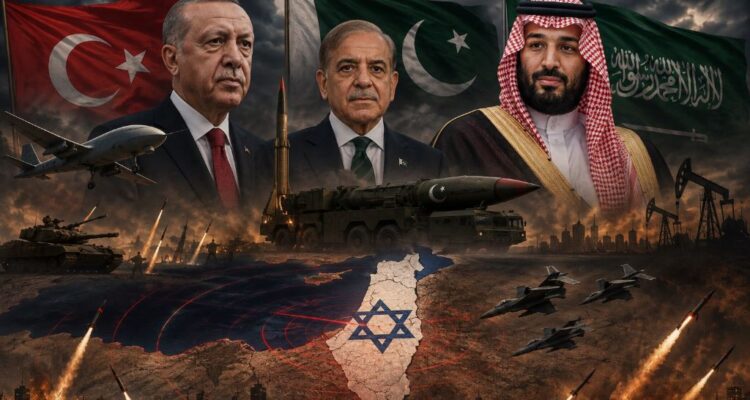
A new defense alliance between Saudi Arabia, Turkey and nuclear-armed Pakistan is likely to pose a serious long-term threat to Israel, Jonathan Pollard warned this week.
By World Israel News Staff
A newly formed defense alliance bringing together Saudi Arabia, Turkey and nuclear-armed Pakistan could dramatically reshape Israel’s strategic environment in the years ahead, according to Jonathan Pollard.
The three countries signed the Mecca Joint Defense Agreement on Aug. 7, establishing a collective-defense arrangement under which an armed attack against one member would be regarded as an attack against all three.
Turkish Foreign Minister Hakan Fidan has compared the principle to NATO’s Article 5 collective-defense clause, although the precise military obligations imposed on each country remain unclear.
Writing in an analysis published by Israel National News, Pollard warned that Israel should focus not only on what the alliance is today, but on what it could eventually become.
“The nightmare scenario is not necessarily that the Mecca agreement immediately becomes an Islamic NATO,” Pollard wrote. “The nightmare is that it gradually becomes one.”
A formidable combination
The three countries bring markedly different capabilities to the emerging partnership.
Saudi Arabia contributes enormous financial resources, oil wealth and considerable political influence in the Sunni Muslim world.
Turkey has NATO’s second-largest military and a rapidly expanding domestic defense industry, including sophisticated drone and missile technologies.
Pakistan, meanwhile, brings a large military establishment and something neither of the other two countries possesses: nuclear weapons.
Together, Pollard argues, those capabilities could eventually form the foundation of a military alliance considerably more powerful than the sum of its parts.
“Money. Oil. Military power. Advanced weapons production. Strategic geography. And nuclear weapons,” Pollard wrote.
The concern is not entirely theoretical.
Reuters reported in May that Pakistan had deployed roughly 8,000 troops to Saudi Arabia, along with approximately 16 fighter aircraft, two drone squadrons and a Chinese-made HQ-9 air-defense system.
The equipment was being operated by Pakistani personnel and financed by Saudi Arabia, according to the report.
That deployment built upon a longstanding Saudi-Pakistani military relationship that took a major step forward in September 2025, when Riyadh and Islamabad signed their own mutual-defense agreement declaring aggression against either country to be aggression against both.
The agreement did not publicly establish a Pakistani nuclear guarantee for Saudi Arabia, leaving unanswered questions over whether Riyadh effectively falls under Islamabad’s nuclear umbrella.
Nevertheless, Pakistan’s status as the Muslim world’s only nuclear-armed state gives the new three-country arrangement a strategic dimension that Israel cannot ignore.
Could Egypt be next?
Perhaps the most significant question for Israel is whether the alliance will remain limited to its three founding members.
Pakistani officials have said the pact is open to additional countries, while Fidan has specifically identified Egypt as a potential future participant.
Egypt has already been coordinating closely with the three members.
In June, the foreign ministers of Egypt, Turkey, Pakistan and Saudi Arabia met in Cairo and formally reaffirmed their intention to continue consultation and coordination on regional security issues.
The four governments have also repeatedly issued joint statements on Israel and the Palestinians, including condemnations of Israeli policies and actions at the Temple Mount.
Pollard believes Egyptian membership would substantially increase the potential danger to Israel.
“If Egypt ultimately joins, the strategic equation becomes still more serious,” he wrote.
Egypt possesses one of the Arab world’s largest militaries, controls the strategically vital Suez Canal and shares a lengthy border with Israel.
Its inclusion would potentially create a security framework extending from Turkey in the eastern Mediterranean through Egypt and Saudi Arabia to nuclear-armed Pakistan in South Asia.
That would not mean the countries were preparing for war with Israel, Pollard emphasized.
But it would create the infrastructure through which a future conflict involving one country could potentially draw in others.
Officials insist alliance is defensive
The governments involved have rejected suggestions that they are creating an aggressive Islamic military bloc.
Fidan said Saturday that the agreement is not directed against Iran or any other specific country and said assistance to a member under attack could range from intelligence and logistical support to military forces, depending upon the circumstances.
Pakistan has similarly described the agreement as “purely defensive.”
The pact nevertheless goes beyond a general declaration of friendship. It provides for political and military coordination, regular meetings among senior officials and a permanent secretariat in Saudi Arabia.
Fidan had also made clear months before the agreement was signed that Ankara favored a broader regional security structure.
In a January interview, the Turkish foreign minister said a regional pact could begin with “2-3 countries” and eventually evolve into something encompassing most countries in the region.
A changing regional order
The alliance also raises questions about Saudi Arabia’s long-discussed normalization with Israel.
For years, American and Israeli officials envisioned Saudi Arabia potentially joining the Abraham Accords and becoming a central component of a U.S.-backed regional architecture linking Israel with moderate Arab states.
The Mecca pact represents a different model: Saudi Arabia strengthening its security through partnerships with two major Muslim powers outside the Arab world, both of which have frequently clashed politically with Israel.
It does not necessarily rule out future Saudi-Israeli normalization. Riyadh has historically pursued multiple and sometimes competing relationships simultaneously.
But it could complicate efforts to build a regional security system centered on cooperation between Israel and Saudi Arabia.
For Pollard, the immediate question is not whether the three countries intend to attack Israel.
It is whether Israel is watching the early stages of an alliance that could become far more consequential in five or ten years.
“Strategic alliances rarely appear fully formed,” he wrote. “They develop incrementally.”
Pollard urged Israel to respond by strengthening missile defense, intelligence capabilities, air superiority, long-range strike capacity and relationships with countries opposed to the emergence of a hostile regional military bloc.
“The most dangerous mistake Israel could make,” he concluded, “would be to wait until the alliance is fully assembled before taking the threat seriously.”
Jonathan Pollard’s original analysis was published by Israel National News.
============================================================================
Hamas support falls as Marwan Barghouti leads Palestinian opinion poll

The poll further found that 83% of respondents believe there is corruption within Palestinian Authority institutions, while 65% described the PA as “a burden” rather than an achievement.
By Pesach Benson, TPS
Hamas has lost significant public support among Palestinians in Judea and Samaria and the Gaza Strip, while imprisoned Fatah figure Marwan Barghouti emerged as the clear front-runner in a hypothetical Palestinian Authority presidential election, according to a new survey.
The poll, conducted by the Ramallah-based Palestinian Center for Policy and Survey Research (PCPSR), was released as Hamas said it had accepted a proposal from Peace Council envoy Nikolay Mladenov covering the second phase of the Trump plan for Gaza, including the group’s relinquishing its weapons.
According to the survey, Hamas’s overall support fell to 24%, down from 35% 10 months earlier, while Fatah remained at 24%.
The decline was sharpest in Judea and Samaria, where support for Hamas fell from about one-third of respondents to roughly one-fifth.
In Gaza, support for the group fell to about one-third.
In a hypothetical presidential election among likely voters, Barghouti would receive 54% of the vote, followed by Hamas figure Khalil al-Hayya at 26% and Palestinian Authority President Mahmoud Abbas at just 14%.
Separately, 79% of respondents said they want Abbas to resign.
Barghouti, now 67, is the highest-profile Palestinian imprisoned in Israel, serving currently serving five life sentences for his role in terror attacks during the Second Intifada.
Palestinians have not held national elections since 2005, and Abbas is now in the 21st year of what was supposed to be a four-year term.
Since then, Abbas has postponed or canceled planned elections amid disagreements between Fatah and Hamas, most recently in 2021.
Palestinian legislative elections are currently scheduled for November 28.
The survey also found that only 20% of Palestinians believe Hamas won the Gaza war, compared with 39% who held that view 10 months ago, while 60% said neither side won.
Despite Hamas’s declining popularity, most respondents oppose disarming the group before a full Israeli withdrawal from Gaza.
The poll found that 72% oppose Hamas giving up its weapons before such a withdrawal, while the same percentage said disarmament would lead to renewed fighting rather than an Israeli pullout.
Support for negotiations as the most effective path to Palestinian statehood rose to 44%, up from 36% 10 months earlier and the highest level in four years.
At the same time, support for what the poll calls “armed struggle” fell to 27%, its lowest level in that period, while support for “peaceful popular resistance” rose to 19%.
Palestinians remain divided, however, over whether “armed resistance” has been effective.
Half said it had failed to end the presence of Israeli forces or protect Palestinians, while half disagreed.
Fifty-eight percent said a two-state solution is no longer practical because of the expansion of Israeli communities in Judea and Samaria, while 64% said they see little or no chance of an independent Palestinian state being established within five years.
The poll further found that 83% of respondents believe there is corruption within Palestinian Authority institutions, while 65% described the PA as “a burden” rather than an achievement.
On regional matters, the survey found relatively high levels of satisfaction with Iran, Hezbollah and the Houthis, while satisfaction with U.S. President Donald Trump stood at just 5%.
The poll was based on 1,270 respondents — 830 in Judea and Samaria and 440 in Gaza — surveyed between August 5 and 8. The reported margin of error was 3.5%.
============================================================================

No comments:
Post a Comment