"I am the Way, the Truth, and the Life"

Father God, thank you for the love of the truth you have given me. Please bless me with the wisdom, knowledge and discernment needed to always present the truth in an attitude of grace and love. Use this blog and Northwoods Ministries for your glory. Help us all to read and to study Your Word without preconceived notions, but rather, let scripture interpret scripture in the presence of the Holy Spirit. All praise to our Lord and Saviour Jesus Christ.

Please note: All my writings and comments appear in bold italics in this colour
Showing posts with label MSF. Show all posts

Friday, December 7, 2018

Mediterranean Migrant Rescue Ship Aquarius Ends Operations

By Clyde Hughes

The rescue vessel MV Aquarius enters the Grand Harbour in Senglea, Valletta, Malta, on August 15.
Photo by Domenic Aquilina/EPA-EFE

UPI -- The migrant rescue ship Aquarius is ending its operations in the Mediterranean Sea after Doctors Without Borders said Thursday the Italian government intervened.

Doctors Without Borders said in a statement a "sustained campaign" has been waged against the ship that has transported numerous migrants at sea. The Aquarius has so far rescued more than 80,000 people escaping war, poverty and other conditions in their home countries.

The Aquarius has not left the dock in Marseille, France, since October, when Panama refused to grant the vessel a request to continue under its flag after being pressured by Italian authorities, The Telegraph reported.

"Sustained attacks on search and rescue by European states will mean more deaths at sea and more needless deaths that will go unwitnessed," Doctors Without Borders tweeted.

Last month, Italy seized the ship on suspicions it was dumping toxic waste.

"This is a dark day," Nelke Manders, Doctors Without Borders general director, said in a statement. "Not only has Europe failed to provide search and rescue capacity, it has also actively sabotaged others' attempts to save lives."

The organization said more than 2,100 migrants have died in the Mediterranean this year, most from Libya. It said the Libyan coast guard has intercepted more than 14,000 at sea.

Italian Prime Minister Matteo Salvini, who took office in June riding an anti-immigrant stance, has shut down the country's ports to ships that rescue migrants at sea -- saying it's been shouldering an unfair burden of the European migrant crisis.

The populist Italian government on Friday began removing immigrants from "welcome centers" built to protect them on humanitarian grounds.


Thursday, December 21, 2017

'Devastating’: Yemen’s Cholera Endemic Hits 1 Million Mark

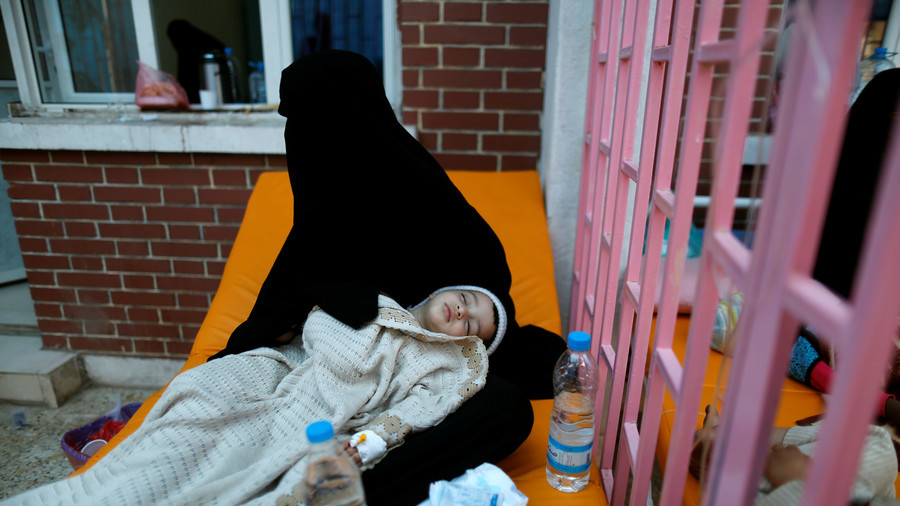
A woman holds her son who is suspected of being infected with cholera in Sanaa. © Khaled Abdullah / Reuters
Yes, there is a woman in this photo - she's invisible, as are all women in devout Islam

Yemen’s cholera outbreak has surpassed the 1 million mark while 300 cases of diphtheria have been reported as civilians in the war-ravaged country continue to face starvation and a crippling blockade. “We can confirm that the country has now reached 1 million suspected cases of cholera,” the International Committee of the Red Cross said. “This is devastating.”

The World Health Organization has recorded 2,226 deaths since the epidemic began in April. Cholera causes severe diarrhea and dehydration and is spread by dirty water and the contamination of food with feces. It can cause death within hours if untreated.

The ICRC also said over 80 percent of Yemen is in need of food, clean water, healthcare and fuel.

The country is in the grips of a brutal war, with a Saudi-led coalition of nine countries conducting airstrikes against the Houthi rebels in support of President Abdrabbuh Mansour Hadi, who fled the country in 2015.

The Houthis were in alliance with long-running former President Ali Abdullah Saleh, who they killed in December after indicating he was changing sides and seeking dialogue with the Saudis.

The Houthi rebels are supported by Iran, which is also accused of supplying weapons to the group, a charge which Iranian Foreign Minister Mohammad Javad Zarif described as “baseless accusations,” on Wednesday.

Saudi Arabia has imposed a blockade on the country, which has further intensified the food and aid shortage. On Wednesday, it said it would keep the rebel-controlled port of Hodeidah open for 30 days to allow humanitarian deliveries to get into the country.

In January, the UN Office for the Coordination of Humanitarian Affairs said the civilian death toll had reached 10,000, citing data gathered by health facilities, and said the actual number could be much higher.  

The United Nations on Tuesday said coalition airstrikes had killed at least 136 civilians between December 6 and 16.

“We urge all parties to the conflict to respect their obligations under international humanitarian law, including their obligation to respect the principles of distinction, proportionality and precaution,” Rupert Colville, spokesperson for the Office of the UN High Commissioner for Human Rights (OHCHR) said.“They should take all feasible precautions to avoid, and in any event to minimise, the impact of violence on civilians.”

Meanwhile, MSF announced in Geneva on Thursday the country also faces a diphtheria outbreak, with more than 300 cases reported. “In Yemen, the last diphtheria case was recorded in 1992, and the last outbreak in 1982,” MSF Emergency Coordinator said. “The ongoing war and blockade is sending Yemen’s health system decades back in time.”


At about the same time as the above report came out,
the Pentagon confirms ‘multiple ground ops & 120+ strikes’ in Yemen 

Why is the US in Yemen?

A man walks past a graffiti, denouncing strikes by U.S. drones in Yemen, painted on a wall in Sanaa, Yemen
on November 13, 2014. © Khaled Abdullah / Reuters

The Pentagon has disclosed that it carried out “multiple ground operations” in Yemen this year. The confirmation sheds new light on largely covert US military activities in the region.

US forces have conducted “multiple ground operations and more than 120 strikes in 2017,” according to a statement released by US Central Command in Tampa, Florida. The US military hopes to prevent Al-Qaeda in the Arabian Peninsula (AQAP) and Islamic State from using Yemen “as a hub for terrorist recruiting, training and base of operations to export terror worldwide,” the statement reads.

The 120 claimed strikes against targets in Yemen would mark a 3-fold increase compared to the number of airstrikes from last year.


Before Wednesday’s statement, there had been few official disclosures of the extent of US military involvement in Yemen. In sharp contrast to the fight against IS in Syria and Iraq, the Pentagon has avoided holding regular briefings or updates on ground or air operations in Yemen.

However, there are sporadic reports of US military activity in the country. US Central Command said earlier this month that five Al-Qaeda militants had been killed in a US airstrike that took place on November 20 in Yemen’s Bayda Governorate.

The Pentagon previously acknowledged that the US “has people on the ground” in Yemen. According to media reports, in April, US special operations forces stepped up ground operations in Yemen, but military officials did not elaborate on the matter. It is still unclear exactly how many US boots are on the ground in Yemen. A White House report submitted to Congress last week detailing US military operations worldwide failed to disclose the number of US troops stationed in Yemen.

In February, it was revealed that a botched US raid in the country had left at least 25 civilians and one Navy SEAL dead. Inquiries into the disaster found that the raid yielded no significant intelligence, but the Trump administration nonetheless praised the mission as a success. Apart from the deaths, a $70 million military helicopter was also destroyed.

The latest acknowledgement of US ground operations in Yemen raises questions about the legality of such activity with respect to Yemen’s sovereignty.

Kim Sharif, director of Human Rights for Yemen, said in March, “the Yemeni people are saying: ‘Where are the other powers in the Security Council? Why aren’t they standing up for the sovereignty of Yemen, when clearly it is in their best interest as well to do so, because they surely must have business interest, commercial interest to protect and preserve the sovereignty of Yemen for the purpose of preserving that international passage for the benefit of all.’”


Friday, October 17, 2014

WHO Failure has Made Ebola Crisis Much Worse than It Should Have Been

Poor communication and incompetent staff meant the World Health Organization failed to react swiftly Ebola outbreak in Africa, reports say.

An internal document said those involved "failed to see some fairly plain writing on the wall", according to the Associated Press.

Separately, sources close to the WHO told Bloomberg of multiple failures in the outbreak's early stages.

In the worst affected countries - Liberia, Guinea and Sierra Leone - the Ebola virus has now killed 4,546 people with cases of infection numbering 9,191, according to the latest WHO figures.

The reports have brought into focus the way the WHO dealt with the outbreak in the months after it received the first reports of Ebola cases in Guinea in March.

Medical charity Medecins Sans Frontieres (MSF) warned in April that the outbreak was out of control - something disputed by the WHO at the time.

"Nearly everyone involved in the outbreak response failed to see some fairly plain writing on the wall," the document obtained by AP says.

The draft report - a timeline of the outbreak - also reportedly says that experts should have realised that traditional methods of containing infectious disease would not work in a region with porous borders and poor heath systems.

Among the problems cited in the information obtained by AP and Bloomberg are:

A failure of WHO experts in the field to send reports to WHO headquarters in Geneva

Bureaucratic hurdles preventing $500,000 reaching the response effort in Guinea

Doctors unable to gain access because visas had not been obtained

Responding to the allegations, the WHO's head of global response and alert, Isabelle Nuttall, told the BBC: "Time will come for investigation. Right now we have to focus on the response."
Head of global response and alert at the WHO, Isabelle Nuttall
On the alleged failure of the WHO to react quickly enough, she said the disease had, up till then, not been common in West Africa, only in Central Africa.

"When we scaled up, the beginning of the outbreak was very comparable to what we had seen elsewhere in Africa," she said. "And then, by June, it became something different.

"We indicated that this outbreak was different. I'm afraid we probably didn't say it loud enough for the world to understand what we were saying and for all the international community to be mobilised."

Earlier, WHO Director General Margaret Chan told Bloomberg that she was "not fully informed of the evolution of the outbreak" and the response might not have matched the "scale" and "complexity" of the spread.

A medical worker dons protective gear before entering
an Ebola treatment centre in Freetown, Sierra Leone 
Analysis: Imogen Foulkes, BBC News, Geneva

The combination of a leaked internal document and frank comments from the WHO's director general signal growing concerns about the effectiveness of the agency's efforts against Ebola.

Back in April, MSF described the outbreak in West Africa as unprecedented, warning that it risked spiralling out of control.

The WHO responded that it had seen only sporadic cases in a limited geographic area. It was not until August that the organisation suggested international reaction to Ebola may have been too slow.

Perhaps WHO officials feared accusations of overreacting: in 2009 the organisation swiftly declared a global pandemic of swine flu, advising countries to spend billions on treatments and vaccines against a virus which caused far fewer deaths than regular seasonal flu.

There are allegations too that the WHO's regional office in Africa may be part of the problem, that its staff failed to properly monitor West Africa's Ebola outbreak. We now know it began in December, but the first cases were not notified until March.

Earlier, MSF said international pledges of deployments and aid for Africa's Ebola-hit regions had not yet had any impact on the epidemic.

MSF's Christopher Stokes said the disease was still out of control.

He said it was "ridiculous" that volunteers working for his charity were bearing the brunt of care in the worst-affected countries.

Mr Stokes, who leads MSF's Ebola response, said international efforts would not have any effect for another month and a half.

MSF runs about 700 out of the 1,000 beds available in treatment facilities Liberia, Sierra Leone and Guinea.

The BBC's Mark Doyle, at the UN Ebola logistics base in Ghana, says it is generally agreed that at least three times that number are needed.

Responding to MSF's criticisms, David Nabarro, the UN system co-ordinator for Ebola, told the BBC that he had seen a big increase in the international response over the past two months.

"I am absolutely certain that when we look at the history, that this effort that has been put in place will have been shown to have had an impact, though I will accept that we probably won't see a reduction in the outbreak curve until the end of the year."
Family suffering from Ebola waiting for treatment
In other developments:

The WHO has announced that Senegal is now officially free of Ebola, as it has gone 42 days without any sign of the virus.

President Obama named Ron Klain - former chief of staff to Vice President Joe Biden - as Ebola "tsar" in charge of combating the virus in the US

Five East African countries - Kenya, Uganda, Tanzania, Rwanda and Burundi - are to send 600 personnel to help in the worst affected nations

How not to catch Ebola:

Avoid direct contact with sick patients as the virus is spread through contaminated body fluids
Wear goggles to protect eyes

Clothing and clinical waste should be incinerated and any medical equipment that needs to be kept should be decontaminated

People who recover from Ebola should abstain from sex or use condoms for three months