"I am the Way, the Truth, and the Life"

Father God, thank you for the love of the truth you have given me. Please bless me with the wisdom, knowledge and discernment needed to always present the truth in an attitude of grace and love. Use this blog and Northwoods Ministries for your glory. Help us all to read and to study Your Word without preconceived notions, but rather, let scripture interpret scripture in the presence of the Holy Spirit. All praise to our Lord and Saviour Jesus Christ.

Please note: All my writings and comments appear in bold italics in this colour
Showing posts with label Hamburg. Show all posts

Monday, February 24, 2020

Merkel's Rudderless Party Sinking as SS Hamburg Lists Sharply to Port

‘Chaotic Demoralized Union’: Merkel’s CDU laments ‘bitter day’ after losing big in Hamburg state election

Germany's Social Democratic Party and the Greens won big during the Hamburg election,
leaving CDU far behind © Patrik Stollarz / AFP

Leadership chaos and the recent scandal in Thuringia – where the CDU sided with the tabooed AfD – led voters to punish the chancellor’s party in Germany’s second-largest city, its top-tier members and opponents believe.

The Christian Democratic Union (CDU) achieved its worst ever result in the city state of Hamburg on Sunday, scoring only 11.2 percent of the vote and trailing far behind its center-left rivals, the Social Democrats and Greens, who won the support of 39 and 24.2 percent of residents respectively.

This is one of the most embarrassing state election defeats in the CDU’s history, according to Der Spiegel, second only to the 1951 vote in Bremen, where it garnered just nine percent. Unsurprisingly, morale among the Christian Democrats – already dubbed the ‘Chaotic Demoralized Union’ in the media – was as low as their election result.

“It is a bitter day for the CDU in Germany and a historically bad result in Hamburg,” lamented the party’s secretary general Paul Ziemiak. "For us as a union there is nothing to gloss over,” added Daniel Gunther, prime minister of northern state Schleswig-Holstein.

The bitter defeat didn’t come out of the blue; the Christian Democrats have suffered from the leadership crisis which broke out after party leader and designated Merkel successor Annegret Kramp-Karrenbauer – or AKK as she came to be known in German media – suddenly stepped aside, sending the party into a tailspin and blowing open the race for the chancellorship.

With AKK no longer at the helm – although she technically leads the CDU – the party lacked the determination and vision needed to win. The defeat in Hamburg was about “leaderlessness,” as Saarland Prime Minister Tobias Hans put it on ARD.

Referring to the selection of a new leader, he said it was important that AKK “has the right to act in order to organize the whole thing,” but failed to mention that Kramp-Karrenbauer’s abdication was due to organization and management skills she couldn’t show.

Earlier this month, a CDU branch in the eastern state of Thuringia defied AKK’s instructions and voted with the anti-immigration Alternative for Germany (AfD) party to unseat the Left Party’s State Premier Bodo Ramelow and install the little-known Thomas Kemmerich, from the liberal Free Democratic Party (FDP).

The move, which Merkel called “unforgivable,” broke with a consensus among mainstream parties of not cooperating with the right-wing group, and “noticeably overshadowed the Hamburg election campaign,” according to CDU’s major candidate Marcus Weinberg.

“These developments have made us famous and ultimately cost a lot of votes,” he admitted, explaining why voters handed the Christian Democrats their worst result. "Despite a creative and committed election campaign, our own election goals were clearly missed,” Weinberg said.

Meanwhile, Susanne Hennig-Wellsow, head of the Left Party in Thuringia, agreed with the judgement, saying “the taboo breach has hit [CDU] all the way to Hamburg.”

Some say, however, that the “leaderlessness” and the Thuringia scandal aren’t the biggest problems in the party.

“The problems are homemade,” a high-ranking CDU member who refused to be named told Die Welt newspaper. He said the mood within the party was poisoned by envy and resentment instead of mutual support. “Internally, we tend to be malicious when one of us fails – and we don't realize that it all falls back on all of us,” he revealed.

Later in the year, the chancellor’s center-right party faces a string of local elections in Bavaria, North Rhine-Westphalia and the city of Leipzig in the east, the results of which will likely affect the nationwide vote in 2021.

According to recent polls by ARD and Bild, CDU – and its Bavarian allies – still holds the ground with between 26 and 27 percent of voter support, but as the Hamburg vote has shown, predictability is no longer a feature of German politics.

Here's a prediction you can take to the bank - if Germany continues to list to port, especially in the national elections next year, and if they continue to ostracize the AfD, there will be a very rapid and violent rise in far-right extremism. You cannot continue to ignore the presence of Islam in a post-Christian country.


Tuesday, March 28, 2017

Police Vans Torched in German City of Hamburg, Second Incident in 10 Days

As if German police didn't have enough trouble on their hands with absurdly
excessive numbers of undocumented migrants, and right wing reactionaries
to that immigration issue, now German lefties are acting up and
making police work that much more difficult and expensive.

© Polizei Hamburg / Facebook

Several vans have been set on fire outside a police station in Hamburg, Germany, just 10 days after unknown assailants carried out an arson attack on a car belonging to the city mayor’s security detail.

In the early hours of Monday, eight cars were torched outside a local police station in the Eimsbuettel neighborhood of Hamburg.

Police later confirmed that four patrol vehicles had been destroyed beyond repair, while four others were damaged. No one was injured in the incident.

Germany’s Bild newspaper reported that two of the damaged vehicles were civilian.

What appears to be a well-planned arson attack was praised on a local left-wing website, according to broadcaster NDR. The message, titled ‘The whole of Hamburg hates the police, the whole world hates the police’, claims that the target for the assault had been chosen carefully.

The police are acting as protectors of the ruling class and must be “attacked with full severity,” it added. 

An investigation will specifically look at a possible link between the incident and the upcoming G20 summit in Hamburg, NDR reported. Gerhard Kirsch, head of the regional police union, said the arson attack signals the preparation of violent protests during the event, but cautioned against spreading panic. 

Hamburg police released an angry statement on their Facebook page, saying: “The right to protest is enshrined in our basic law, but it has to stay within legal limits. Anyone who expresses their views through violence, either against property or people, is acting as a criminal.

“Setting vehicles on fire always endangers people – residents, fire brigades and policemen!” they wrote.

Hamburg, which is preparing to host the G20 summit in July, has already seen similar acts of destruction in recent days.

In mid-March, radical left activists claimed responsibility for an arson attack on two police vehicles in the city. One of the cars, a police Mercedes Sprinter, was assigned to a security detail protecting the residence of Hamburg Mayor Olaf Scholz.

Shortly after, a Mercedes Viano belonging to the local police union was torched within sight of a police station.

Police said they suspected the attack could be related to the July G20 summit.

"We cannot rule out that this act was politically motivated," said police spokesman Oliver Malchow on Friday, according to Deutsche Welle.


Tuesday, December 20, 2016

Terrorist Attacks in Europe in 2016

This is a list of terrorist attacks only. It does not include those attacks that were thwarted by police. Nor does it include the thousands of sexual or child sex attacks that have occurred in Europe this year at the hands of Muslim immigrants. That's a whole 'nuther story which I hope to compile before the end of the year.

Note: all the attacks listed below were committed by Muslims

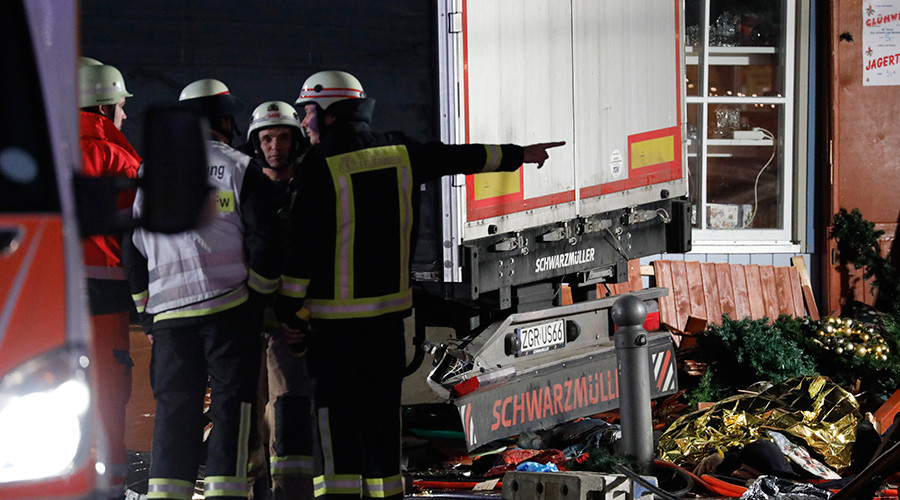
Firefighter stand beside a truck at a Christmas market in Berlin, Germany, December 19, 2016
after the truck ploughed into the crowded Christmas market in the German capital
© Pawel Kopczynski / Reuters

Monday’s suspected terrorist attack on Berlin’s Christmas market and the assassination of Russia’s ambassador to Turkey Andrey Karlov, which has been condemned as an act of terrorism, add to the deadly wave of attacks that have rocked Europe this year.

RT takes a look back at the major terrorist incidents which occurred since the November 2015 Paris attacks, which left 130 victims dead, and marked 2016 as another bloody year for Europe.


Brussels bombings, March 22 – 35 killed, including three suicide bombers

Three explosions hit Brussels during the morning rush hour. Two blasts went off in the departure hall of Brussels’ Zaventem Airport while another bomb exploded at the Maalbeek Metro station. Some 300 people were injured. Belgium responded by raising the terrorist threat to the highest level.


Munich stabbing attack,  May 10 – 1 killed

One person was killed and three injured at a train station near Munich when they were attacked by a knife-wielding man, reportedly shouting “Allahu Akbar”. Officials later reported the man has mental health issues and would not stand trial as a result.


French police couple stabbed on June 13 – 3 killed, including the attacker

Two police officers, who were married to each other, were stabbed to death at their home in Magnanville, west of Paris in what French president Francois Hollande described as "unquestionably a terrorist act".

The attacker, Larossi Abballa, pledged allegiance to Islamic State and previously spent time in jail over jihadist links. He was killed by police special forces.


Nice truck terror attack, July 14 – 87 killed, 400+ injured

Eighty-six people were killed and 434 people injured when a truck plowed into a crowd in Nice during Bastille Day celebrations. The Tunisian truck driver was killed by police. It was reported he shouted “Allahu Akbar” before the attack.

President Hollande responded to this by extending the national state of emergency, which had been in place since the Paris attacks.


Ansbach bombing Germany, July 24 – suicide bomber killed, 15 injured

Fifteen people were injured, four seriously, in a suicide bombing outside a wine bar in Ansbach, Germany.

The bomber, identified as Mohammad Daleel, was a 27-year-old Syrian refugee who had pledged allegiance to Abu Bakr al-Baghdadi, leader of the Islamic State.


Normandy church attack, July 26 – 3 killed, including two attackers

An 84-year-old priest was killed in an attack at a church in Saint-Étienne-du-Rouvray, Normandy. IS later claimed responsibility for the incident.

The priest was among six people taken hostage by the attackers before they were killed by police.


Hamburg stabbing attack, October 16 – 1 killed

A 16-year-old boy was fatally stabbed near the Alster lake bridge in Hamburg. His girlfriend who was thrown into a lake by the assailant swam to safety.

On October 20 IS claimed responsibility for the killing through their news site Amaq however, following an investigation, police later said any links to the extremist group were unlikely.

Friday, October 16, 2015

Brand Merkel Comes Under Pressure Over Migrants

Katya Adler
Europe editor
From BBCn Europe

It didn't much look like a protest.

Lots of casually dressed, smiley very middle-class Germans - some with children, others with dogs, chatting animatedly in beautiful parkland on the outskirts of Hamburg on a sunny Sunday afternoon.

But this was indeed a protest group, putting together a petition in an attempt to stop a new refugee centre being built on the green.

Syrian refugees Wael Al-Awis, 31, right, his wife Reem Haskour, 30, and their
son Ali Al-Awis, 6, visit the harbor October 10, 2015 in Hamburg,
Germany. Getty Images
Germany could see more than a million refugees this year
 - and Hamburg is a popular destination

People here were keen to emphasise that they were not anti-immigrant. Their main aim, they said, was to protect an area of natural beauty. But once we got talking, broader worries soon surfaced.

Birgit said finding a home was difficult enough for Germans. Hamburg has an acute housing shortage at the best of times. With the arrival of tens of thousands of immigrants, the port city threatened to burst at the seams.

In desperation, the authorities have been turning shipping containers into refugee homes and repossessing empty commercial properties and open spaces to build new migrant centres.

"I don't think Angela Merkel has any idea what she started," Birgit concluded.

Hanno kept shaking his head when he said, "I just don't think Germany can integrate this number of people. It's a real worry. A real worry."

This was no demonstration of the minority anti-immigrant far right in Germany, so adept at grabbing headlines.

These were Angela Merkel's core voters: the comfortable middle classes. Now plagued by doubt and insecurity.

To be clear: most Germans don't question a duty to help those fleeing war or human rights abuses but they do find the huge number of arrivals unsettling.

More than a million refugees are expected here by the end of the year. Some experts we spoke to told us the figure could reach 1.5m.

Like the captain of a football team, Chancellor Merkel keeps repeating: "Wir schaffen es!" ("We can do it!").

It's her version of Barack Obama's "Yes We Can" - but increasingly Germans are asking: How?

Lea, 12 (L), gives lollipops to Syrian refugee children at a welcome festival
(Willkommensfest) for migrants on September 19, 2015 in the
Karolinenviertel neighborhood of Hamburg, Germany Getty Images
Groups of people have welcomed migrants to Hamburg 
- but many worry about how the country will cope

Only one in three here say they agree with Mrs Merkel's migrant policy, according to the most recent poll. And she's slipping in popularity ratings.

The joke used to be that she was a politician of 'little steps' who made decisions only once she'd studied the opinion polls.

But a summer of refugees drowning in the Mediterranean and desperate crowds thronging at the gates of Europe seems to have changed all that.

Mrs Merkel completely surprised her countrymen a month ago by unilaterally declaring all Syrian refugees welcome and refusing to put an upper limit on how many Germany would take in.

It seemed like a passionate outburst, a spontaneous throwing of caution to wind by a woman traditionally admired by Germans for her stable, strong and stoic disposition. All sought-after attributes here.

'Hers is a solid brand'

Florian Juerg, a branding consultant, wonders whether Angela Merkel is now expressing her "other self".

"Until now she has acted like the sensible scientist that she is," he told me (Mrs Merkel is a trained physicist). "But suddenly she's transformed back into the moral-driven pastor's daughter of her youth."

Hamburg is the German hub for marketing and brand imaging.

I asked Florian if "Brand Merkel" would be dented by the migrant crisis.

"Not in the long-term," he told me. "Building up a brand takes a long time and the last 10 years of Merkel as Chancellor have been good for Germans. Hers is a solid brand."

For now. But if her refugee policy backfires, it will stain her political legacy.

Mrs Merkel's nickname here is Mutti, or Mummy.

Election after election, Germans have put their trust in her to decide what's best for them. She's seen as key in making Germany the success story it is today.

'Merkel must go' reads one sign in the city of Magdeburg
The way she's handling the migrant crisis is the biggest gamble of her political career.

Brand Merkel may have helped make Brand Germany great but she could now inadvertently damage her country.

The arrival of so many asylum seekers in one go will impact Germany's economy, its society and its politics.

Already there are well-chronicled splits within Mrs Merkel's own conservative bloc.

"We have to get the balance right," said Lorenz Caffier, CDU Interior Minister of Mecklenburg-Western Pomerania.

"The German constitution demands that we look after refugees but the benefits we give them are too generous.

"Frankly, I'm amazed at any migrant who doesn't choose to come to Germany. Our benefit system acts like a travel agency. We must put the well-being of our own people first."

Cucumbers, bananas - or greater matters?

German newspapers are full of reports about the benefits refugees receive compared to German citizens on welfare, leading, in some quarters, to a sense of injustice.

There's also a more widespread worry about strains on the national health and education systems.
"Germany can't take everyone in," Mr Caffier told me. "Up till now we had no choice. Angela Merkel didn't open the door to the refugees. They were already at the door.

"What was she going to do - send tanks to the Austrian border? Actually it's impossible to close borders. Any politician who suggests that is lying."

Excuse me, Hungary just did!

He insisted vehemently that the rest of Europe play its part.

"We Germans can't do this alone. Brussels has to decide whether it's going to focus on the curvature of cucumbers and bananas or tackle European issues of importance."

In the meantime, other European leaders are not queuing up to take in asylum seekers by the hundreds and thousands. Or, hundreds of thousands.

Chancellor Merkel's lead role in the migrant crisis is as controversial in the rest of Europe as it is at home.

The queen of consensus politics is no more.