"I am the Way, the Truth, and the Life"

Father God, thank you for the love of the truth you have given me. Please bless me with the wisdom, knowledge and discernment needed to always present the truth in an attitude of grace and love. Use this blog and Northwoods Ministries for your glory. Help us all to read and to study Your Word without preconceived notions, but rather, let scripture interpret scripture in the presence of the Holy Spirit. All praise to our Lord and Saviour Jesus Christ.

Please note: All my writings and comments appear in bold italics in this colour
Showing posts with label killings. Show all posts

Wednesday, January 5, 2022

European Gas Crisis Spreads to Kazakhstan - Government Quits, State of Emergency, 8 Killed

..

Kazakhstan declares state of emergency in several cities

as ongoing fuel price protests erupt


Fuel price increase that kicked in on Jan. 1 sparked tensions,

but autocracy has long stifled dissent

Thomson Reuters · 
Posted: Jan 05, 2022 9:27 AM ET


A view shows a burning police car during a protest following the Kazakh authorities' decision to lift price caps on liquefied petroleum gas in Almaty early Wednesday. (Pavel Mikheyev/Reuters)


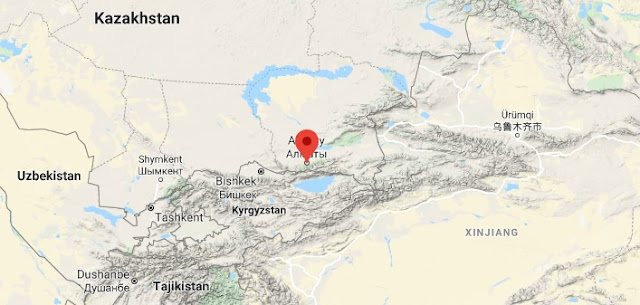
Kazakhstan declared emergencies in the capital, main city and provinces on Wednesday after demonstrators stormed and torched public buildings, the worst unrest for more than a decade in a tightly controlled country that promotes an image of stability.

The cabinet resigned but that failed to quell the anger of the demonstrators, who have taken to the streets in response to a fuel price increase from the start of the new year.

An Instagram live stream by a Kazakh blogger showed a fire blazing in the office of the Almaty mayor, with apparent gunshots audible nearby. Videos posted online also showed the nearby prosecutor's office burning.

Earlier on Wednesday, Reuters journalists saw thousands of protesters pressing toward Almaty city centre, some of them on a large truck. Security forces, in helmets and riot shields, fired tear gas and flash-bang grenades.

The city's police chief said Almaty was under attack by "extremists and radicals," who had beaten up 500 civilians and ransacked hundreds of businesses.

This image grab from video shows protesters near an administrative building during a rally over a hike in energy prices in Almaty. Protesters stormed the mayor's office in Kazakhstan's largest city. (AFP/Getty Images)

A presidential decree announced a two-week state of emergency and nighttime curfew in the capital Nur-Sultan, citing "a serious and direct security threat to citizens." States of emergency were also declared in Almaty and in western Mangistau province, where the protests first emerged in recent days.

Authorities appeared to have shut the country off the internet as the unrest spread. Netblocks, a site that monitors global internet connectivity, said the country was "in the midst of a nation-scale internet blackout."

Government resigns

President Kassym-Jomart Tokayev accepted the government's resignation on Wednesday following the protests, which have spread from the provinces to main cities since price caps on liquefied petroleum gas (LPG) were lifted on New Year's Day.

Speaking to the acting cabinet, Tokayev ordered the price hikes reversed and new caps placed on the cost of other fuels.

The government said the regulated price was causing losses for producers and needed to be liberalized, but Tokayev acknowledged the move had been botched.

The unrest is the biggest test yet of Tokayev, 68, who took power in 2019 as hand-picked successor to Nursultan Nazarbayev, a former Communist Party boss who had become the longest-serving ruler in the former Soviet Union by the time he stepped down. Nazarbayev, 81, still retains substantial authority as head of the ruling party and chairman of the security council.

Kazakhstan's reputation for political stability under three decades of one-man rule by former leader Nazarbayev helped it attract hundreds of billions of dollars of foreign investment in its oil and metals industries, but the pandemic has led to economic pressures, as elsewhere.

Tokayev said on Wednesday he had taken over as head of the country's Security Council and promised to act with "maximum toughness."

Scores of injuries

Atameken, Kazakhstan's business lobby group, said its members were reporting attacks on banks, stores and restaurants.

The city health department said 190 people had sought medical help, including 137 police. City authorities urged residents to stay home.

The interior ministry said government buildings were also attacked in the southern cities of Shymkent and Taraz overnight, with 95 police wounded in clashes. Police have detained more than 200 people.

A video posted online showed police using a water cannon and stun grenades against protesters in front of the mayor's office in Aktobe, capital of another western province.

The size of the crowd in Almaty late Tuesday is shown. Police fired tear gas and stun grenades in a bid to break up an unprecedented thousands-strong march, with injuries to protesters and police reported. (Ruslan Pryanikov/AFP/Getty Images)

Kazakhstan has been grappling with rising price pressures. Inflation was closing in on nine per cent year-on-year late last year — its highest level in more than five years — forcing the central bank to raise interest rates to 9.75 per cent.

Some analysts said the protests pointed to more deep-rooted issues.

"I think there is an underlying undercurrent of frustrations in Kazakhstan over the lack of democracy," said Tim Ash, emerging market strategist at BlueBay Asset Management.

"Young, internet-savvy Kazakhs, especially in Almaty, likely want similar freedoms as Ukrainians, Georgians, Moldovans, Kyrgyz and Armenians, who have also vented their frustrations over the years with authoritarian regimes."

European and international election observers continually condemned the legitimacy of presidential elections in Kazakhstan under Nazarbayev, who regularly won with over 95 per cent of the vote. Voting irregularities and detentions of government opponents were also noted in the 2019 vote, which Tokayev won with a more modest 71 per cent total.

Kremlin spokesperson Dmitry Peskov said on Wednesday that Kazakhstan could solve its own problems and it was important that no one interfered from the outside, RIA news agency reported.

Russia's foreign ministry said it was closely monitoring the situation in its southern neighbour and counting on the "soonest possible normalization."

"We advocate the peaceful resolution of all problems within the constitutional and legal framework and dialogue, rather than through street riots and the violation of laws," it said.

The Latest > Eight police and military killed, over 300 injured in Wednesday’s violence so far, the Kazakh interior ministry says

Friday, June 28, 2019

Migrants, Protests & Aid Cuts: Legacy of US-Backed 2009 Coup in Honduras

As with Europe in Africa, the USA in Central America literally raped the countries of their natural resources leaving them in poverty and with dictators who are cruel and brutal. Then America builds walls to keep them from migrating. I know they can't all come to America, but America needs to be working to improve conditions in Central America giving the people hope and a reason to stay.

FILE PHOTO: A migrant holds flags of Honduras and the United States next to US-Mexican border
© Reuters / Kim Kyung-Hoon

As caravans of migrants stream toward the US border and protesters in Honduras demand the president’s resignation, a coup in Tegucigalpa exactly 10 years ago is now making for strange political allies in Washington.

Congresswoman Ilhan Omar (D-Minnesota) thus found herself on the same wavelength as US President Donald Trump when she advocated cutting off the aid to the government of President Juan Orlando Hernandez in March, and tweeted out a photo with the daughter of the slain Honduran activist Berta Caceres on Friday.

Ilhan Omar✔
@IlhanMN

 In 2016, Honduran activist Berta Cáceres was murdered by US-trained Honduran special forces.

The next year, I had the honor of meeting her daughter, Bertha.

Today marks 10 years since the coup in Honduras. We in the US must stop funding its brutality.


Trump also wants to cut US funding to Honduras, but for a completely different reason: along with Guatemala and El Salvador, the country is a major source of migrant “caravans” that have been streaming across the US border over the past year. All three Central American nations have experienced Washington’s meddling throughout their history.

On June 28, 2009, the Honduran military raided the home of President Manuel Zelaya and led him away at gunpoint. He was replaced by Porfirio Lobo Sosa, leader of the National Party, who held the office until 2014, when he handed it over to Hernandez.

The administration of Barack Obama – specifically, Secretary of State Hillary Clinton – was involved in planning and executing the coup, it later emerged. Clinton herself admitted it in her memoir “Hard Choices,” first published in 2014. After public scrutiny, however, the part of the book detailing her involvement in Honduras was removed from the paperback edition. 

In the decade since, Honduras has become a human rights nightmare, according to organizations such as Amnesty International, which accused state security forces of routinely engaging in torture and extrajudicial killings. 

Caceres, for instance, was murdered in 2016 in attack widely believed to have been in retaliation for her activism against the construction of the Aguas Zarca dam in the Gualcarque river.


Over the last several months, public anger at Hernandez’s rule has turned into widespread unrest. Riots first began in April, in protest over his plans to privatize the education, healthcare and pension systems of Honduras. In May, demonstrators set fire to the US embassy in Tegucigalpa, and later attacked containers belonging to the Dole Fruit Company. 

Fruit companies are a symbol of US military and political meddling in Central America, which gave rise to the term “banana republic.”

On Tuesday, state security forces opened fire on a group of student protesters, injuring four people. Activists are no longer calling for merely reversing the privatization, but also for  Hernandez to step down.

While Hernandez’s economic policies have created a favorable environment for US multinational corporations, they brought ruin to the small farmers of Honduras, who are fleeing to the US in droves in search of work. 

The political establishment in Washington, however, has considerable interest in keeping Hernandez in power, as he has promised to keep open the US military base at Soto Cano. 

Good grief! How cheaply we sell our soul!


Monday, November 19, 2018

Corruption is Everywhere - Why Would You Expect Anything Else in Haiti?

Unrest in Haiti


Haiti's government is under siege as public anger grows over allegations that billions in foreign aid has been pocketed by corrupt politicians.

Yesterday, six people were killed and at least a half-dozen more wounded amid protests and clashes with police as the country marked the 215th anniversary of the Battle of Vertières, a major victory in the slave uprising against the French army that won the island its independence.

More demonstrations are planned for today.

Haitians protest Sunday in Port-au-Prince, their anger aimed primarily at the misuse of funds from the Petrocaribe program. Through Petrocaribe, Venezuela for years supplied Haiti and other Caribbean and Central American countries with oil at cut-rate prices and on easy credit terms. (Estailove St. Val/EPA-EFE)

In Port-au-Prince, a crowd of several thousand blocked roads, setting alight bonfires of tires and garbage as they chanted anti-government slogans and waved the old black-and-red flag that Haiti replaced after the Duvalier dictatorship was ousted from power in 1987.

At one point, protesters threw rocks at police protecting the offices of Prime Minister Jean Henry Céant. And there were reports of gunmen in unmarked cars firing indiscriminately into the crowds.  

It's the second round of violent clashes in less than a month, and the unpopular President Jovenel Moise appears to be running scared. He cancelled a planned visit to Vertiéres yesterday and zipped through a wreath-laying ceremony in the capital in under 10 minutes.


Haitians are demanding action after a corruption probe implicated government officials.
(Estailove St. Val/EPA-EFE)

The anger stems from widespread public suspicion of corruption surrounding some $3.8 billion US in money and discount oil that Haiti received from Venezuela starting in 2005 as part of a regional Petrocaribe aid program.

The Haitian Senate produced reports in 2016 and 2017 alleging that nearly $2 billion of the money, which was intended for infrastructure and economic development projects, was embezzled or misappropriated.

The probes implicated 14 senior members of the government of former President Michel Martelly in the alleged fraud, but to date no one has been charged. And Moise, who succeeded Martelly as leader of the Tèt Kale [Baldhead] party, is perceived to be doing little to advance the investigation.

The protests have been spurred by the viral "Kot Kob Petwo Karibe a?" campaign, with Haitians from all walks of life taking to social media and demanding to know what happened to the PetroCaribe money.

Haitian Police block anti-corruption demonstrators Sunday in Port-au-Prince. Investigations by the Haitian Senate
in 2016 and 2017 concluded that nearly $2 billion US from a Venezuelan aid program called Petrocaribe was misused.
(Hector Retamal/AFP/Getty Images)

Moise's administration has been on dangerous ground since July, when its plan to end government subsidies for gasoline, diesel and kerosene — hiking prices by almost 50 per cent overnight — touched off a week of nationwide protests and rioting. The proposal was quickly abandoned and then-Prime Minister Jack Guy Lafontant resigned, but the dissatisfaction has persisted.

Moise, who barely eked out a victory in the disputed 2016 general election, has said that corruption is the biggest issue facing his nation. But he himself faces unresolved allegations of money laundering, and since coming to office has replaced the heads of both government fiscal watchdogs with own hand-picked men.

Meanwhile, the country's economic situation grows ever more precarious. The foreign aid that flowed in following 2010 earthquake and subsequent hurricanes has all but dried up, and the government has few domestic revenue sources to tap.

This year's budget deficit is forecast to be as much as $470 million Cdn. And more than six million of its 10.5 million citizens live on less than $3.15 a day, solidifying Haiti's status as the poorest country in the Americas.

A demonstrator in Port-au-Prince, Haiti, raises his fist Sunday. At least six were killed during the protests.
(Hector Retamal/AFP/Getty Images)

Canadian and American diplomats have reportedly been busy trying to defuse the situation, holding meetings with Moise and parliamentarians, and urging restraint in the face of the protests.

But the reality is that Haiti remains a basket case, sharing the same rank as Zimbabwe, Uzbekistan and Burundi on the global corruption index, tied for 157th place among 180 nations.

And there has been little sign of improvement, regardless of who holds power.

Although this weekend's protests brought a fitting close to the official week of "the audit, corruption and good governance."


Wednesday, August 29, 2018

U.N. Report Cites Deaths, Abuses in Nicaraguan Human Rights Crisis

A reporter from NPR spoke to protestors who explained that while the initial issue was about the pension reform, the uprisings that spread across the country reflected many grievances about the government's time in office, and that the fight is for President Ortega and his Vice President wife to step down. - Wikipedia

Ortega is serving his 4th term as President and 3rd consecutive term, which required an act of parliament to enable. Outside observers are not allowed in Nicaraguan elections.

By Ed Adamczyk

Protesters participate in an anti-government demonstration Managua, Nicaragua, on July 12, 2018. A United Nations report released on Wednesday said there have been 300 killings and numerous human rights violations in a four-month crackdown. File Photo by Jorge Torres/EPA-EFE

(UPI) -- A United Nations report, released Wednesday, condemned Nicaragua's human rights record and urged action and accountability in the Central American nation.

The 41-page report by the U.N. Human Rights Office covers the period from April, when protests in Nicaragua against planned social security cuts began, to August. It identifies a disproportionate use of force by police, sometimes resulting in deaths; killings, disappearances and widespread arbitrary detentions; torture and violations of the right to freedom of opinion and peaceful assembly.

At least 300 people have been killed and at least 2,000 injured, mostly men under 30, the U.N. said. The casualty count reflects the protesters, who included university students and young professionals, the report said. At least 22 police officers died as well.

"The level of brutality in some of these episodes, including burning, amputations and desecration of corpses illustrates the serious degeneration of the crisis," the report said.

At least 300 civilians have been prosecuted on charges of terrorism and organized crime in courts that do not observe due process, the U.N. report said citing data from non-governmental organizations. Teachers, doctors and civil servants have been fired from jobs for criticizing the government, and authorities have harassed or stigmatized protesters and defenders of human rights, the U.N. report said.

"Repression and retaliation against demonstrators continue in Nicaragua as the world looks away. The violence and impunity of these past four months have exposed the fragility of the country's institutions and the rule of law, and created a climate of fear and mistrust," said U.N. High Commissioner for Human Rights Zeid Ra'ad Al Hussein.

The report urges the Nicaraguan government to guarantee the independence of the country's judiciary and resume a dialogue with its adversaries.