"I am the Way, the Truth, and the Life"

Father God, thank you for the love of the truth you have given me. Please bless me with the wisdom, knowledge and discernment needed to always present the truth in an attitude of grace and love. Use this blog and Northwoods Ministries for your glory. Help us all to read and to study Your Word without preconceived notions, but rather, let scripture interpret scripture in the presence of the Holy Spirit. All praise to our Lord and Saviour Jesus Christ.

Please note: All my writings and comments appear in bold italics in this colour
Showing posts with label Peshmerga. Show all posts

Friday, May 1, 2026

Middle East geo-politics > Erdogan's biggest fears, Israel's biggest hopes


Erdogan on Israel, Iran, and the Kurds


Recep Tayyip Erdogan has firm views on Israel: he doesn’t like the Jewish state, and wishes it would disappear. He is convinced it practices “apartheid” at home and “genocide” abroad. He has fantasized about creating, and heading, a pan-Islamic army that would be able to defeat the IDF, so that “from the river and the sea/Palestine will be free” — which is the thinly-disguised call for Israel to disappear entirely, to be replaced by a state of “Palestine.”

Erdogan has watched with alarm Israel’s swift battering of Iran, a display of advanced weaponry, spectacular intelligence, and a brilliant and brave soldiery, made up of both battle-hardened professionals and reservists. But he is not entirely displeased at the weakening of the Islamic Republic. He wants Iran weakened, but not enough to lead to the regime’s collapse, that could mean Iranian Kurds would gain full autonomy. More on this can be found here: 


As Israel becomes a dominant force in the Middle East, where does Turkey stand? – analysis

by Amichai Stein, Jerusalem Post, April 27, 2026:
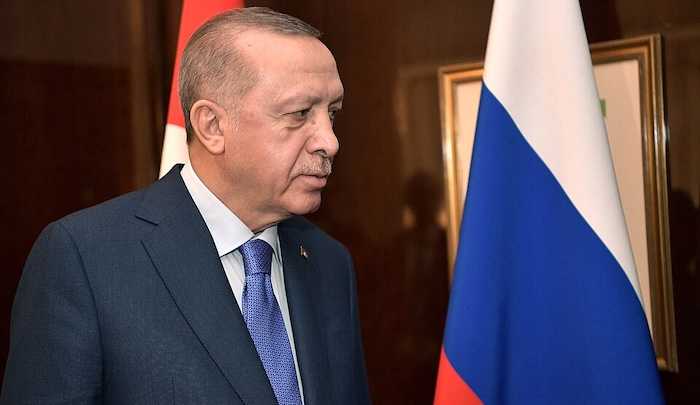
Turkish President Recep Tayyip Erdogan, Russian Presidential Executive Office, Creative Commons Attribution 4.0

As the smoke cleared over Tehran after the beginning of the Israeli-US strikes, Turkish President Recep Tayyip Erdogan was quick to point the finger. “This all began following Netanyahu’s provocations,” the Turkish leader stated, “we feel deep sorrow and great concern.” He went further, issuing a chilling warning: “God willing, I have no doubt that Israel will pay the price for this.”

The casual observer might imagine that Turkey, fighting as it is with Iran for dominance of the region, would welcome the strike against the Islamic Republic.

However, Hay Eytan Cohen Yanarocak, a leading expert on Turkish affairs at the Jerusalem Institute for Strategy and Security, explains that Turkey has a vested interest in the survival of the current Iranian regime.

“Ankara does not want to see a new ‘surprise’ in the form of regime change,” Yanarocak notes. “They are interested in the continuation of the regime because if a revolution occurs, Turkey’s monopoly as the primary bridge between the West and the Middle East simply disappears.”

Policy expert Jonathan Adiri agrees, suggesting that Turkey prefers a crippled neighbor over a liberated one.

“Turkey wants a non-nuclear, weak Iran,” Adiri says. “They want a sort of ‘weakened virus’ in the region. An Iran that is pro-Western and working with the Americans would become a magnet for foreign investment, which would directly hurt the Turkish economy.”

Right now, Turkey sees itself as the chief Muslim interlocutor with America. It has been a member of NATO since 1952, and in the past, the Americans used the Incirlik air base to spy on the Soviets and to pre-position war planes in case of need in the region. However, in recent years, Turkey has sometimes refused to allow the Americans to use that base to attack ISIS fighters in Iraq. Right now, Turkey continues, despite Erdogan’s hysterical anti-Israel animus, to be the main bridge between the Muslim world and the West, while Iran is a confirmed enemy of the West, especially of the United States, the Islamic Republic’s “Great Satan.”

Perhaps the most potent driver of Erdogan’s anxiety is the Kurdish question. For decades, the Iranian and Turkish regimes have shared a common interest in suppressing Kurdish nationalist aspirations. A destabilized Iran could lead to the emergence of an autonomous or independent Kurdish entity on Turkey’s southern border – a prospect Erdogan finds intolerable.

According to several sources, Erdogan and other senior Turkish officials pressured US President Donald Trump not to give a green light to an Israeli operation that would have resulted in Kurdish fighters in Iran starting a rebellion against the Iranian regime.

For decades, the Israelis have had clandestine ties with Kurds in Iraq and Iran. Beginning in the 1960s, Israel provided weapons and training to Kurdish forces — known as the peshmerga — in Iraq, and it still does. Since Muslim fanatics took over Iran 47 years ago, Israel has supplied weapons intermittently to Kurdish militias in that country as well. After the American pullout of forces from Syria, Israel decided to supply weapons to Syrian Kurds in their quasi-autonomous stronghold of Rojava. Erdogan is fearful of any Kurdish separatist movement in Iran or Iraq or Syria, that if successful, might prompt the Kurds in Turkey to join forces with those other Kurds in order to realize the ancient dream of an independent Kurdistan. Turkey wants Iran to be weakened, but left strong enough to suppress the Kurdish militias inside the country.

Adira [sic] points out that Erdogan and Turkey’s Foreign Minister Hakan Fidan drew a red line with Washington regarding the use of Kurdish forces from Iraq to move against Iran.

“Erdogan told his public: ‘Case closed,’ regarding the Kurdish story,” Adiri observes. “He is deathly afraid of that box being reopened. From Ankara’s perspective, the success of a Kurdish-led or Kurdish-supported uprising in Iran would have a domino effect on Kurds in Turkey, Syria, and Iraq.”…

That is exactly what Israel would want: that “domino effect” following upon the 15 million Kurds in Iran carrying out a successful separatist uprising. After the shellacking the Islamic Revolutionary Guard Corps and the Iranian army received in recent months from Israeli and American forces, this may be the Iranian Kurds’ best chance to rise up. If they do so, they can almost certainly count on Israel’s support. The IDF could supply the Kurds with both intelligence and weapons, including missiles, drones, artillery, and likely use its fighter jets, too, in order to halt with bombs away any attempted advance by Iranian forces.


Friday, March 18, 2016

‘Democracy, Freedom and the Rule of Law’ have No Value, Erdogan Says

Turkey will strike Kurds everywhere
Turkish President Recep Tayyip Erdogan © Adem Altan / AFP

Democracy, freedom and the rule of law have no value any longer, Turkish President Recep Tayyip Erdogan has said. He added that those who don’t support Ankara’ efforts to combat terrorists in the country are Turkey’s “enemies.”

“Democracy, freedom and the rule of law…For us, these words have absolutely no value any longer. Those who stand on our side in the fight against terrorism are our friend. Those on the opposite side are our enemy,” Erdogan told local leaders in Ankara on Wednesday, according to the DPA news agency.

"You're either with us, or your against us"! Where did I hear that before? Oh, yes, just before America invaded Iraq.

Ankara is planning to deploy “an iron fist against terrorism” and “fight Kurdistan Workers' Party (PKK) militants” in the country’s south east Erdogan said.

Turkey views all Kurdish militia that are also spread widely throughout Syria and Iraq as a direct national threat. Erdogan repeated Turkey will strike Kurds everywhere.

Isn't that akin to genocide? This ought to be particularly disconcerting to Canada which is planning on increasing its training of Peshmerga forces in the Syrian conflict. They will definitely be going into the line of fire. Will Erdogan care? I doubt it!

Erdogan bombs Kurds 'wherever they are'

"Wherever you run, our soldiers, police and village guards will find you there and do what is necessary," the president said, referring to Kurdish militants.

He also urged the authorities to “swiftly” end immunity from prosecution for pro-Kurdish politicians.

“I no longer see as legitimate political actors the members of a party, which is operating as a branch of the terrorist organization," Erdogan said. The Turkish president has repeatedly accused the Peoples' Democratic Party of Turkey (HDP) of supporting PKK fighters.

Watch for the arrest of Kurdish politicians, coming soon to a theater near you.

This is not the first controversial comment made by the Turkish president. In January, he reiterated his desire to ensure Turkey’s adoption of a presidential system of government. He has even cited Adolf Hitler’s Germany as an example of how this can be achieved.

“There are already examples in the world. You can see it when you look at Hitler’s Germany,” he said on Thursday, according to a recording broadcast by the Dogan news agency. “There are later examples in various other countries.”

In February, Erdogan accused Washington of causing the bloodbath in Syria by not recognizing as terrorists Kurdish forces fighting against Islamic State (IS, former ISIS, ISIL) in the region.

Of course, Erdogan is a supporter of ISIS. He thinks they are the good guys and the Peshmerga are the bad guys. That tells you a lot about Erdogan.

“Oh America! I told you many times, you are [either] beside us, or all of these terrorist organizations. You haven’t had a good grasp of them, and that is why the region has turned into a sea of blood,” Erdogan said, referring to the Syrian Kurdish Democratic Union Party (PYD) and its militia wing, the People’s Protection Units (YPG), which the US does not recognize as terror groups.

The conflict between the Turkish government and Kurdish population, who demand greater autonomy, has been continuing for decades. With several failed ceasefires between the sides, Ankara has been blamed by a number of human rights groups for putting civilian lives at risk in Turkey's mainly Kurdish southeast.

In summer 2015, Ankara launched a military operation to crack down on Kurdish fighters linked to the Kurdistan Workers’ Party (PKK). The violence ended a two-year truce.

Wednesday, March 16, 2016

Kurds to Announce 'Democratic Federal' System In Controlled Syrian Territories, Turkey Rejects

The YPG Kurdish flag waves at a protest.
PHOTO: A Syrian Kurdish flag flies during a protest against exclusion from the Geneva talks. (AFP: Delil Souleiman)

Kurdish-controlled areas of northern Syria are expected to declare a federal system imminently, Kurdish officials say, taking matters into their own hands after being excluded from talks in Geneva to resolve Syria's civil war.

The step aims to combine three Kurdish-led autonomous areas of northern Syria into a federal arrangement and will be sure to alarm neighbouring Turkey, which fears a growing Kurdish sway in Syria is fuelling separatism among its own minority Kurds.

Well this is certainly no surprise. The Kurds will not easily give up control of the significant area of Syria that they have fought so hard to win. Not inviting them to Geneva seems like a matter of Erdogan closing his eyes and hoping the problem would go away. It didn't!

A conference held in the Kurdish-controlled town of Rmeilan on Wednesday discussed a "Democratic Federal System for Rojava — Northern Syria", and ended with a decision to make the announcement at a news conference on Thursday.

Iraqi Kurdistan is a parliamentary democracy within Iraq with a regional assembly that consists of 111 seats. The announcement reveals the intention to create a similar government within northern Syria. Ankara is afraid that the PKK in southeastern Turkey will attempt to follow suit.

Rojava is the Kurdish name for northern Syria.

Aldar Khalil, a Kurdish official and one of the organisers, said he anticipated the approval of a new system, and "democratic federalism" was the best one.

Conference participants also forecast a failure of UN-led talks which began in Geneva this week, in the absence of the Syrian Kurdish PYD party.

Syrian Kurds effectively control an uninterrupted stretch of 400 kilometres along the Syrian-Turkish border from the Euphrates river to the frontier with Iraq, where Iraqi Kurds have enjoyed autonomy since the early 1990s.

Turkey, whose conflict with the Kurdish PKK has escalated in recent months, said such federalism was not acceptable.


Who are the Kurds? Why are they fighting Islamic State? Why is Turkey fighting them? And what do they want?

"Syria's national unity and territorial integrity is fundamental for us," a Turkish Foreign Ministry official said.

"Outside of this, unilateral decisions cannot have validity."

On Saturday, Syria's government in Damascus ruled out the idea of a federal system for the country, just days after a Russian official said that could be a possible model.

The PYD has been left out of the Geneva peace talks, in line with the wishes of Turkey, which sees it as an extension of the PKK group that is waging an insurgency in south-eastern Turkey.

The area of northern Syria controlled by the Syrian Kurdish YPG militia and groups fighting with it is growing with their advances against Islamic State militants over the last year.

Syrian Kurdish groups and their allies have already carved out three autonomous zones, or cantons, known as Jazeera, Kobani and Afrin.

Their capture of the town of Tel Abyad from Islamic State last year created territorial contiguity between the Jazeera and Kobani areas.

Reuters

Wednesday, April 22, 2015

Small Kurdish Girl Pictured Firing a Huge Machine Gun

What is the world coming to when even the 'good guys' teach their little children to kill? If there are any 'good guys'?

BBC Trending
Does a video of a Kurdish girl firing a machine gun mean that those fighting Islamic State are now mimicking their propaganda techniques?

The girl looks about six or seven years old. She chats away with an off-camera adult, possibly her father, who asks her how many Islamic State fighters she has killed. "Four hundred!" she says, speaking in a Kurdish dialect local to Sulaymaniyah in northern Iraq.

'Four hundred", she's hardly old enough to count to 400.

Then the little girl leans over a machine gun bigger than she is, and using both hands, she fires away into the distance. As the shots echo across the desert, the man behind the camera eggs her on: "Kill! Kill!"

The striking footage appears to have first surfaced in mid-January on a Facebook page devoted to pro-Kurdish videos, and shortly thereafter it cropped up on a YouTube channel called "Kurdish YPG". The YPG, or People's Protection Units, are the armed wing of the Kurdish Democratic Union Party in Syria.

The Kurdish YPG channel includes several other films glorifying the famous female Kurdish fighting battalions, alongside films about cooking potatoes and other random subjects. The channel also includes reports ripped straight from news organisations - here's a link to the original version of one of the news reports featured on the channel, a BBC video about Kurdish female warriors.

It's unclear how popular the video of the girl was until the social news site Vocativ reported on it a week ago - but since then other news outlets have picked up the story and various versions have clocked up hundreds of thousands of views in total.

The Islamic State militants who control huge areas in Syria and Iraq have increasingly been using children in propaganda videos. So does the video of the girl herald a new propaganda tactic on the part of Kurdish militias who are fighting IS?

It's unlikely, according to media analyst Hiwa Osman. "I think this is an isolated incident," he told BBC Trending via phone from the Iraqi city of Irbil. "I haven't seen other videos such as this - the most militarised pictures I've seen are of children dressing in the clothes of the Peshmerga [Iraqi Kurdistan fighters] for celebrations."

Osman added that Kurdish leaders in northern Iraq have gone out of their way to avoid mimicking the techniques of Islamic State. "After a failed [IS] attack in Kirkuk, one of the militants fell into the hands of the public, and the people who captured him were angry, and they beheaded him. The military leaders and the political leaders in the area came out strongly against the beheading. They don't want to be seen to be using the tactics of ISIS."

It's also clear that the girl isn't actually shooting at IS troops, says British-Kurdish blogger Ruwayda Mustafah. There are no other fighters or any other people pictured in the video, and the girl and the man behind the camera don't appear to be in any danger.

"I've seen the footage on several Facebook pages in Kurdish. Most people are outraged at the prospect of a young girl 'shooting'" Mustafah says. "But it's obvious from the video that this is just sensationalist and not factual ... the girl in the video hasn't really killed 400 ISIS terrorists."

Messages to the Facebook account that initially posted the video went unanswered, but Trending did manage to speak to the man behind the YouTube channel. The man, who (somewhat oddly) lives in Gaza, says he has no Kurdish family connection - he says he simply admires the Kurdish fighters and also runs websites and blogs devoted to the Russian Army and other fighting forces.

Saturday, February 14, 2015

ISIS Burns Kurdish Muslims Alive, Beheads Egyptian Christians in Libya

While popularity polls and positive sound bytes are ever so important to Western politicians, the steadily strengthening ISIS terrorist army gives the very real impression they could give a Tinker's Damn less what the Western press, politicians or self-appointed hash tag diplomats think of them.

Case in point would be the reports coming out of the Middle East and North Africa that the Islamic Jihadists have not only have charged forward in their seemingly non-stop butchery of innocents, they also have stepped up their death by fire executions of anyone with the backbone to fight back.

ISIS reportedly slaughters Kurdish Muslims, Egyptian Christians
As reported by the International Business Times (India edition) on Feb. 14, 2015, the terrorists paraded 17 caged Kurdish Peshmerga freedom fighters through the occupied Iraqi city of Kirkuk, reportedly on their way to be burned alive in the same fashion as they recently executed Royal Jordanian Air Force Lt. Mu'ath al-Kasasba. While ISIS claims to adhere to the Sunni branch of Islam as do many of the Kurds of northern Iraq, the jihadists seem not to have much of a problem slaughtering the Kurds wholesale.

In a video released by the terrorists on social media, Britain's The Independent notes on Feb. 14, 2015 that crowds lines the streets of Kirkuk to voice their opinion of the impending death sentence on the 17 Kurds. As reporter Lizzie Dearden penned, "People lining the streets could be heard jeering and shouting 'Allahu Akbar' (God is great) as they passed one by one on the back of flat bed vans."

Watch video

Long known for being fiercely independent, the Kurds by-and-large reject the ISIS goal of a world-wide hard-core Islamist caliphate, instead opting for a Kurdish homeland encompassing a region covering northern Iraq, northwest Iran, and southeastern Turkey. Rejecting Islamic Jihad, the Kurds openly fight side-by-side with the area's many Christian and Yazidi minorities who've seen their communities victims of especially viscous ISIS attacks, to include crucifixions, beheadings and many boys and girls being sold into sexual slavery.

Flexing its muscle, ISIS has expanded its terror network to Libya, where the Christian-centered Assyrian International News Agency reported on Feb. 12, 2015, that 21 Coptic Christians from Egypt who were kidnapped last Christmastide have just been beheaded by the Libyan branch of ISIS, which goes by the tag of Ansar al-Sharia. This group has long been known to have ties to the al-Qaeda terrorist group that is most famous for the 9/11 attack on the United States, and the 7/7 attack on Great Britain.

The Egyptian Copts were originally from many of the impoverished Christian villages of the Upper Egypt region of the nation. Attempting to eek out enough money to keep their families fed, clothed, and housed, the men traveled to Libya to seek employment even in the most menial construction jobs. ISIS released a statement claiming the kidnapping of the workers "commemorates" the October 2010 bombing of a Chaldean-rite Catholic Church in Baghdad which killed 58 worshippers.