"I am the Way, the Truth, and the Life"

Father God, thank you for the love of the truth you have given me. Please bless me with the wisdom, knowledge and discernment needed to always present the truth in an attitude of grace and love. Use this blog and Northwoods Ministries for your glory. Help us all to read and to study Your Word without preconceived notions, but rather, let scripture interpret scripture in the presence of the Holy Spirit. All praise to our Lord and Saviour Jesus Christ.

Please note: All my writings and comments appear in bold italics in this colour
Showing posts with label Turkey. Show all posts

Friday, May 1, 2026

Middle East geo-politics > Erdogan's biggest fears, Israel's biggest hopes


Erdogan on Israel, Iran, and the Kurds


Recep Tayyip Erdogan has firm views on Israel: he doesn’t like the Jewish state, and wishes it would disappear. He is convinced it practices “apartheid” at home and “genocide” abroad. He has fantasized about creating, and heading, a pan-Islamic army that would be able to defeat the IDF, so that “from the river and the sea/Palestine will be free” — which is the thinly-disguised call for Israel to disappear entirely, to be replaced by a state of “Palestine.”

Erdogan has watched with alarm Israel’s swift battering of Iran, a display of advanced weaponry, spectacular intelligence, and a brilliant and brave soldiery, made up of both battle-hardened professionals and reservists. But he is not entirely displeased at the weakening of the Islamic Republic. He wants Iran weakened, but not enough to lead to the regime’s collapse, that could mean Iranian Kurds would gain full autonomy. More on this can be found here: 


As Israel becomes a dominant force in the Middle East, where does Turkey stand? – analysis

by Amichai Stein, Jerusalem Post, April 27, 2026:
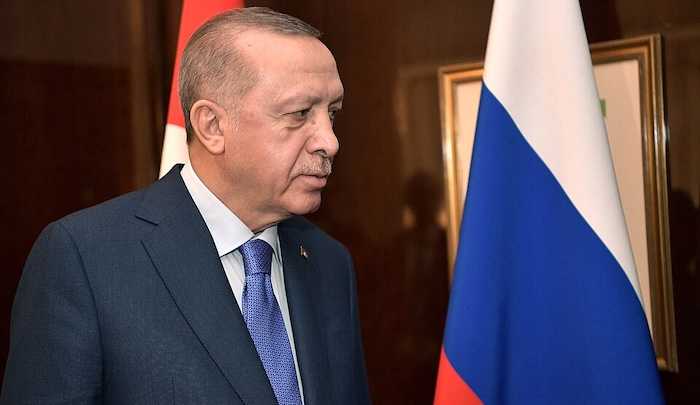
Turkish President Recep Tayyip Erdogan, Russian Presidential Executive Office, Creative Commons Attribution 4.0

As the smoke cleared over Tehran after the beginning of the Israeli-US strikes, Turkish President Recep Tayyip Erdogan was quick to point the finger. “This all began following Netanyahu’s provocations,” the Turkish leader stated, “we feel deep sorrow and great concern.” He went further, issuing a chilling warning: “God willing, I have no doubt that Israel will pay the price for this.”

The casual observer might imagine that Turkey, fighting as it is with Iran for dominance of the region, would welcome the strike against the Islamic Republic.

However, Hay Eytan Cohen Yanarocak, a leading expert on Turkish affairs at the Jerusalem Institute for Strategy and Security, explains that Turkey has a vested interest in the survival of the current Iranian regime.

“Ankara does not want to see a new ‘surprise’ in the form of regime change,” Yanarocak notes. “They are interested in the continuation of the regime because if a revolution occurs, Turkey’s monopoly as the primary bridge between the West and the Middle East simply disappears.”

Policy expert Jonathan Adiri agrees, suggesting that Turkey prefers a crippled neighbor over a liberated one.

“Turkey wants a non-nuclear, weak Iran,” Adiri says. “They want a sort of ‘weakened virus’ in the region. An Iran that is pro-Western and working with the Americans would become a magnet for foreign investment, which would directly hurt the Turkish economy.”

Right now, Turkey sees itself as the chief Muslim interlocutor with America. It has been a member of NATO since 1952, and in the past, the Americans used the Incirlik air base to spy on the Soviets and to pre-position war planes in case of need in the region. However, in recent years, Turkey has sometimes refused to allow the Americans to use that base to attack ISIS fighters in Iraq. Right now, Turkey continues, despite Erdogan’s hysterical anti-Israel animus, to be the main bridge between the Muslim world and the West, while Iran is a confirmed enemy of the West, especially of the United States, the Islamic Republic’s “Great Satan.”

Perhaps the most potent driver of Erdogan’s anxiety is the Kurdish question. For decades, the Iranian and Turkish regimes have shared a common interest in suppressing Kurdish nationalist aspirations. A destabilized Iran could lead to the emergence of an autonomous or independent Kurdish entity on Turkey’s southern border – a prospect Erdogan finds intolerable.

According to several sources, Erdogan and other senior Turkish officials pressured US President Donald Trump not to give a green light to an Israeli operation that would have resulted in Kurdish fighters in Iran starting a rebellion against the Iranian regime.

For decades, the Israelis have had clandestine ties with Kurds in Iraq and Iran. Beginning in the 1960s, Israel provided weapons and training to Kurdish forces — known as the peshmerga — in Iraq, and it still does. Since Muslim fanatics took over Iran 47 years ago, Israel has supplied weapons intermittently to Kurdish militias in that country as well. After the American pullout of forces from Syria, Israel decided to supply weapons to Syrian Kurds in their quasi-autonomous stronghold of Rojava. Erdogan is fearful of any Kurdish separatist movement in Iran or Iraq or Syria, that if successful, might prompt the Kurds in Turkey to join forces with those other Kurds in order to realize the ancient dream of an independent Kurdistan. Turkey wants Iran to be weakened, but left strong enough to suppress the Kurdish militias inside the country.

Adira [sic] points out that Erdogan and Turkey’s Foreign Minister Hakan Fidan drew a red line with Washington regarding the use of Kurdish forces from Iraq to move against Iran.

“Erdogan told his public: ‘Case closed,’ regarding the Kurdish story,” Adiri observes. “He is deathly afraid of that box being reopened. From Ankara’s perspective, the success of a Kurdish-led or Kurdish-supported uprising in Iran would have a domino effect on Kurds in Turkey, Syria, and Iraq.”…

That is exactly what Israel would want: that “domino effect” following upon the 15 million Kurds in Iran carrying out a successful separatist uprising. After the shellacking the Islamic Revolutionary Guard Corps and the Iranian army received in recent months from Israeli and American forces, this may be the Iranian Kurds’ best chance to rise up. If they do so, they can almost certainly count on Israel’s support. The IDF could supply the Kurds with both intelligence and weapons, including missiles, drones, artillery, and likely use its fighter jets, too, in order to halt with bombs away any attempted advance by Iranian forces.


Saturday, April 18, 2026

Military Madness > Is Turkey still trying to find a way to enter the Middle East war? Russia issues warning to Baltic states; Dutch Navy stealth warship tracked by €5 gadget


The chance of a Türkiye-Israel war has never been more real


A recent media frenzy about open threats from Ankara may have been just that – but the slide toward actual conflict is there

Published 17 Apr, 2026 18:10 | Updated 17 Apr, 2026 19:15

The chance of a Türkiye-Israel war has never been more real


The latest wave of discussion about a possible Turkish-Israeli confrontation was triggered by media reports claiming Turkish President Recep Tayyip Erdogan threatened to invade Israel.

Soon afterward, however, that interpretation was challenged in Türkiye. The specific quote turned out to be old and taken out of context, and Turkish voices insisted that Erdogan had made no direct statement about being prepared to launch a war against Israel. Still, he has undeniably been escalating his harsh rhetoric towards Israel, including calling it a terrorist state and comparing Prime Minister Benjamin Netanyahu to Hitler.

Yet even setting aside the dispute over the precise wording, the intensity of the reaction to the ‘invasion threat’ reports is revealing in itself. It shows that relations between Ankara and West Jerusalem have already reached a stage at which even an ambiguous phrase is instantly treated as a political signal, and any sharp comment can become part of the wider picture of a major regional confrontation. The ground for such a perception has long been prepared by the very trajectory of Turkish-Israeli relations.

A slide towards conflict

At first glance, this may appear to be no more than another burst of emotional rhetoric of the kind that has long been common in the Middle East, where dramatic threats and demonstrative statements have become part of the political language. But that explanation is too shallow and therefore misses the real point. What we are witnessing in fact reflects a much deeper and more dangerous process. Türkiye and Israel are gradually ceasing to see one another merely as occasional opponents divided by particular disputes, and are increasingly beginning to view each other as strategic rivals in a long game. That is what makes the current exchange of statements especially alarming. Once states enter a phase of systemic rivalry, rhetoric itself starts shaping how elites, societies, and security institutions imagine a future conflict as something almost natural.

In one sense, there is nothing surprising about this. The Middle East is structured in such a way that several ambitious centers of power can rarely coexist without an escalating competition between them. When multiple states claim exceptional status, the role of regional guarantor, or the right to speak for the region or at least for a large part of it, their interests will sooner or later collide. Türkiye and Israel are now moving ever more clearly toward precisely that point. Both states lay claim to a special mission. Both want to be indispensable to outside powers. Both believe that yielding to a rival today may become a historic defeat tomorrow. And both build their strategies not only around the defense of national interests but also around the idea of regional primacy. In such a context, even temporary tactical cooperation does not alter the deeper reality. Competition over space, influence, routes, alliances, and symbolic leadership continues to accumulate at a systemic level.

A history of partnership

It is particularly important to understand that Türkiye and Israel were by no means destined for hostility. On the contrary, for decades their relations developed along a very different trajectory. Ankara became the first Muslim-majority country to recognize Israel in the middle of the twentieth century. During the Cold War, the two maintained working ties grounded in pragmatism, shared links to the Western world, and an understanding that in an unstable regional environment it was better to have additional channels of interaction than to turn ideological differences into a permanent source of conflict. But the true flourishing of Turkish-Israeli cooperation came in the 1990s. That was when both sides began to see in the other an important element of their own security strategy.

In those years, Turkish-Israeli relations did indeed approach a near-strategic level. Military and intelligence cooperation was particularly close. For Türkiye, this meant access to technology, modernization, coordination on security matters, and the strengthening of its armed forces. For Israel, an alliance with a large Muslim country occupying a position of immense geographic importance carried both symbolic and practical value. It demonstrated that the Jewish state was capable of building durable ties in the region and moving beyond the usual boundaries of diplomatic isolation. Joint exercises, military contacts, defense agreements, technical modernization, intelligence exchanges, and political coordination all created the impression that a long-term axis was taking shape between the two states.

It is to that period that the story of Kurdistan Workers’ Party (PKK) leader Abdullah Ocalan belongs, a story that still carries symbolic weight for understanding how Turkish-Israeli closeness was perceived both in Türkiye and across the region. What remains a confirmed fact is that Ocalan was captured by Turkish intelligence in Kenya in 1999. Yet almost immediately, a broader narrative took hold suggesting that Israeli intelligence may have assisted Türkiye in the operation. That theme became part of the half-shadowed political memory of the region. For some, it was evidence of the depth of the Turkish-Israeli partnership. For others, it became part of a wider myth that Israel, at critical moments, stood with the Turkish state in its struggle against the Kurdish movement. Even if one leaves aside the question of how accurate those perceptions were, the more important point remains. Such narratives could only take root because, in the 1990s, Turkish-Israeli cooperation appeared so close that many found it entirely plausible that Israel might have had a hand in some of Türkiye’s most sensitive operations.

And this is where one of the most striking ironies of modern Middle Eastern history lies. What once seemed like a durable strategic partnership gradually turned into a field of irritation, mutual suspicion, and then near-open rivalry. Erdogan’s rise to power did not produce an immediate rupture, but it steadily altered the ideological framework of the relationship. The new Turkish leadership viewed the region differently. It sought not merely to preserve ties to the Western security architecture, but to construct its own autonomous axis of influence, drawing upon the Islamic factor, a more active policy across former Ottoman spaces, and the projection of moral leadership on issues tied to the Muslim world. Within that model, Israel could no longer remain for Ankara simply a pragmatic partner. It increasingly became a convenient point of ideological contrast and at the same time an important target of foreign policy pressure.

Continue reading this article on RT at:

Much more than just Palestine


Russian security chief issues drone attack warning to four NATO states


Sergey Shoigu has cautioned Finland and the Baltic states against allowing Kiev to use their airspace for attacks on Russia
Published 16 Apr, 2026 20:21 | Updated 17 Apr, 2026 06:13
Russian security chief issues drone attack warning to four NATO states


Russia has the right to retaliate if Finland and the Baltic states are found to be deliberately allowing Ukrainian drones to pass through their airspace, Security Council Secretary Sergey Shoigu warned on Thursday.

“Recently, there has been an increase in Ukrainian drone strikes against Russia via Finland, Lithuania, Latvia, and Estonia,” Shoigu told journalists. “As a result, civilians are suffering and significant damage is being caused to civilian infrastructure.”

Either Western air defenses are proving ineffective, or these four countries “deliberately provide their airspace, thereby becoming open accomplices in aggression against Russia,” he added. In the latter case, Moscow has the right to self-defense in response to an “armed attack” under Article 51 of the UN Charter, the security chief stressed.

In recent weeks, Kiev has intensified drone strikes on Russia in what Moscow has characterized as “terrorist attacks,” with the Russian military regularly reporting hundreds of UAVs downed in a single night.

Late last month, Kiev attacked Russia’s Baltic Sea ports of Ust-Luga and Primorsk with swarms of UAVs. The raids resulted in fires in both towns, which house extensive petrochemical infrastructure.

Kremlin aide Nikolay Patrushev said he believed that Finland and the Baltic states were “complicit in these crimes.” The provision of national airspace for Ukrainian drone strikes would “signify direct NATO participation” in attacks on Russia, he said Monday.

Multiple Ukrainian drones have also struck the territories of Finland and the three Baltic states since early March. Despite this, all four nations have avoided condemning Kiev outright for violating their airspace.

Moscow has already formally warned Lithuania, Latvia and Estonia against allowing Ukraine to send drones via their territory, Russian Foreign Ministry spokeswoman Maria Zakharova said last week. “If the regimes in these countries are smart enough, they will listen. If not, then they will have to deal with the consequences,” she said.


€5 gadget tracks down Dutch Navy's stealth warship while on mission


The regional broadcaster Omroep Gelderland determined the location of the Zr. MS. Evertsen, a stealth frigate of the Dutch navy currently on mission, by using a €5 gadget, an envelope, and two stamps. The Ministry of Defense is taking measures, the broadcaster reported.

Omroep Gelderland found the Evertsen using a Bluetooth tracker, a cheap device typically used for things like finding your keys. The broadcaster got the tracker on board the ship by posting it through the Military Postal Organization, the Ministry’s own post office that lets soldiers stay in touch with loved ones at home. Instructions for using this service are available on the Defense website.

The Ministry checks incoming post for dangerous items. But videos posted online by the Ministry show only packages passing through an X-ray scanner. Omroep Gelderland, therefore, packaged the tracker in an envelope, and it went to the Evertsen undetected.

Rowin Jansen, an assistant professor of National Security Law at Radboud University in Nijmegen, told Omroep Gelderland that Defense needs to be more careful about what it puts online, given the current geopolitical tensions. “It’s a trade-off between the private interests of soldiers who want to maintain contact with their families and national security. And with everything that is going on at the moment, you would expect national security to take precedence.”

“You would rather not have a warship’s location known,” Former Lieutenant General Mart de Kruif from Laag-Keppel told the broadcaster. “Nowadays, you can eliminate targets remotely and with great precision, but you do need to know where they are. So, as a frigate, you never want to reveal your location.” You can’t just go along with the existing rules, he said. “We are still a bit naive, and that mindset needs to change.”

The Evetsen is currently deployed to protect a French aircraft carrier against missile attacks. Information regarding the stealth ship’s location is therefore highly sensitive. Yet this is not the first time its location was easily revealed. A few weeks ago, a French soldier accidentally revealed the location by uploading his jog to the running app Strava.

The Ministry of Defense banned Dutch soldiers from using fitness apps in 2018, after such apps' data revealed Dutch military patrol routes in Mali. Yet last year, Omroep Gelderland was still able to obtain the data of 900 Dutch soldiers through Strava. 

===============================================================================================


Thursday, March 19, 2026

Will Erdogan replace Iran to lead the Middle East Muslims?


As I have mentioned a few times before, it is possible that Turkey, not Russia, could lead the End Times assault on Israel. It certainly is Erdogan's ambition to do so.


Erdogan Plans for Turkey to Replace Iran as Leader of Gulf Muslims


President Recep Tayyip Erdogan of Turkey has long harbored dreams of glory. A few years ago, he predicted that in the future there could be a war between “the Crescent and the Cross,” and he clearly saw himself as leading the forces of the Crescent — the world’s Muslims — against the world’s Christians. In another vision, he presented Turkey as the leader of a pan-Islamic army that would be strong enough to take on, and defeat, the Jewish state. Now, as he watches the American and Israeli militaries batter the Islamic Republic of Iran, he is planning to replace Iran as the major Muslim power in the Middle East and North Africa. More on Erdogan’s view of Turkey’s future role in the region can be found here:


Israel’s next test: Turkey positions itself to lead a post-Islamic Iran Middle East – opinion

by Amine Ayoub, Jerusalem Post, March 14, 2026:

Screenshot

As the regional architecture of the Middle East undergoes a violent transformation, observers are beginning to realize that the collapse of the Islamic Republic of Iran is not the end of the story but the beginning of a far more complex chapter.

The conflict, dubbed Operation Roaring Lion, has entered a phase where the systemic deterrence of the mullahs is effectively finished. However, history teaches us that the moment of greatest victory is often the moment of greatest danger.

We have reached what historians now call a 1919 Moment, a juncture where the primary threats of the past decade ⁠– Sunni jihadism and the Iranian proxy network ⁠– have been beaten, but the victorious alliance is already beginning to fracture.

The most significant and dangerous crack in this new order is the rising ambition of Islamist Turkey. For months, the government of President Recep Tayyip Erdogan has adopted a strategy that prioritized the survival of the clerical regime in Tehran as a counterweight to Western influence.

Now that the Iranian regime is in its death throes, Ankara is shifting its messaging to prepare for a direct confrontation with the new regional reality. Pro-government Turkish columnists have begun to frame Israel as the last obstacle to regional stability, with some explicitly claiming that after Iran, it will be Turkey’s turn.

Despite the fears of those columnists, Israel has no intention of attacking Turkey. Turkey is much less of a threat to the Jewish state; it does not possess a nuclear weapons program; it has not rushed headlong to produce thousands of ballistic missiles. Turkish crowds do not scream “Death to Israel,” even if hostility to the Jewish state is widespread. Unlike the Islamic Republic, Turkey does not see destroying Israel as central to its being. Unlike Iran, Turkey is a member of the Western alliance, NATO, and its military leaders have over almost 80 years fostered close ties with the American generals.

This rhetoric is not accidental; it is a calculated effort to position Turkey as the sole remaining champion of political Islam in a vacuum left by the IRGC. Ankara fears that a Western-aligned or Israel-friendly government in Tehran would permanently shift the balance of power, leaving Erdogan as a regional outlier.

Would not Sunni Turkey be much more successful as a regional power than was Shi’a Iran, given that the Sunni Arabs of the Gulf are hostile to the Shi’a, with some of those Sunnis even considering the Shi’a to be “rafidite dogs” to be mistrusted and scorned as little better than Infidels?

The signs of this shift are most visible in Syria, which has become the epicenter of the new power struggle. The recent appointment of Kurdish commander Sipan Hemo as Syria’s Assistant Defense Minister for the Eastern Region is a watershed moment.

While on the surface this appears to be a local administrative move by the government of President Ahmed al-Sharaa, it is actually a signal that Turkey and its regional partners are moving faster than the West to consolidate the spaces once held by Iran….

By appointing a Kurdish commander to a high post in the Ministry of Defense, the Syrian leader, Ahmed al-Sharaa, is hoping to co-opt the Kurds in Syria who might be tempted to revolt against Damascus in order to obtain greater autonomy, or even gain, with the help of Kurds in Iran, Iraq, and Turkey, an independent Kurdish state. Instead, al-Sharaa is giving high-profile positions to a handful of Kurds, in an attempt to persuade the Kurdish population that they will play important roles in the new government. That might lessen Kurdish resentment of rule from Damascus.

Erdogan, meanwhile, knows that Israel and the U.S. will be victorious against Iran, but doesn’t want the victory to be too overwhelming, leaving Israel to be perceived as the strongest military power in the region. He would like Iran to continue to be a threat to the Jewish state, not through its greatly diminished store of ballistic missiles and its nuclear program which is about to be wiped out, but through the huge size of its various military groups. Iran’s armed forces consist of 150,000 active personnel in the Islamic Revolutionary Guard Corps, 350,000 in the regular army, and between one and five million men in the Basij militia.

Israel and the United States are performing a spectacular and indispensable service to the region and the world by destroying Iran’s military threat — its ballistic missiles and its nuclear program. But the ideology of these fanatical Shia could be replaced by the aggressive Sunni expansionism that has taken hold in Turkey ever since Erdogan became a national figure.

The Americans and Israelis, and those Gulf Arab states that have joined the Abraham Accords, constitute a coalition that could contain any Turkish moves to become the hegemonic power in the region. Turkish designs on Syria, where Istanbul has established military outposts to keep the Syrian Kurds in check, should be opposed by the Americans. Washington does have considerable leverage over Turkey; it supplies almost all of the country’s weaponry; the American military hold joint training sessions and maneuvers with the Turkish military. Some NATO members, alarmed at the re-Islamization and de-Kemalization of Turkey, as Turkey becomes ever more “Islamic,” have even spoken about Turkey no longer being fit for NATO membership — especially as it has threatened violence against another NATO member, Greece.

After the definitive military defeat of the Iranian regime — though not necessarily its replacement by a democracy — President Erdogan’s ambitions in the region should be swiftly shot down. Israel will need no convincing. Nor will the Gulf Arab states, whose people are well aware of how the Ottoman Turks mistreated their Arab subjects during four hundred years of imperial rule. Erdogan doesn’t dare attack Turkey’s hereditary enemy, Greece, because it is a member of NATO and could invoke Article 5; nor can the Turks expand their foothold on Cyprus without earning the ire of the other NATO members. And always there will be the threat hanging over Ankara if it tries to expand the territory of the Turkish Republic of Northern Cyprus, or if it tries to create, on the Iranian model, proxies in the region, chiefly by sending money and weapons to Hamas in Gaza or to the Muslim Brotherhood in any of a half-dozen Gulf countries. That threat is twofold: Washington will cut off all weapons sales to Ankara and may even call for expelling Turkey from NATO. That should keep the Padishah in check.