"I am the Way, the Truth, and the Life"

Father God, thank you for the love of the truth you have given me. Please bless me with the wisdom, knowledge and discernment needed to always present the truth in an attitude of grace and love. Use this blog and Northwoods Ministries for your glory. Help us all to read and to study Your Word without preconceived notions, but rather, let scripture interpret scripture in the presence of the Holy Spirit. All praise to our Lord and Saviour Jesus Christ.

Please note: All my writings and comments appear in bold italics in this colour
Showing posts with label Macedonia. Show all posts

Monday, May 15, 2017

Albania's Hyper-Corruption Threatens Regional Peace and Stability in Balkans

Here’s why Albania is a failed state
Adam Garrie, The Duran
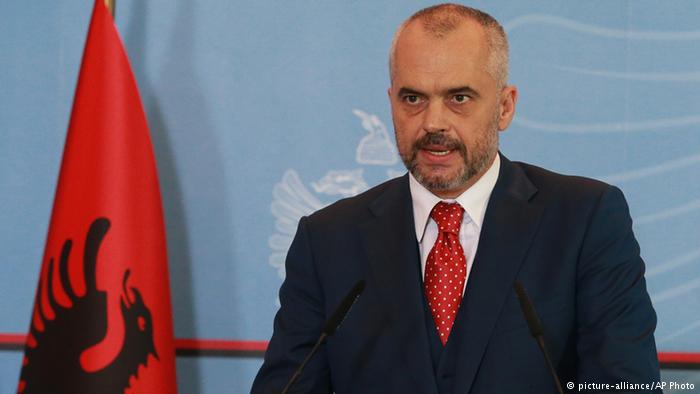
Abanian Prime Minister Edi Rama

With many eyes on Macedonia’s political situation which has been made worse by foreign interventions from the EU and NATO which both support the Tirana Platform which would effectively destroy the unity of the Macedonian state, internal events in Albania itself may soon jeopardise stability in the region.

Protests throughout Albania have been going on for months as the main opposition Democratic Party and other activists have called for the Prime Minister Edi Rama to resign prior to elections scheduled for 18 June, 2017 . Many want a technocratic government to oversee the process, having lost all faith in democracy.

We have reached an impasse wherein self-proclaimed Albanian democrats no longer trust that their country is democratic. Impartial observers have been warning of this for years.

Kruje, Albania - was the capitol city in the middle ages

Albania has a population of under 3 million people about 60% of whom are Muslim (Sunni) and 17% Christian. At one point under communism, Albania was declared the world's first atheist state. Since the collapse of communism, religion has returned. Albanians are believed to be involved in a significant amount of human trafficking as portrayed in the movie "Taken". 

One can tell that the genie is fully out of the bottle when even the neo-liberal Financial Times admits that half of Albania’s GDP comes from drug sales and cultivation.

The truth of the matter is that Albania is a narco-state, built on top of a mafia state where the illegal drugs trade, organ trade, weapons trade, human trafficking and blatant corruption are the guided forces of business in both the private and public sectors.

The fact that this impoverished, broken state has imperialist ambitions, threatening to annex neighbouring states including parts Serbia, Macedonia, Greece and Montenegro is not only illegal and irresponsible but also deeply frightening.

Many in Albania are openly calling for a ‘Greater Albania’ which would encompass the sovereign territories of each aforementioned nation. But as it stands, Albanian leaders cannot even run the state that they have according to its current borders.

Actually, from their perspective they may be running the state just fine.

A lengthy report from a US based anti-corruption website, citing a variety of mostly western sources has found that corruption exists at almost every level of the Albanian state, including in private business dealings.

The EU is all rather confused about this. Albania’s corrupt mafioso elite are staunchly pro-EU and Albania is an enthusiastic member of NATO.

Some realists in the EU however realise that Albania’s cringe-worthy levels of corruption would be an economic and security disaster for the EU. More worryingly though, many EU officials prefer to look the other way or simply lie about the dire situation in order to continue promulgating a narrative that Albania is an EU country in the making.

While the EU itself is deeply corrupt, Albania’s corruption is far more ‘old school’ in the sense that money talks and when it doesn’t, the bullets do the talking.

Albania’s terrorist proxies and violent separatists threaten to break up Macedonia and violate Serbia’s territorial integrity. When one realises that these people cannot control their own country, it puts things into perspective. The perspective is in a word: grim.


Monday, January 30, 2017

Soros-Funded NGOs Aiming to Bring Down Hungarian Gov't – Foreign Minister

George Soros © imago stock&people / www.globallookpress.com

The activities of organizations funded by US billionaire investor George Soros in Hungary are “anti-democratic,” as they want to undermine the government in Budapest, the foreign minister of Hungary told RT.

Soroswould like this government to fail, he would like to kind of fire this government because he doesn’t like our approach, doesn’t like our policies,” Foreign Minister Peter Szijjarto told RT’s Sophie Shevardnadze.

“We find it very anti-democratic if someone from abroad would like to influence Hungarian voters on whom to vote for,” he asserted.

Several days before the interview, the Hungarian parliament began to discuss a bill allowing authorities to audit NGO executives and request detailed reports on their foreign donations.

Earlier in January, chairman of the ruling Fidesz party Szilard Nemeth said that “these organizations must be pushed back with all available tools, and I think they must be swept out, and now I believe the international conditions are right for this with the election of the new president [Donald Trump].”

Last September, Nemeth, who is also the deputy chairman of Hungary’s National Security Committee, submitted a list of 22 NGOs “connected to the Soros network for the purpose of having these organizations screened.”

Foreign Minister Szijjarto said it is obviously the right of his country to be protected from foreign influence. “This is what we have heard a lot from the US for the last months – that external influence is so dangerous… So, it’s a good reason – if this is the American position, it can be our position as well.”

Hungary, which lies at the very heart of Europe, last year became a main passageway for hundreds of thousands of migrants and refugees eager to reach northern European countries. The government, led by right-wing President Viktor Orban, responded by erecting fences along Hungary’s borders and introducing strict border controls. Budapest has consistently refused EU-backed mandatory resettlement quotas, calling them a blow to member states’ sovereignty.

Szijjarto cited intelligence reports alleging that “there were organizations which helped illegal migrants find ways to Hungary, to find where they could violate our border, to find out how to apply for asylum status, and these reports have said that George Soros was in the background of these organizations.”

video 26:18

Countries to Hungary’s east and south are concerned about Soros’ operations, too. In Macedonia, an organization called Stop Operation Soros (SOS) has been launched. Its founder, Nikola Srbov, accused Soros of hijacking civil society, calling upon followers to “fight against one-mindedness in the civil sector, which is devised and led by Soros,” according to Vecer newspaper.

Russian prosecutors branded the Open Society Foundation (OSF), a major Soros asset, and Open Society Institute’s Assistance Foundation threats to the country’s constitutional order and national security in 2015, and banned them from providing grants to Russian partners.

Groups run by Soros have also been accused of meddling in Ukrainian affairs and supporting the 2013 Euromaidan protests that led to the ouster of democratically-elected President Viktor Yanukovich.

Thursday, January 19, 2017

‘Stop Operation Soros’ Movement Begins in Macedonia

It is interesting to watch as country after country begins to chip away at the foundations established by George Soros. They started out well enough helping communist countries transition to democracies, but their influence didn't stop there. Soros was a polarizing figure in the recent American elections and probably one of the reasons that establishment politics was rejected. 

While Russia has born the brunt of criticism for interfering with the American elections, which is probable but not really proven, we have no idea what role Soros had to play in the elections. We know he was a big supporter of Hillary but whether it was just financial support or if there were more clandestine things going on, we may never know.

Does Soros have a God-complex because he has so much money and he thinks he knows how the world should work and goes about trying to make it so? Who knows? We also don't know whether this 'push-back' by Macedonia and Hungary is completely legitimate or whether there is a communist-like benefactor behind it. In politics things are seldom as they seem. 

Caution: This article is from RT (Russia Today) and so some political bias can be expected. 


A new initiative, Stop Operation Soros (SOS), dedicated to countering the influence of American billionaire activist George Soros, has been launched in Macedonia.

In a press conference on Tuesday, the founders of the group called on all “free-minded citizens,” regardless of ethnicity or religion, to join them in the “fight against one-mindedness in the civil sector, which is devised and led by George Soros,” the Vecer newspaper reported. The movement says it will first focus on uncovering ‘subversive’ activities by Soros-funded NGOs.

According to Nikola Srbov, a columnist for pro-government news portal Kurir and co-founder of SOS, Soros-funded NGOs have monopolized civil society in Macedonia and used their position to suppress dissenting views.

“We've witnessed the takeover of the entire civil sector and its abuse and instrumentalization to meet the goals of one political party. That is unacceptable and goes beyond the principles of civic organizing,” Srbov said at the press conference.

“The Open Society Foundation, operating under the Soros umbrella, used its funding and personnel to support violent processes in Macedonia. It has monopolized the civil society sector, pushing outside any organization which disagrees with the Soros ideology,” he stated.

Another co-founder, Cvetin Cilimanov, editor-in-chief of the state-run MIA news agency, accused Soros’s Open Society Foundations of undermining Macedonian sovereignty by working not only with the opposition center-left SDSM party, but also with outside interests. By cooperating with foreign embassies and organizations such as USAID, Cilimanov believes Soros-backed groups have interfered in the political process of Macedonia.

“This is unacceptable and has largely contributed to a feeling in the public that the traditional relations of partnership Macedonia enjoyed with some countries are being undermined,” Cilimanov told journalists.

A third founder of the initiative and editor-in-chief of the Republika news portal, Nenad Mircevski, declared that the group would work towards the “de-Soros-ization” of Macedonia, echoing a speech made by former prime minister and leader of the ruling VMRO-DPMNE party Nikola Gruevski in December. In the speech, Gruevski accused foreign powers and Soros-backed organizations of meddling in Macedonian politics.

Opposition figures have expressed concern at the rhetoric used by Gruevski, fearing the start of a crackdown on dissent and advocacy groups.

The Open Society Foundation (OSF) was set up by Hungarian-born Soros between the mid-1980s to early 1990s with the stated aim of helping former Eastern bloc countries transition from communism. However, aside from its support for progressive causes such as drug policy reform, the OSF has also been involved in political activities and Soros publically supported the violent overthrow of the legitimately-elected government in Ukraine during the ‘Euromaidan’ revolution. This has earned him the ire of Russian authorities, which in 2015 banned Soros and his foundations as a threat to national security.

Soros and his foundations have come under scrutiny elsewhere as well. In an interview with the internet portal 888.hu in December, Hungarian Prime Minister Viktor Orban said that 2017 would bring about “the extrusion of George Soros and the forces symbolized by him.” Orban has accused Soros of undermining European borders and values by helping facilitate the flow of refugees and asylum seekers from the Middle East and elsewhere. During a Reddit AMA (Ask Me Anything), WikiLeaks’ Julian Assange also blasted the Organized Crime and Corruption Reporting Project, funded by Soros, for focusing “exclusively on negative stories about Russia and former Soviet states.”


Sunday, May 10, 2015

Macedonia Blames Kosovans for Kumanovo Clashes Killing 8 Officers

From BBC Europe
Police officers run across a street in Kumanovo, Macedonia, 9 May 2015
Macedonia says five Kosovans led the armed group which was involved in clashes with security forces in the northern town of Kumanovo.

Eight officers were killed and 37 injured, as well as 14 gunmen, Interior ministry spokesman Ivo Kotevski said.

Those named were members of the now dismantled Kosovo Liberation Army.

Mr Kotevski said the threat in Kumanovo, near the Serbian-Kosovan border, had been "eliminated" and a large amount of weapons seized.

Last month, about 40 ethic Albanians from Kosovo briefly took over a Macedonian police station in the village of Gosince near the border, demanding the creation of an Albanian state in Macedonia.

Map showing Kumanovo in Macedonia
In 2001, rebels demanding greater rights for the ethnic Albanian minority launched an uprising against the government, and tensions have continued despite a peace deal.

About a quarter of Macedonia's two million population are ethnic Albanians.

Men in uniforms

Sami Ukshini, Beg Rizaj, Dem Shehu, Muhamet Krasniqi and Mirsad Ndrecaj were the leaders of the armed group that clashed with police in a suburb of Kumanovo, some 40km (25 miles) north of the capital, Skopje on Saturday, the interior ministry spokesman said.

Only one of the 14 uniformed bodies had been identified - that of another Kosovo national, named Xhafer Zymberi, said the spokesman.

"More than 30 terrorists, mainly Macedonian nationals and one from Albania, surrendered yesterday [Saturday] to the police forces," he added.

Ethnic Albanians in the village of Studenicani pray during the funeral of
Isamedin Osmani, one of the police officers killed in the Kumanovo operation
An elderly woman is evacuated in an armoured vehicle near a police
checkpoint in Kumanovo, Macedonia May 10, 2015
People on bicycles pass in front of the Government building where the national
flags are lowered at half mast, in Skopje, Macedonia May 10, 2015
They would face Macedonian justice, Prime Minister Nikola Gruevski said. The group had tried to destabilise the country, he said, after paying tribute to the security forces.

His government is already under pressure over claims of illegal wire-tapping and police brutality.

The opposition and the government have accused each other of deliberately destabilising the country.

Nato Secretary-General Jens Stoltenberg said he was following the situation with "great concern" and urged all sides to "exercise restraint and avoid any further escalation, in the interest of the country and the whole region".

Earlier, the European Commission issued a similar call.

Macedonia, which is a candidate for European Union membership, is observing two days of mourning.

Saturday, May 9, 2015

5 Macedonian Police Killed in Clash with Armed Gang

Who are the Macedonian terrorists?

Balkan nation grappling with deepest political crisis since independence 
from former Yugoslavia
The Associated Press 
People are evacuated safely from the scene of an altercation involving the police in northern Macedonian town of Kumanovo, on Saturday. Authorities say parts of the town have been sealed off after police clashed with an armed group.

An armed group attacked special forces police Saturday in a town in northern Macedonia in a clash that killed five police officers and injured more than 30, officials said, amid a political crisis that has raised concern about the stability of the Balkan nation.

Interior minister Gordana Jankulovska told reporters late Saturday that the police casualties occurred during a sweep operation in Diva Naselba, a neighbourhood in western Kumanovo. Police had come under attack from automatic guns and bombs.

A weeping Jankulovska described the five slain police officers as "heroes who gave their lives today for the Republic of Macedonia."

She added that the "terrorist group," which had entered Macedonia from an unspecified neighbouring country, planned to "use the current political situation to perform attacks on state institutions."

Jankulovska said more than 20 members of the armed group had surrendered, but added that the police operation is still ongoing because other attackers have refused to give up.

Jankulovska said some of the attackers had been killed, without specifying the number. She was not able immediately able to confirm whether there were any civilian casualties.

Deepening crisis

Saturday's clashes come as Macedonia is grappling with its deepest political crisis since its independence from former Yugoslavia in 1991. The government and the opposition have accused each other of planning to destabilize the country to take or preserve power, and some analysts fear leaders on both sides are ready to provoke ethnic clashes as leverage.

A woman cries as she hugs her relative after she was
evacuated safely from the scene of an altercation
involving the police. (Visar Kryeziu/Associated Press)
Macedonia Shootings

Kumanovo is an ethnically mixed town located about 40 kilometres northeast of the capital Skopje, near the border with Kosovo and Serbia. The region was the center of hostilities between ethnic Albanian rebels and government forces during the ethnic conflict in 2001.

Ethnic Albanians, who make up a quarter of Macedonia's 2 million people, took up arms in 2001 demanding more rights. The conflict ended after six months with a western-brokered peace deal that granted more rights to the minority group.

Saso Ordanovski, a political analyst, suggested in a debate on local TV station 24 Vesti Saturday that the members of the armed group in Kumanovo were mercenaries.

"Somebody has paid them to change the subject on what is going on at the moment in the country," Ordanovski said.

This is a pretty serious charge, since only the government would benefit from changing the subject. Starting a war has saved many a faltering government.

Serbia sends special forces to border

The EU delegation in Macedonia appealed for calm and said in a statement it is waiting "for facts to be established by the relevant authorities."

The U.S Embassy in Skopje issued a statement saying it "deeply regret(s) the loss of life."

"We are following the situation and are in close contact with the authorities and political leaders. We urge citizens to remain calm and allow the facts to be established," the embassy said in a statement.

Macedonian President Gjorge Ivanov urgently ended his visit to Russia and travelled back home. The president's office said he will call for a National Security Council meeting in relation to the latest developments.

Police officers walk through a street near the scene of the clash.
(Boris Grdanoski/Associated Press)
Serbia, Macedonia's northern neighbor, reacted by sending reinforcements of special police to the border region, apparently fearing a possible spillover of violence.

Jankulovska, the Interior Minister, said the armed group was "sheltered in the houses of supporters," but did not give any more details about the organization.

Local TV stations aired video footage showing black smoke rising from houses in western Kumanovo and many civilians fleeing the area.


Police brutality

On Friday, thousands of opposition supporters took part in nationwide protests against alleged police brutality in Macedonia. The protests started after opposition leader Zoran Zaev — citing illegally recorded conversations — accused the government of trying to cover up the 2011 police killing of a 22-year-old man.

The recordings are part of a series of wiretaps Zaev has been releasing that he says reveals corruption at the highest level of government in this country of 2 million people, including mismanagement of funds and criminal prosecutions of opponents.

Matka Lake, Macedonia
Zaev claims Prime Minister Nikola Gruevski was behind the alleged illegal wiretapping and that he received the material from a source. Gruevski denies wrongdoing, claiming the recordings were fabricated with the help of foreign spies. He has accused Zaev of plotting a coup.

Zaev on Saturday appealed for calm, but had earlier called for a large anti-government protest on May 17.

The junior coalition partner in the conservative government, the ethnic Albanian Democratic Union for Integrations, or DUI, (no jokes, please) has also expressed concern and appealed for calm. DUI urged people not to respond to provocations.