"I am the Way, the Truth, and the Life"

Father God, thank you for the love of the truth you have given me. Please bless me with the wisdom, knowledge and discernment needed to always present the truth in an attitude of grace and love. Use this blog and Northwoods Ministries for your glory. Help us all to read and to study Your Word without preconceived notions, but rather, let scripture interpret scripture in the presence of the Holy Spirit. All praise to our Lord and Saviour Jesus Christ.

Please note: All my writings and comments appear in bold italics in this colour

Saturday, February 1, 2025

Military Madness > An Iron Dome for America? Germany says no to 5% GDP for military; Danes say no to Greenland sale - see USA as a threat


Trump orders ‘Iron Dome’ missile defense for US

The president wants a “next-generation” system to protect the country from long-range attacks
Trump orders ‘Iron Dome’ missile defense for US


US President Donald Trump has ordered the Pentagon to develop a plan for a new integrated missile shield, arguing a potential sophisticated long-range aerial attack remains the “most catastrophic threat” to the country.

Trump on Monday tasked the defense secretary with creating the system in an executive order, dubbed ‘The Iron Dome for America.’

Secretary of Defense Pete Hegseth now has 60 days to hatch the plan to protect the US from “ballistic, hypersonic, advanced cruise missiles, and other next-generation aerial attacks from peer, near-peer, and rogue adversaries” and envision the new multi-layered missile shield.

“Over the past 40 years, rather than lessening, the threat from next-generation strategic weapons has become more intense and complex with the development by peer and near-peer adversaries of next-generation delivery systems and their own homeland integrated air and missile defense capabilities,” the executive order reads.

The directive mandates the creation of various features of the proposed missile shield, including the “development and deployment of proliferated space-based interceptors,” capable of shooting down incoming ballistic missiles during their boost phase, bolstering of the “underlayer and terminal-phase intercept capabilities,” as well as unspecified “capabilities to defeat missile attacks prior to launch.”

Trump has repeatedly promised to create an Israeli-style integrated missile defense shield, yet it remains to be seen how exactly such an approach would work for the US, a country immensely larger than Israel.

While the order implies the plans should be incorporated into the next year’s budget, it does not provide any cost estimates on the ambitious program. Nor does it provide a timeframe on when exactly the missile shield should materialize.

Israel’s Iron Dome system is primarily designed to intercept small crude unguided rockets, drones and artillery shells, while other weapons provide capabilities against other threats, such as sophisticated long-range ballistic and cruise missiles.

I can see the need for an iron dome around Washington, DC, and maybe NYC, and some military bases, but the cost of covering all the coasts and borders of America would be insane. 

Having said that, Trump knows very well that if he doesn't order things that keep America's War Industry getting filthy rich, he will never live to see the end of his term. Consequently, the Iron Dome scheme, the raising of NATO spending to 5% of GDP, etc.


=============================================================================================


Germany rejects Trump’s military spending demand

Berlin will not spend almost half of its federal budget on defense, Boris Pistorius has said
Germany rejects Trump’s military spending demand


German Defense Minister Boris Pistorius has said that Berlin simply cannot afford to spend 5% of its GDP on the military, as US President Donald Trump is demanding from NATO member states.

The need to invest more in defense is “undisputed,” but there are limits to what Germany can do, Pistorius pointed out in an interview with Tagesspiegel newspaper on Saturday.

He explained that “5% of our GDP would correspond to 42% of the federal budget. That would be almost every second euro spent by the federal government, €230 billion. We could neither afford that nor spend that.”

“The competition for even higher percentages distracts from the actual issue at hand. It is crucial that we explain to our citizens what threats we face and show them the best possible way to protect ourselves,” the minister argued.

However, he acknowledged that “Germany will have to spend more on its defense in the future, even more than the 2% of its GDP now achieved by this government.” 

Trump, who has long criticized Washington’s European allies for not contributing enough to NATO, voiced the idea of raising the bloc’s spending goal during a press conference in early January, before his inauguration.

“They can all afford it, but they should be at 5%, not 2%,” he insisted, expressing frustration that “Europe is in for a tiny fraction of the money that we are in” when it comes to investment in defense.

But Donald, most of that money comes back to the US War Industry. Surely you must understand that!

Previously, Trump warned that under his leadership, the US would not defend NATO countries that fail to meet their financial commitments.

Lithuanian President Gitanas Nauseda fully backed the US President’s 5% goal during an interview with Newsweek on Thursday.

“You can never feel safe living in this part of the world because we have this neighbor and we will still have it after one hundred or two hundred years,” Nauseda said, referring to Russia.

The more you build up militarily, the less safe you should feel.

Last year, Russian President Vladimir Putin rejected allegations his country was planning aggression against NATO as “nonsense” and “utter rubbish.” Such claims are made by Western politicians to deceive their constituents and justify increased spending on defense and aid to Kiev amid the conflict with Moscow, in his view. “In Ukraine, we are just protecting ourselves,” Putin insisted.

Don't dismiss that last sentence as absurd even though it sounds that way. NATO moving into Ukraine is a serious threat to the security of Russia. It's also a broken promise and a deliberate provocation of war.


Danish citizens increasingly see US as a ‘threat’ – poll

Danes consider America to be a greater danger that North Korea or Iran, a survey has suggested
NATO state’s citizens increasingly see US as a ‘threat’ – poll


Almost half of Danes surveyed consider the US a “threat” to their country, a YouGov poll has suggested.

And they don't even read my blog...

The YouGov survey, the results of which were published by the Guardian on Friday, was undertaken amid growing tensions between Copenhagen and Washington over US President Donald Trump’s proposal to make Greenland, an autonomous territory of the Kingdom of Denmark, part of America.


According to the poll, 46% of Danes consider the US to be either “a very big threat” or “a fairly big threat.”

The figure suggests that people living in the NATO and EU member state are more concerned about the US than they are about North Korea or Iran, deemed a threat by 44% and 40% or respondents, respectively.

However, Russia continues to top the list of the fears of the Danish public, with 86% of those surveyed calling it a danger to their country.

As part of the same poll, 78% of respondents said they would oppose Greenland being sold to America, with 72% insisting that the decision about joining the US should be made by the 57,000 residents of the Arctic island rather than Denmark.

Another survey conducted by the Danish pollster Verian earlier this week suggested that only 6% of Greenlanders want to become Americans. It contradicted the results of an earlier study by the US company Patriot Polling, which claimed that 57% of the people on the island supported joining the US.

One or both of those polls have a very large margin of error!

US Secretary of State Marco Rubio said in an interview on Sirius XM’s The Megyn Kelly Show on Thursday, that Trump’s aspiration to acquire Greenland is “not a joke.”

“I know it is a delicate topic for Denmark, but it is again a national interest item for the US,” he said.

I don't think it's a national issue!

The Arctic region will become “critical” for shipping in the coming years and Washington needs control over Greenland in order to prevent China from establishing itself on the world’s largest island, he claimed.

It is the world's biggest island, but I'm thinking 99% of it is uninhabited.


Politics in Europe > Bundestag vote will challenge Schengen; Vote fails as MPs prefer Islamic madness to AfD; Gas prices spike in Europe as Trump demands they buy more LNG


German MPs vote to tighten border controls

The Bundestag has approved a motion to impose stricter migration measures following a fatal knife attack in Bavaria
German MPs vote to tighten border controls


The German Bundestag has voted to tighten border controls, passing a motion that calls for increased checks at land borders amid growing immigration and security concerns. Critics claim the decision could violate EU laws under the Schengen agreement on free movement.

The vote on Wednesday followed a fatal knife attack in Bavaria last week, in which a rejected Afghan asylum-seeker killed two people, including a two-year-old child, and injured several others. Opposition leader Friedrich Merz of the Christian Democratic Union (CDU) has since pushed for urgent measures, emphasizing stricter border enforcement and round-the-clock patrols.

Merz’s nonbinding motion passed by 348 votes to 345, with notable backing from the right-wing Alternative for Germany (AfD). It calls for indefinite border controls, random identity checks, and detainment of individuals without valid residency.

The move aligns with a broader trend in Europe, where countries including Austria, Denmark, and France have reintroduced border controls and stricter checks in response to security concerns.

Hungarian Prime Minister Viktor Orban welcomed the Bundestag’s vote, writing “Good morning, Germany! Welcome to the club,” on X on Thursday. Budapest has also implemented tighter border measures in recent years.

The decision has triggered a backlash with hundreds of protesters taking to the streets in Berlin on Wednesday. Critics of the move, including German Foreign Minister Annalena Baerbock, have argued that the motion could hurt EU cohesion and violate rules of the Schengen freedom of movement bloc. German Interior Minister Nancy Faeser warned Berlin could also face legal challenges from Brussels.

The vote comes ahead of Germany’s parliamentary elections, set for February 23, after the collapse of Chancellor Olaf Scholz’s governing ‘traffic light’ coalition. The CDU is leading in the polls, with the AfD in second place ahead of Scholz’s Social Democratic Party (SPD).

Germany, Europe’s largest economy, remains a top destination for irregular migrants, receiving nearly a quarter of the more than 500,000 asylum applications lodged in the EU in the first half of 2024. Most migrants are from Syria and Afghanistan, according to the European Union Agency for Asylum (EUAA).

Meanwhile, Germany has seen a rise in violent crime, with non-Germans disproportionately represented. In Bavaria, police crime statistics for 2023 suggest nearly 40% of violent crimes were committed by foreigners, who make up just 16% of the population.

A recent Ipsos survey found that over a third of Germans see immigration as a key issue affecting them personally.


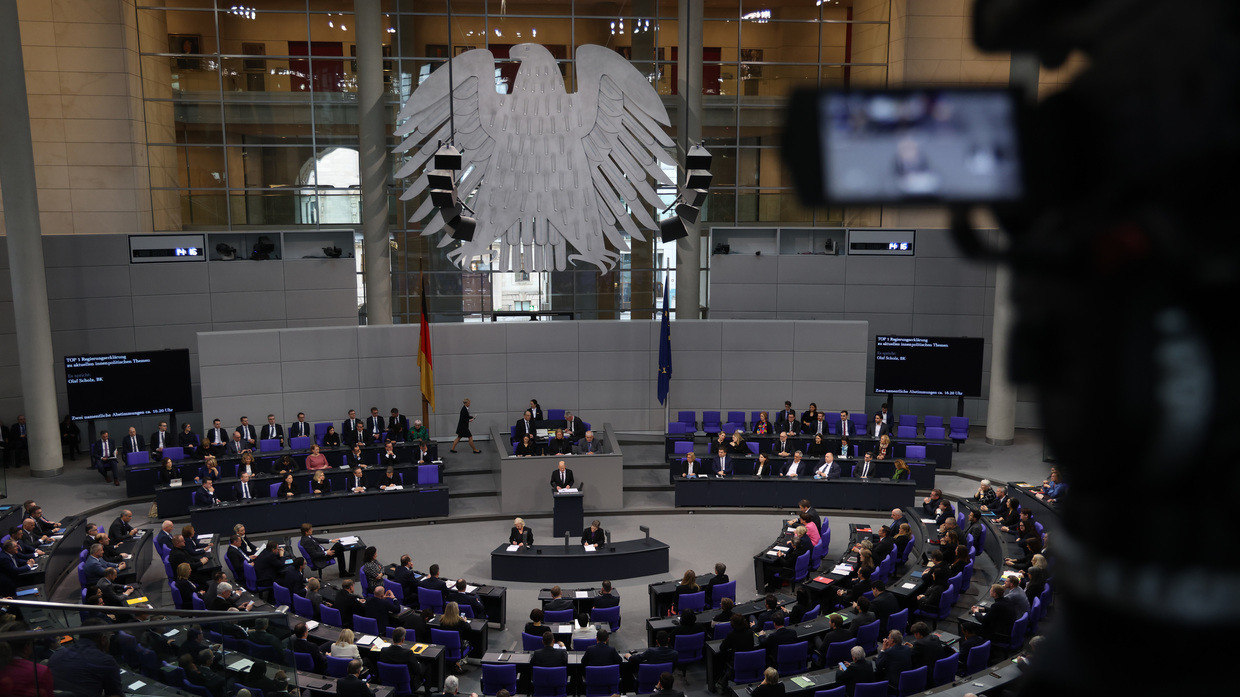
Germany's parliament narrowly rejects immigration law amid controversy over far-right support


Europe

The German parliament narrowly rejected on Friday a bill sponsored by conservatives and the far right calling for stricter rules on immigration. Opposition leader Friedrich Merz said the new law was a necessary response to a series of high-profile killings in public spaces by people of immigrant background. 

Christian Democratic Party (CDU) party leader Friedrich Merz attends a session of the lower house of parliament Bundestag in Berlin, Germany, January 30, 2025.
Christian Democratic Party (CDU) party leader Friedrich Merz attends a session of the lower house of parliament Bundestag in Berlin, Germany, January 30, 2025. © Nadja Wohlleben, Reuters

The German parliament narrowly rejected on Friday an opposition-sponsored bill calling for tougher rules on migration that risked becoming the first draft legislation to pass thanks to a far-right party and became a focus of a controversy about the attitude of the front-runner in Germany’s upcoming election toward the far right.

Opposition leader Friedrich Merz has put demands for a more restrictive approach to migration at the center of his campaign for the Feb. 23 election since a deadly knife attack last week by a rejected asylum-seeker.

The way he has done so prompted opponents to accuse him of breaking a taboo and endangering mainstream parties’ “firewall” against the far-right Alternative for Germany. He insists his position is unchanged and that he didn’t and won’t work with the party.

On Wednesday, Merz put a nonbinding motion to parliament calling for Germany to turn back many more migrants at its borders, insisting decisions are needed now regardless of who supports them. The measure squeaked through thanks to support from the far-right party, a first that draw(sic) a rare public rebuke from ex-Chancellor Angela Merkel, a former leader of Merz’s party.

It was Angela Merkel who started the problem with Muslim migrants in the first place, and now she complains when someone tries to fix her problem. It was also Angela who recommended Ursula von der Leyen to lead the EU as it works relentlessly to prevent any real solution to the Islam problem.


On Friday, months-old legislation proposed by Merz’s center-right Union bloc that called for an end to family reunions for migrants with a protection status that falls short of full asylum went to a vote. It also would have given federal police increased powers to carry out deportations. The center-left governing parties said they would reject the so-called “influx limitation bill,” while a combination of opposition parties including Alternative for Germany, or AfD, said they would back it.

After an unusually heated debate delayed by long and unsuccessful negotiations on a compromise between mainstream parties, it was rejected by 350 votes to 338, with five abstentions. Some lawmakers cheered and clapped as the result was announced. 

This week's maneuvering has amplified a divide between Merz’s bloc, Chancellor Olaf Scholz’s center-left Social Democrats and their remaining coalition partners, the environmentalist Greens — parties he may need to form a governing coalition after the election. 

Polls show the Union leading with around 30% support, while AfD is second with about 20%, and the Social Democrats and Greens are further back.

Merz appears to hope that he will gain support by making the Union look decisive in forcing a tougher approach to migration, while blunting the appeal of the anti-immigration AfD and making the governing parties — which say they already have done much to tackle the issue — look out of touch with Germans’ concerns. It’s uncertain whether that will succeed.

“You don’t have to tear down a firewall with a wrecking ball to set your own house on fire. It’s enough to keep drilling holes,” Foreign Minister Annalena Baerbock, a Green, said in Friday’s debate. “First a motion on Wednesday, then a bill today — what’s coming next?” 

You would think Germany has seen enough artificial walls for one lifetime. Annalena and Angela are protecting a Germany that is nothing like the post-WWII country that was so attractive as to draw millions of Muslims to it in the past ten years. The direction they are headed will mean Germany will never recover.

TALKING EUROPE
TALKING EUROPE © FRANCE 24

Merz said: “You can’t seriously believe that we are reaching out our hand to a party that wants to destroy us?” He said he will “do everything in the coming weeks, months and if necessary years so that this party doesn’t continue to grow and becomes a peripheral phenomenon again as soon as possible.”

“People out there ... don’t want us to argue with each other about AfD,” he said. “They want us to reach solutions to the questions with which people concern themselves in their everyday lives, and above all we want to reach solutions so that people in our country can feel safe again.”

The 12-year-old AfD first entered the national parliament in 2017, benefiting from Merkel’s decision two years earlier to allow large numbers of migrants into the country. Scholz has suggested that Merz can no longer be trusted not to form a government with AfD, an accusation that Merz has angrily rejected.

Merz insisted that he has sought majorities in the political center. The center-left parties pointed the finger back at him, noting that he said there could be no compromises on his proposals.

AfD chief whip Bernd Baumann taunted Merz’s party, saying that “once again these are our demands; the Union only copied them and so we are voting for them again.” He said the conservatives are “thoroughly untrustworthy” and won’t implement their promises.

Thousands of protesters gathered on Thursday outside the headquarters in Berlin of Merz’s Christian Democratic Union. Other demonstrations were held elsewhere in Germany.

The election is being held earlier than originally scheduled after Scholz’s three-party governing coalition collapsed in November in a dispute over how to revitalize the German economy. That left Scholz running a government that lacks a parliamentary majority.

(AP) 

=============================================================================================


European gas prices spike

Prices surged following Ukraine’s recent refusal to extend a five-year gas transit agreement with Moscow
European gas prices spike


European gas prices have surged to their highest level since October 2023, driven by supply disruptions following Ukraine’s recent refusal to extend a gas transit agreement with Moscow. Colder weather forecasts have been exacerbating concerns in an already tight energy market.

Kiev decided at the end of 2024 to terminate its five-year gas transit contract with Russian energy giant Gazprom, cutting off Russian pipeline gas supplies to Hungary, Romania, Poland, Slovakia, Austria, Italy, and Moldova. Vladimir Zelensky has claimed the contract’s termination was aimed at eliminating Moscow’s energy revenues. However, Slovakia and Hungary have accused him of deliberately triggering an energy crisis for political gain.

The benchmark front-month contract at the Dutch TTF gas hub climbed more than 4% on Friday, surpassing $590 per thousand cubic meters, or €53.62 per megawatt-hour, extending the previous days’ rally.

Data shows that EU gas storage levels have dwindled to approximately 55%, significantly lower than the 72% recorded at the same time last year and below the five-year average of 62%.

Analysts anticipate a further increase in heating demand amid forecasts that temperatures will drop further in the coming days.

The EU has faced a dramatic reduction in Russian gas imports, which previously accounted for 40% of the bloc’s total supply, due to Ukraine-related sanctions and the 2022 sabotage of the Nord Stream pipelines.

To compensate, the bloc has increased its reliance on imports of more expensive Liquefied Natural Gas (LNG) imports from the US and Norway, driving up overall energy costs. Recent outages at Norway’s Gullfaks, Troll, and Asgard fields have further constrained energy supplies to continental Europe.

Despite ongoing efforts to reduce dependence on Russian energy, EU member states have been importing record volumes of Russian LNG. In the first half of 2024, Russia emerged as the EU’s second-largest LNG supplier, trailing only the US, according to data from the Institute of Energy Economics and Financial Analysis.

US President Donald Trump previously urged Brussels to purchase more American LNG, threatening tariffs if they did not comply.

Astonishing! After NATO (Read America) pushed Russia into the war with Ukraine, then blew up Nord Stream II, forcing Europeans to buy expensive American LNG, now Trump is demanding that they buy more. 

Conspiracy theorists like me suspect that the Ukraine proxy war happened for two reasons - to keep America's War Industry inventories moving, and to undermine Russia's gas and oil industry - all for America's financial benefit.

The EU is set to become increasingly reliant on LNG amid growing geopolitical tensions, as current levels are “insufficient” for the European market “to balance and rebuild inventories for the next winter,” analysts at DNB Markets have warned, according to The MarketWatch.

EU officials are now discussing the possibility of resuming Russian gas imports as part of a potential agreement resolving the Ukraine conflict, the Financial Times reported this week. However, it remains wary that such a move could undermine ongoing efforts to diversify energy sources and reduce dependence on Russian supplies. Moscow has also expressed skepticism regarding the feasibility of the reported plan.

==============================================================================================