"I am the Way, the Truth, and the Life"

Father God, thank you for the love of the truth you have given me. Please bless me with the wisdom, knowledge and discernment needed to always present the truth in an attitude of grace and love. Use this blog and Northwoods Ministries for your glory. Help us all to read and to study Your Word without preconceived notions, but rather, let scripture interpret scripture in the presence of the Holy Spirit. All praise to our Lord and Saviour Jesus Christ.

Please note: All my writings and comments appear in bold italics in this colour
Showing posts with label resurrection. Show all posts

Saturday, August 1, 2026

Godless Liberals ensure Canadian military will be godless too


Canadian Military Expands Prayer Ban in Official Settings With New Directive Applying to All Personnel

|Updated:

The Canadian Armed Forces has issued new rules that expand restrictions on faith-specific language and practices during official military ceremonies and public events, including references to God.

The new directive, released on July 29, applies to all Canadian Armed Forces (CAF) members, Department of National Defence (DND) employees, contractors, and volunteers engaged in offering “spiritual or religious services” for the CAF, expanding application of previous instructions that only specified chaplains. The new directive also offers further specific details on what the prohibition entails.

Under the latest directive, chaplains and any others taking part in official military ceremonies or commemorative events where prayers or religious observances would traditionally be offered must instead deliver a “spiritual reflection.” It defines “spiritual reflection” as reflecting on “lessons learned, beliefs, values, and experiences to inspire gratitude, remembrance, hope, and integrity.”

The directive applies to all events connected to official government business that CAF members are mandated to attend.  This includes graduation parades, change-of-command ceremonies, honours and awards ceremonies, and other official military commemorations such as Remembrance Day ceremonies.

The latest directive supersedes an earlier policy from 2023 that only specified chaplains as having to adhere to “a sensitive and inclusive approach” during official ceremonies, reasoning that those attending who don’t share the religious beliefs of the chaplain could then take part “with a clear conscience, no matter their beliefs.”
The 2023 policy had in turn replaced a 2013 directive on public prayer, with the 2023 directive referring to a public address by chaplains as “reflection” rather than as prayer as the 2013 one had done, and banning words such as “God” and “Heavenly Father” during official ceremonies.

Exceptions

The new directive sets out exceptions where religious and spiritual language is permitted, including allowance for “indigenous practices” that include spiritual beliefs, which are still permitted in military settings “for cultural, historical, and educational purposes.”

It specifies that these practices, including “spiritual elements,” must be “framed explicitly within an educational and cultural context” and that CAF members and those attending can’t be forced to take part in the spiritual part of any indigenous practices.

A padre says a prayer near a coffin bearing the remains of a Canadian soldier during a ceremony at the Canadian War Cemetery in Bergen op Zoom, Netherlands, on May 6, 2015. AP Photo/Phil Nijhuis

The directive also notes that the restrictions do not apply to military or state funerals where the wishes of the deceased and their family may be observed.

The instruction allows chaplains to offer faith-specific prayers and rituals during private interactions with CAF members, voluntary faith-specific religious gatherings, and in members’ specific, in-person spiritual role.

It notes that regimental prayers and traditions around patron saints can still be taught for the sake of military history but CAF members can’t be compelled to take part.

The directive also states that religious dress such as hijabs, Sikh turbans, Jewish yarmulkes, and other approved religious headwear or personal items are still permitted, but no specific faith tradition may be referenced during public comments.

A religious accommodation policy issued on July 15, 2016, required the CAF to accommodate members’ sincerely held religious or spiritual beliefs—including practices related to dress, diet, observances, fasting, and prayer—unless doing so would violate the law or the CAF’s minimum operational requirements.

‘Severe and Obvious Restriction’

The CAF says the policy is intended to uphold religious neutrality in public duties while respecting Charter protections for both religious belief and the freedom not to hold religious beliefs. It cites a 2010 Supreme Court of Canada ruling that required religious neutrality by the state.
“The CAF must uphold and respect the Charter rights of our members and members of the public by maintaining religious and spiritual neutrality in the exercise of our public duties,” the text of the new directive says.

An active chaplain in the CAF, who asked to remain anonymous to avoid reprisal, told the Epoch Times he disagrees strongly with the new rules.

“After the drama of the spiritual reflection first published nearly three years ago, they kept pushing it every year. Now three years later, this is their new attack,” he said. “If they can’t convince us, they will exhaust us into compliance.”

The chaplain added that the fact that this applies to all CAF members is especially concerning to him.

“After being told by multiple MPs we will never be kept from praying, well now all CAF members are required to adopt secularism as the official religion of the CAF publicly,” he said, adding that “this is using the cover of religious freedom to obliterate religious freedom.”

Another chaplain, who also asked to remain anonymous, said the new directive amounts to an “inversion” of rights.

“They invoke the Charter—which is supposed to protect religious freedom— in order to cancel religious freedom,” he told The Epoch Times. "And then they have the audacity to claim that this policy enhances the chaplain’s ability to serve the needs of our CAF members, when it is a severe and obvious restriction.

Then-Chaplain General Guy Chapdelaine places his hand on the rock centrepiece of the Kandahar cenotaph, located inside the Afghanistan Memorial Hall, during the cenotaph's rededication ceremony at National Defence Headquarters in Ottawa on Aug. 17, 2019. The Canadian Press/Justin Tang

The Epoch Times contacted the DND and the office of the Minister of Defence David McGuinty for comment but didn’t hear back by publication time. A DND spokesperson previously told The Epoch Times that the changes are meant to “ensure that all feel included and able to participate in reflection no matter their beliefs.”

Conservative MP and shadow minister for national defence James Bezan said the new rules violate CAF members’ freedom of religious expression.

“Conservatives are deeply concerned about this Liberal government’s continued interference in the traditions, values, and personal freedoms that have defined the Canadian Armed Forces,” Bezan told The Epoch Times in a statement.

Bezan added that all CAF members should be permitted to take part in military events in the way that reflects their faith and traditions, and said the new directive prohibits military faith leaders from expressing their religious beliefs.

“Instead of being inclusive, this Liberal government has excluded military members of faith and sent a message that they are no longer welcome in the Canadian Armed Forces,” he said.  “This Liberal government must reverse this unnecessary and regressive policy and restore the freedom of religious expression to our women and men in uniform.”

The July 29 instruction doesn’t specify penalties for violations. Under broader CAF administrative and disciplinary frameworks, failure to follow lawful military instructions can result in administrative or disciplinary consequences.

===============================================================================================


Monday, April 21, 2025

Why Two Easters when there is only One Christ? Both calendars are wrong! Here's the fix!


Two Easters, one Christ: The complex calendar politics of faith

Why Orthodox Christians and Catholics celebrate Easter on different days
Two Easters, one Christ: The complex calendar politics of faith


It is Lent in the Christian world, but in reality, it only alters the lives of monks and Moscow restaurateurs, who rush to invent Lenten menus to profit from the public’s fear of living in sin. However, Lent inevitably leads to the most important Christian holiday: Easter.

This year, Orthodox Easter coincides with that of other denominations – a rare event, last seen in 2017. But why do they usually fall on different dates? The answer lies in history, astronomy, and religious identity.

The calculation of Easter’s date is famously complicated. For Orthodox Christians, Easter is determined by the Julian calendar. It must fall on the first Sunday after the full moon following the spring equinox – but only if it also occurs after Jewish Passover (Pesach). This rule is based on the Bible’s account of Christ’s crucifixion during the Passover season. Christianity, like Islam, is an Abrahamic religion deeply rooted in Judaism, even if it has often distanced itself from those origins.

Christianity departed from Judaism when Christ came to earth as Jesus. Islam departed from Judaism when it was invented by Mohammed and followed Ishmail who was cast out by Abraham with the approval of God. 

Muslims believe Allah is the God of Abraham and Ishmail, while Christians believe He is the God of Abraham, Isaac, and Jacob (Israel).

Catholic Easter follows similar logic, but uses the Gregorian calendar. It too changes annually, but is calculated using rules introduced in the 16th century by Pope Gregory XIII. The result is that Orthodox and Catholic Easter only align once every few years.

There are four main reasons why the Russian Orthodox Church has held on to the Julian calendar:

First, it is a statement of independence. The Orthodox Church sees itself as distinct from Rome. While it may not always be stated directly, in Orthodox theological thought, Catholicism is often viewed as schismatic. Maintaining a separate calendar reinforces that divide.

Second, tradition has weight. Every day in the Orthodox calendar commemorates saints, texts, hymns, and rituals. With thousands of parishes following this system, shifting to a new calendar would cause logistical chaos.

Third, Church leaders fear that calendar reform could provoke unrest. A failed attempt to modernize the Church in the early 20th century, when the “Renovationists” tried to introduce reforms, remains a cautionary tale. The memory of that upheaval still lingers.

Fourth, the Julian calendar is seen as part of ancient Church tradition – an expression of historical continuity and spiritual identity. To abandon it would be, for many, to break from something sacred.

Still, practical contradictions remain. Consider this: the modern world celebrates January 1 as New Year’s Day, but Russian Orthodox believers celebrate Christmas twelve days later than other denominations, on January 7. It means we ring in the “new year” before the birth of Christ—an odd inversion of the Christian calendar.

Some have suggested aligning Christmas with the Gregorian calendar, as the Greek Orthodox Church has done. In that model, fixed holidays match the modern calendar, but Easter continues to be calculated using Julian rules. Complicated? Absolutely. But theology is a complicated discipline. Liturgical studies, canon law, and Church history are all well-established academic fields. Surely, a Church department could study how to transition to the Gregorian calendar without losing liturgical continuity.

About a decade ago, there was a proposal to move Christmas to January 1. The logic was simple: New Year’s Day marks the start of a new era, and the festivities already exist. Why not combine the joy of the secular calendar with the birth of Christ? Those who wished could even treat the end of December as a fast before Christmas, making the celebration more meaningful.

Now, here is where we could actually make some progress. Christmas should not be January 1st, Easter should be January 1st. 
Why? Because the resurrection of Jesus is the most important day in the history of the world. The very center of all time and Eternity. More important than the birth of Jesus as glorious as that was.

Resurrection Sunday should not only be the first day of the year, it should be the first day of the calendar, Day 1, Year zero. 
If this correction was made to the calendar, year 2000 would actually occur about 2030. 

I realize this would be enormously complicated, but it is certainly still possible. 
If Jesus returns somewhere around 2030, will we start a new calendar?

Ultimately, the Church must remain a firm pillar of spiritual life. It cannot follow every passing whim. But pillars, too, are built by human hands. And perhaps, sometimes, they can be adjusted – not out of weakness, but for the sake of clarity and relevance.

In an era when Easter rarely brings all Christians together on the same day, it may be worth asking whether the spiritual world is being served by the division over dates. Or whether it’s time to think again about what unites us.

Did Pope Gregory XIII Get the Calendar Wrong?

=============================================================================================

Tuesday, November 1, 2016

‘My Knees are Shaking’: Jesus Christ’s 'Tomb' Seen for First Time

The team had 60 hours to examine the tomb before it was resealed. © Ammar Awad
The team had 60 hours to examine the tomb before it was resealed. © Ammar Awad / Reuters

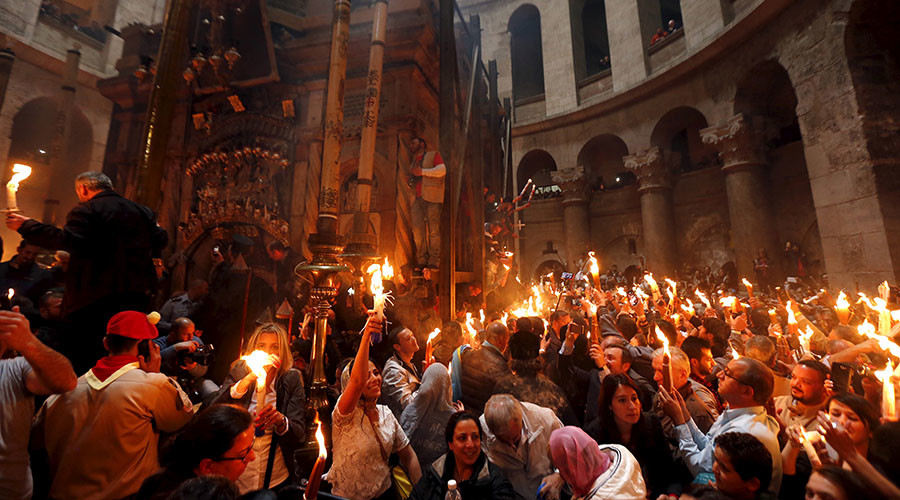
Further details of the supposed burial tomb of Jesus Christ have been revealed by researchers in Jerusalem. The limestone slab where Christ is said to have been placed has been exposed along with part of the original wall.

The research team working at the Church of the Holy Sepulchre detected the original limestone shelf, known as a “burial bed”, last week but have now been able to reveal the fully intact “Holy Rock” in full, according to National Geographic.

"I'm absolutely amazed. My knees are shaking a little bit because I wasn't expecting this," Fredrik Hiebert, one of the archaeologists involved in the project said.

“We can't say 100 percent, but it appears to be visible proof that the location of the tomb has not shifted through time, something that scientists and historians have wondered for decades.”

Part of the original cave wall has also been revealed with the team cutting a window into the side of the tomb to view it. "This is the Holy Rock that has been revered for centuries, but only now can actually be seen," said professor Antonia Moropoulou, who is directing the project.

When marble cladding was first removed from the tomb it revealed a layer of fill material. After hours of removing this, another marble slab with a cross etched into it was uncovered. This slab was taken away for a short time by the team, exposing the original burial slab where Jesus is believed to have lain before his resurrection.

The church was first believed to be the location of Jesus’s burial in 325 A.D. when representatives of the Roman emperor Constantine arrived in Jerusalem.

"We may not be absolutely certain that the site of the Holy Sepulchre Church is the site of Jesus' burial, but we certainly have no other site that can lay a claim nearly as weighty, and we really have no reason to reject the authenticity of the site.” archaeologist Dan Bahat told National Geographic.

    video 2:31

A team from the National Technical University of Athens (NTU) had 60 hours to study the tomb before it was resealed. The project is part of a restoration effort to repair water damage underneath the tomb.

This is the first time that anyone alive today has been able to view the tomb, which has never been photographed or drawn. Located inside a small structure within the church known as an Edicule (‘little house’), the tomb has been covered in marble since at least 1555 A.D. to prevent pilgrims from removing rock from the original bed.

According to scripture, Christ was laid on the shelf in the tomb after dying at the crucifixion around 33 A.D. After three days his remains were discovered to be missing and Jesus was said to have appeared over a period of 40 days before ascending into heaven.

Wednesday, March 30, 2016

Allah Cannot Compete With the Power of Jesus Christ

Faith is confidence or trust in a person or thing. For Christians, it is trust that Jesus is Who He said He is and will do what He said He will do. For instance, "If my people who are called by my name will humble themselves and pray, then I will hear from Heaven, and forgive their sins, and heal their land." 2 Chronicles 7:14.

Elijah taunts the prophets of Baal

Christian faith is based on Jesus Christ being the son of God, His death and resurrection, and His word, as written in the Bible.

Jesus and the Apostles spread the Gospel through preaching, but also through displaying the power of the Name of Jesus and the Holy Spirit. "my message and my preaching were not in persuasive words of wisdom, but in demonstration of the Spirit and of power". 1 Corinthians 2:4

Christians can point to thousands of examples of Christ forgiving the sins of reprobates, healing them, saving them, renewing them to become righteous and holy such that they can glorify Christ by the manifestation of His character.

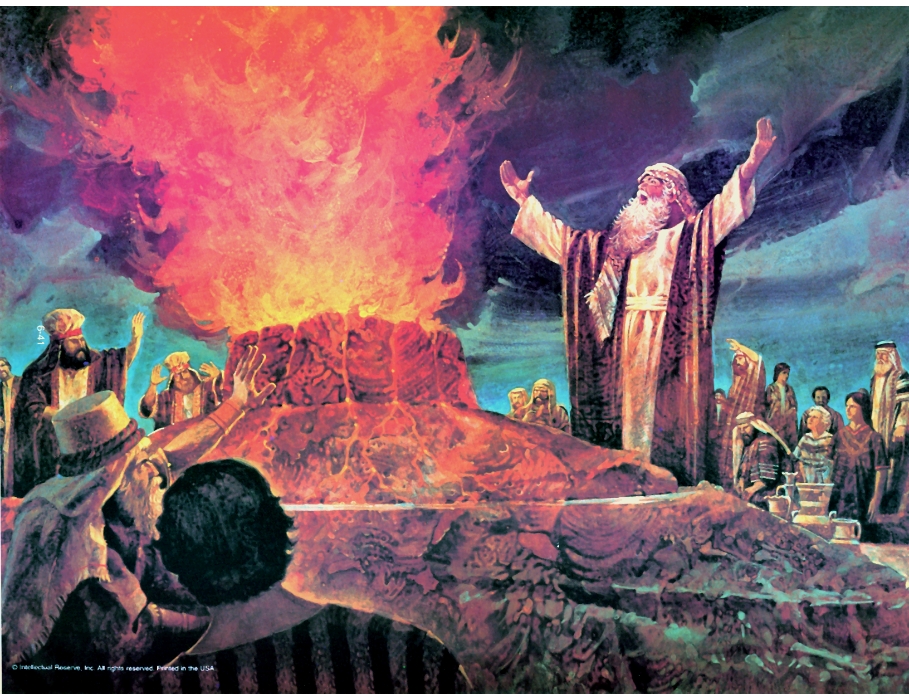
Elijah calls down fire from Heaven

Muslims also have faith. Their faith is in Allah as revealed by Mohammed in the Quran and Hadith. Their faith is taught by memorization of scripture which they are required to believe without questioning even if they don't understand any of it.

They are required to believe what Mohammed said about Allah even though they never see any real example of that manifest. There are no examples of the power of Allah except when it comes to massacres and slaughter of innocents. 

This is not faith, it is fantasy; blind trust! It is like Elijah and the prophets of Baal who were unable to convince Baal to light the fire under their sacrifice. Elijah covered his sacrifice with water and called down fire from Heaven which completely consumed the soaking wet sacrifice.

The God of Abraham, Isaac, and Jacob is real! The god of Mohammed is not!

Watch the video below to see an example of the difference between Islam and Christianity.


Contact me if you have any questions - Google+; email - garymsmail@gmail.com; or Twitter - @GaryWmMyers