Of course, the following statistics assume that Jesus Christ will not return before 2070. He could well return in the decade of the 2030s, and that would change everything. Meanwhile these statistics are troublesome, to say the least, and convicting for us Christians.
The Future of World Religions: Population Growth Projections, 2020-2070
Why Muslims will soon become the world’s largest religious group and Christians will be the second largest
For centuries, Christianity has been the world’s largest religion. That may soon change.
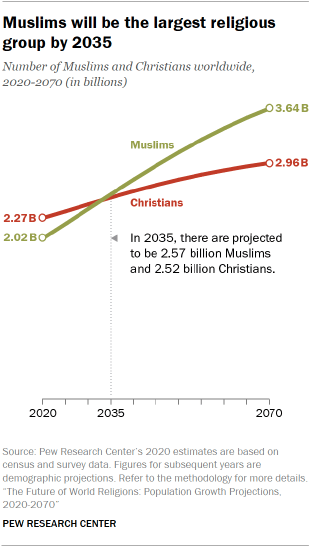
Muslims are expected to outnumber Christians by 2035, according to new projections from Pew Research Center. Both religious groups are growing in size, but Muslims are growing faster. By 2070, if recent trends continue, there will be more than 3.6 billion Muslims and just under 3 billion Christians worldwide.
The world’s total population is projected to increase by 29% between 2020 and 2070. Muslims and Christians are the only religious groups analyzed here that are expected to keep pace, with Christians growing by 30% and Muslims by 80%.
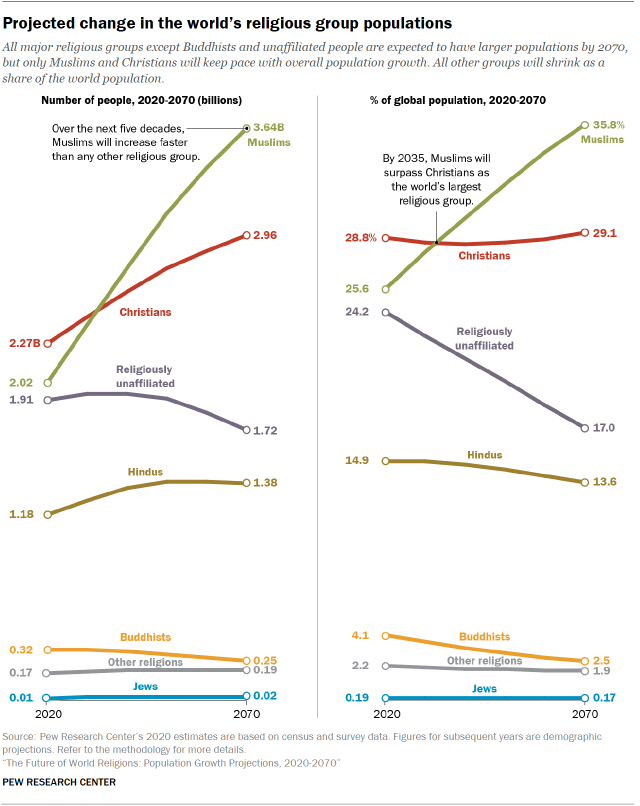
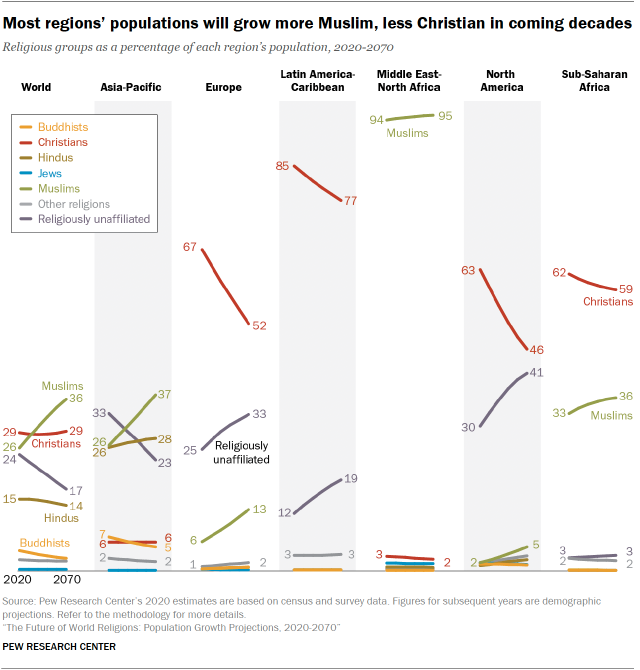
As a result, the size of many religious groups will change relative to the world’s overall population. Muslims will make up a larger percentage of the global population in 2070 (36%) than they did in 2020 (26%). Christians, meanwhile, will hold fairly steady at 29%.
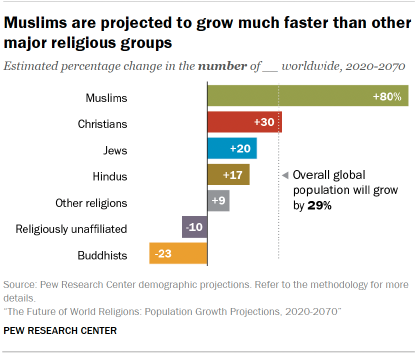
Although Hindus are growing in absolute number, they are projected to decline as a percentage of the global population. Jews are expected to follow a similar pattern.1
Meanwhile, Buddhists are expected to shrink both in number and as a portion of the world’s population in the coming decades.
All other religions combined (including Baha’is, Daoists, Jains, Sikhs, adherents of folk religions and many other groups) are expected to experience a modest increase in number. However, they will slip below 2% of the global population by 2070.2
And people who have no religious affiliation – sometimes called religious “nones” – are projected to drop substantially as a share of the world population, from 24% in 2020 to 17% in 2070.3
Interested in projections for a specific religious group? Jump to sections of this study on: Christians | Muslims | Unaffiliated people | Hindus | Buddhists | Jews | Other religions
What’s behind these changes?
The future size of religious groups is heavily influenced by demographic trends in the countries and regions in which each group is concentrated.
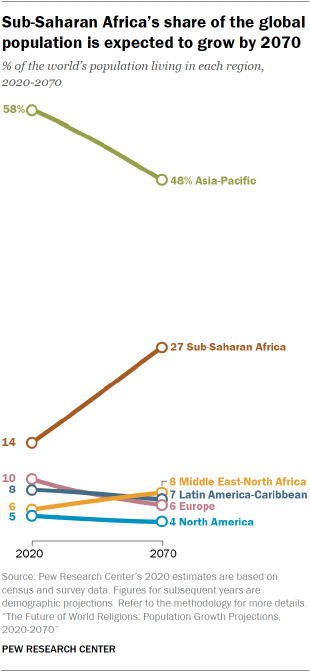
In the 21st century, most of the world’s population growth is expected to occur in Africa, particularly in countries south of the Sahara Desert. By 2070, more than a quarter of all people worldwide will live in sub-Saharan Africa. Since the vast majority of people who currently live there are either Christians or Muslims, the region’s high fertility and rising life expectancy will boost the global numbers of both faiths.
By comparison, the populations of other major geographic regions are expected to grow more modestly, or even to shrink. For example, between 2020 and 2070, the number of people living in Europe will decline, and their share of the world’s population is projected to drop from 10% to 6%.
Fertility differences have big effects on populations. Globally, Muslims tend to have more children than other major religious groups. During the 2020-2025 period, the total fertility rate for Muslims was 3.1 children per woman.4 By comparison, the rate for non-Muslims was 2.0 children per woman.
The current age profile of the people in each religious group also plays a role in the projections. In younger populations, a larger share of people have yet to complete their childbearing years. On average, Muslims around the world are younger than any other religious group in this study. As of 2020, the median age of Muslims (24) was nearly a decade lower than the median age of non-Muslims (33).
If recent trends continue, by 2070:
- More than half of the world’s Christians will live in sub-Saharan Africa.
- An African country, the Democratic Republic of the Congo, will surpass the United States as the country with the greatest number of Christians.
- The United States will no longer have a Christian majority, though Christians will remain the biggest religious group in the country.
- Pakistan will have the largest Muslim population, followed by India, Nigeria and Indonesia (which currently has the most Muslims).
- Hindus will increase the most in absolute number in India, but they will grow faster in countries outside India, including the U.S.
- The overall populations of China, Japan and South Korea will shrink, and their Buddhist populations will drop by more than half.
- Most countries will have more religiously unaffiliated people than they do now. But the increase will be entirely offset by population decline in China, where most religious “nones” currently live.
- 62% of all Jews will live in Israel, up from 46% in 2020.
These findings are part of a broader Pew Research Center project examining how the size of seven religious groups will change globally between 2020 and 2070 if recent demographic trends continue. Our projections take into account the differences between religious groups’ age profiles, fertility rates, and patterns of religious switching and migration. (Religious switching and migration are assumed to continue at the same levels that have been recently observed.) We also incorporate mortality rates, applying the same rate to each religious group within a country. Read the methodology for more details about these projections and their limitations.
The rest of this analysis explores:
- How each region’s religious populations will change
- How religious populations will change within countries
- How the religious majorities in countries will change
- Key factors behind change in the size of religious groups
- Evaluating earlier projections about the future of religion
How each region’s religious populations will change
In the coming decades, religious groups will grow and contract at different speeds, reshaping the religious makeup of the world’s six major regions. Muslims are projected to grow as a percentage of the population in all six regions, while Christians will decline in all but one (the Asia-Pacific region). Still, Christians will continue to make up about half or more of the population in most regions.
If recent trends continue:
- Religiously unaffiliated people will rise from a quarter of all Europeans in 2020 to about a third in 2070. Over the same period, the share of the region’s population that is Muslim is expected to roughly double, from 6% to 13%.
- Muslims will surpass religiously unaffiliated people as the largest group in Asia and the Pacific, and Hindus will become the second-largest group.
- Christians will continue to make up a larger percentage of the population in Latin America and the Caribbean than in any other region, despite dropping from 85% in 2020 to 77% in 2070.
- Muslims will grow in number faster than Christians in sub-Saharan Africa and will make up a larger percentage of the regional population in 2070 (36%) than they did in 2020 (33%).
- The religious mix in the Middle East and North Africa will change little. Muslims are expected to make up 95% of the population in 2070, close to their share in 2020 (94%).
- North America will no longer have a Christian majority, as the portion of the population that is Christian is projected to fall from 63% to 46%.
Please continue reading on Pew Research at:
Religious change in the United States
‘Moscow is the Third Rome, a fourth there shall not be’ – Putin
Published 20 Nov, 2026 21:43 | Updated 21 Nov, 2026 05:28

Russian President Vladimir Putin described Russia as a potential spiritual refuge for people around the world seeking to preserve their religious traditions and family values, arguing that Western Christian churches are losing influence by abandoning their traditional principles.
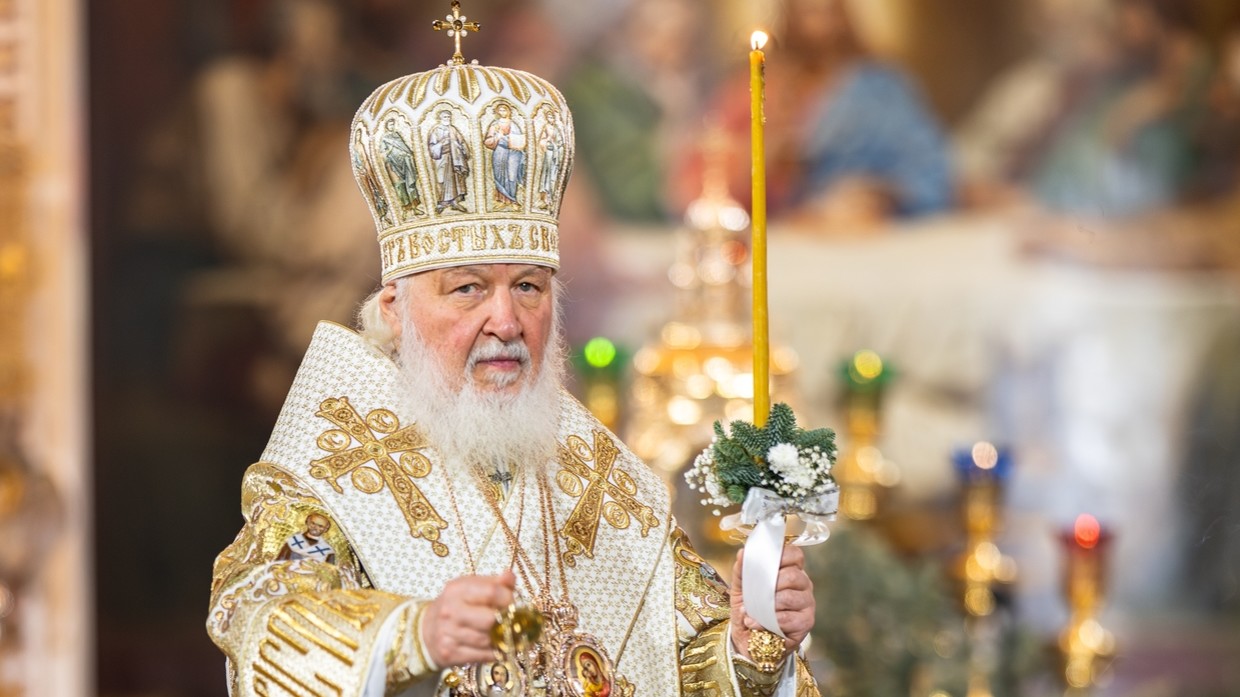
In an interview with Serbian filmmaker Emir Kusturica published on Friday to coincide with the 80th birthday of Patriarch Kirill, the head of the Russian Orthodox Church, Putin invoked the centuries-old concept of Moscow as ‘the Third Rome’.
“Moscow is the Third Rome, a fourth there shall not be,” Putin said, invoking the centuries-old concept of Russia as the spiritual successor to ancient Rome and Constantinople, the capital of the Byzantine Empire. “In a way, it became the Third Rome, the spiritual keeper of those holy values, that heritage.”

Putin stressed that recognizing Russia as a great civilization does not diminish other ancient cultures, pointing to China and India as examples. He noted that Chinese civilization absorbed foreign conquerors over the centuries, while India preserved its extraordinary linguistic and cultural diversity.
What distinguishes Russian civilization, Putin argued, is its ability to accommodate different peoples without erasing their identities.
“Russian civilization never took over others,” he said, arguing that it allowed different ethnic groups to preserve their religions, traditions, and languages. “This is, we may say, a unique feature of Russian civilization.”
However, Putin stressed that Russia’s potential role as a spiritual sanctuary is not merely a matter of historical or theological tradition, but reflects present-day realities.
The president noted that some people from Western countries, including Europe, have already relocated to Russia to protect their families and raise their children according to traditional religious principles.

“When you ask whether Russia can become the ‘ark’ to save people, I would say that it would not only be for Orthodox Christians, and actually not just for Christians,” Putin said.
He pointed to the peaceful coexistence of Russia’s four traditional religions – Orthodox Christianity, Islam, Judaism, and Buddhism – arguing that they share fundamental moral values despite their theological differences.
Putin also criticized what he described as the growing aggressiveness of certain minority rights movements in Western societies, while stressing that Russia does not seek to restrict anyone’s rights.
“We are not trying to limit anyone in anything,” he said, adding that Russian state policy and the Orthodox Church share the goal of preserving human spirituality and the continuity of humanity.
Asked about the declining influence of Western Christian churches, Putin argued that their attempts to modernize their teachings have backfired.
“I am afraid that the backslide by these churches, their certain departure from the canons, is not strengthening their position in society but works the other way round,” he said.
By contrast, he argued, Orthodox Christianity continues to attract new followers because it remains committed to preserving traditional values.

According to Grok:
Russia maintains stronger public and policy-level adherence to certain traditional Christian (especially Orthodox) norms around sex, marriage, family, and gender that have shifted or been rejected in much of Western Europe, North America, and other Western institutions—while actual religious practice and some social outcomes remain weaker than the rhetoric suggests.
The Russian Orthodox Church and state under Putin promote “traditional spiritual-moral values,” framing Russia as a defender against what they describe as Western secularism, rejection of Christian roots, and redefinitions of family and sexuality. This is cultural and political more than a high level of personal piety.
Key areas of stronger traditional Christian norms in Russia
- Marriage defined as one man and one woman, and rejection of same-sex unions: Russia’s constitution and law ban same-sex marriage. Public opinion strongly opposes it (polls from Pew, Levada, and others have shown support in the single digits to low teens in many surveys; higher in some later ones but still a minority). Acceptance of homosexuality as a social norm is low—Pew data has shown large majorities saying it should not be accepted by society (often 70%+ range in Orthodox-majority contexts), with Levada polls indicating negative attitudes (disgust, irritation, or opposition to equal rights) held by a majority and rising in recent years. Laws restrict “LGBT propaganda,” especially to minors, and have expanded; gender-affirming interventions for minors face restrictions or bans in practice. In much of the West, same-sex marriage is legal, public acceptance is majority-level in the US and higher in Western Europe, and gender ideology appears more in education, media, and institutions.
- Emphasis on traditional family, procreation, and resistance to progressive redefinitions: State policy and Church teaching stress the heterosexual family, large families, and demographic recovery. There are bans or restrictions on promoting a “childfree” lifestyle, incentives or messaging around having children, and Church lobbying against abortion. This contrasts with Western trends of delayed marriage, lower fertility, higher acceptance of non-traditional family forms, and institutional embrace of gender fluidity in some places. Orthodoxy is tightly linked to Russian national identity for many.
- Public visibility of Christianity: A majority of Russians identify as Orthodox (figures often in the 60–70% range in recent surveys, up sharply from the early post-Soviet period). Orthodox holidays, symbols, and Church presence in public life have a recognized role, with state support for restoration and influence on moral issues. Western Europe is far more secular in public institutions; the US retains higher personal religiosity but faces ongoing secularization in culture and elites.
These positions align with longstanding Christian teaching (across Orthodox, Catholic, and historic Protestant traditions) on marriage as male-female, the moral status of homosexual acts, and the family as ordered toward children.
Important caveats and data
Russia is not a highly observant Christian society by Western measures of practice:
- Church attendance is low. Surveys (Pew, Levada, and others) consistently put regular attendance (monthly or more) in the single digits to low teens—often cited around 6–12%—lower than in the United States (where frequent attendance has been higher, though also declining).
- Divorce rates are among the world’s highest. Crude rates and especially the ratio of divorces to marriages in a given year frequently put Russia near the top (figures around 60–70%+ of new marriages ending in divorce in recent data have been reported).
- Abortion has long been high by historical standards due to the Soviet legacy. Rates have fallen sharply (registered numbers dropped roughly fourfold over 15 years to around 236,000 recently, with ~20 per 100 births in some figures), partly from contraception and partly from policy pressure, bringing it closer to or below some Western levels. It remains legal on request up to 12 weeks, though the Church has successfully lobbied for tighter access in places and more counseling.
- Religion is often more ethnic/cultural identity than deep personal practice for many. Other Christian groups (non-ROC) face restrictions. Social issues like alcoholism and domestic violence remain significant.
Comparisons to the West depend on the country: the US retains higher churchgoing and more internal debate over these issues than Western Europe. Trends in the West show secularization, legal and cultural acceptance of same-sex marriage and gender transition, and declining fertility linked to delayed or non-traditional family formation—changes many traditional Christians view as departure from historic teaching.
In short, the differences center on resistance to redefining sex, marriage, and family in public norms and law, plus a stronger cultural-Christian national identity. They do not reflect higher overall religiosity, lower family breakdown, or consistently lower abortion by every metric. Both sides involve selective emphasis: Russian messaging highlights cultural conservatism against Western “decadence,” while critics note the gap between rhetoric and personal practice or social outcomes.
=======================================================================================================

No comments:
Post a Comment