"For the time will come when they will not endure sound doctrine; but wanting to have their ears tickled, they will accumulate for themselves teachers in accordance to their own desires, and will turn away their ears from the truth and will turn aside to myths." Northwoods is a ministry dedicated to refreshing Christians and challenging them to search for the truth in Christianity, politics, sociology, and science
"I am the Way, the Truth, and the Life"
Father God, thank you for the love of the truth you have given me. Please bless me with the wisdom, knowledge and discernment needed to always present the truth in an attitude of grace and love. Use this blog and Northwoods Ministries for your glory. Help us all to read and to study Your Word without preconceived notions, but rather, let scripture interpret scripture in the presence of the Holy Spirit. All praise to our Lord and Saviour Jesus Christ.
Please note: All my writings and comments appear in bold italics in this colour
Convicted Dutch drug baron Marco Ebben was reportedly killed in a shootout in a parking garage in a suburb of Mexico City, NOS reported. This is not the first time Ebben has been reported shot dead in Mexico.
Ebben has been onEuropol’s list of wanted criminals for some time. He still had to serve a prison sentence in the Netherlands for his role in the drug trafficking case involving corrupt customs officer Gerrit G. In October 2020, the court sentenced Ebben to 7 years and 4 months in prison for drug trafficking from Brazil to the Netherlands.
In May last year, Ebben briefly spoke to the regional broadcaster Rijnmond to say that he had nothing to do with a series of explosions targeting a plumber in Vlaardingen. In June, Ebben was injured in a shooting in Turkey in which he was reportedly chased by men on motorcycles who opened fire on his car with an automatic weapon.
In October last year, several sources told Rijnmond that Ebben had been killed in a shooting in Mexico. His father, also a well-known drug criminal in Schiedam, told De Telegraaf that Ebben died in a gunfight with the rival of the son of drug lord El Chapo.
Ebben’s death in the recent shootout has not yet been officially confirmed, according to NOS, reputable media sources in Mexico reported that the Dutch drug baron was killed
Over a pound of fentanyl seized at U.S. border, and it came from Canada
Just days after Canada appointed a fentanyl czar to address cross-border trafficking, United States Customs and Border Protection (CBP) officers in Seattle intercepted a shipment containing more than a pound of fentanyl.
Seattle customs officials announced the seizure Wednesday in a media release stating the drug was seized during a targeted enforcement operation at a shipping facility. Officers discovered a brown rock-like substance in plastic bags and further testing determined the substance contained fentanyl.
One of the fentanyl packages originated in Canada, U.S. customs officials said.
5:18
Canada’s new fentanyl czar looks to satisfy Trump’s border demands
“Fentanyl is an extremely dangerous synthetic drug that plagues our communities,” said Rene Ortega, the CBP area port director for Seattle.
“CBP uses a variety of techniques to keep our nation safe. Targeted operations in shipping facilities help keep dangerous narcotics and synthetic drugs off our streets and out of our communities.”
The seizure follows Canada’s recent announcement of a dedicated fentanyl czar, a move aimed at addressing the growing crisis and cracking down on drug trafficking, particularly to the U.S. as U.S. President Donald Trump continues to pressure Canada to tighten its controls.
It’s shortly before 6:30 p.m., and his girlfriend wants to know when he is going to finally come home. Back to Eitorf, a small town near Bonn. Habib I. is at an Autobahn rest stop some 300 kilometers away. He just told his girlfriend a few hours before that there was something he still had to do. Now, she’s asking again. When? Before midnight, he responds, hopefully. And then Habib I. makes a promise that so many others have made before him, even if they don’t really believe it themselves. That this will be his last deal. Just this last one, and that will be "the end.” But his girlfriend knows him. Yeah sure, he’s saying that now. But in five months, it will start all over again, she says.
Five? Not even one month passed before the next cocaine delivery, and Habib I. was again involved, if one can believe the police file. A case file that mentions "narcotics in not small quantities,” which could be the understatement of the century for drug investigators. The intercepted phone calls and surveillance photos paint a picture of the largest known amount of cocaine ever smuggled into Germany. One gang, 10 deliveries, 35.5 tons of cocaine, street value: 2.6 billion euros. A mountain of blow of a size never before seen in Europe – though likely only the tip of the iceberg. Investigators are certain that they haven’t come close to intercepting all of it.
In May, the authorities made their move, making seven arrests, including the 30-year-old Habib I. Düsseldorf prosecutors consider the Bulgarian national to be an important player in this gang that elevated cocaine smuggling to a whole new dimension. Habib I. is thought to have been the leader of the team assigned to extract the narcotics out of the containers once it arrived in the Port of Hamburg from South America.
Apparently also on August 17, 2023 – the day on which he promised his girlfriend that he was going to finally get out of the game. That afternoon, a truck laden with a container drove out of the port and onto the autobahn toward Bremen, followed by a Mercedes that Habib I. is thought to have been driving. The container was full of tropical wood, exclusive material for yachts and villas – according to the papers. Which makes it all the odder that the convoy ended up at a farmhouse at the edge of the tiny village of Kuhstedt – a place so dilapidated that it looked as though the farmer had long ago given up his battle with the soil and with the banks.
Five men were waiting to carry the wooden planks into a barn. The sixth, though, was apparently waiting in the Rhineland for news about what else might be in the container: Ümit D., 39, thought to be the leader of the gang in Germany. A man who used to be a member of the outlawed motorcycle club Hells Angels.
By 9:08 p.m., the men in Kuhstedt had seen enough. No cocaine, not a single gram. They closed up the container. Exactly 10 minutes later, a surveillance team of criminal investigators were watching as Ümit D. parked in front of a McDonald’s in Rhineland. How he jumped out of his BMW and walked agitatedly back and forth, yelling into his mobile phone. A coincidence? Or was this the moment that he realized that customs officials had already searched the container that morning back in the port and confiscated the goods? Not just a couple kilos, nor a couple hundred. It was 7.2 tons of coke worth hundreds of millions of euros. All of it gone.
Today, Ümit D. is sitting behind bars awaiting his trial. Habib I.’s girlfriend also no longer has to wonder when he is coming home. Not before midnight. And not after midnight either. It could be a couple of years.
SITUATION REPORT
In 2013, German officials managed to confiscate one ton of cocaine, five in 2016, another 10 in 2019 and then 20 in 2022. Last year it was 43 tons. Investigators presume that in the best-case scenario, they are only able to intercept 30 percent of the deliveries, but it could be as low as 10 percent.
I have done many stories on my other blog on the dangers (read - madness) of drugs and kids. Apparently, drugs and animals is now a thing.
Maple Ridge raccoon revived with Narcan
after suspected fentanyl poisoning
Ashley Bennett is used to seeing raccoons in her Maple Ridge, B.C., yard.
However, a recent incident has left her shaken.
Bennett moved into the home with her family in 2020 and found the raccoons when they dismantled a deck.
She said they have co-existed since then, with a rule for every family member not to touch or feed the animals.
They’ll actually sit on the tree and the dogs will be in the backyard,” Bennett said.
“There’s no growling, there’s no snarling, there’s no nothing… If I don’t see them for 24 hours, that’s suspicious. They are always around.”
Bennett had just returned from the school run last week when she found the mom and a baby raccoon unconscious, with one of the babies sleeping on the furniture.
She came outside and said the little raccoon didn’t stir at all.
“Its ears didn’t flutter, not anything, which is beyond uncommon,” Bennett said.
“So I sort of tiptoed up to it and nothing. And I began sort of poking it and scratching it on the head a little bit and it was completely silent.”
She called Critter Care Wildlife Society but they were not open so she called Dr. Adrian Walton at the Dewdney Animal Hospital.
He said she could bring the raccoon in.
“I took my cat out of its banana box that it sleeps in and picked up this raccoon, which was completely lifeless, flopped it into my arms and back into the box,” Bennett said.
“And I just carried the box out. I couldn’t find a cat carry case. I couldn’t find a kennel, anything.”
The baby raccoon was sleeping on the patio furniture and could not be roused. Ashley Bennett
When she arrived at the vet, Walton took the baby into an examination room and Bennett said that what happened next was wild.
“I wasn’t in the room but starting from the outside, it was 30 seconds of silence to full chaos,” she said.
“There was glass breaking, food falling on the floor, what sounded like shelves being cleared off. People were not yelling, but you could hear the panic in the room.”
Walton said when the baby arrived at the clinic it was comatose.
“It was super cold. His heart rate was super low. Its pupils were dilated. We were significantly worried that this thing was dying as we spoke.”
Walton said he didn’t know what had happened to the raccoon but he was quickly able to rule out poison and other toxins due to the animal’s lack of symptoms.
“So one of the things we started thinking of was fentanyl,” he said.
“We decided to do a reversing agent, a.k.a. the veterinary version of Narcan.”
2:06
Vancouver Island cat put down after meth exposure
Walton said that created a reaction he was not expecting.
“The next thing we know, we have this raccoon rampaging around the clinic and all of us are trying to herd it into an exam room so that we could actually get it confined,” he said.
Walton and his staff scrambled to find a case in which to put the animal.
“By the time we got back to the exam room, it had basically knocked down every glass container we had and was trying to climb up our computer screen into this little nook that is in our exam rooms,” Walton said.
“And if we had gotten in there, we were not going to get it out easily.”
Donning protective gear, the staff were able to catch the little guy and start to put it into the cage.
“At which point it walked right in, turned around, grabbed the door by his hand and shut it,” Walton said.
“It’s like, ‘I’ve had enough of this’.”
They gave the raccoon Narcan again, sent him home with Bennett and Walton said they were prepared to go to Bennett’s house at the end of the day to administer Narcan to the rest but luckily that was not needed.
1:52
Family dog almost dies from drug overdose in Surrey
While this is the first raccoon they have revived with Narcan, Walton said over the last 18 years they have dealt with an increase in the number of animals, mostly pets, that have consumed narcotics.
But in this case, he said they believe it was fentanyl due to the response to Narcan.
“There are other drugs that it could have gone into that they would also recover with stimulation, but we had an animal that went from really lethargic to wide awake after Narcan application,” Walton said.
Bennett said the baby continued to sleep in her backyard for about 48 hours after she brought it home.
“I’m blown away that it is this close to home out where we are,” she said. “I never thought so. My kids walk to school. We have dogs we walk. This is devastating.”
She said all the raccoons have been back since and are accounted for and she hopes there are no further incidents.
“I’ve grown so fond of these guys, and I think that anybody who knows me knows how much I actually adore them,” Bennett said.
“So it was really sad. I was really panicked about it.”
Earlier this year, Sierra Leone declared a national emergency on substance abuse, amid rising numbers of people addicted to a synthetic drug called kush. Sold for as little as 20 cents per hit, kush is wreaking havoc among young people. The drug, which is made from a mixture of cannabis and other psychoactive substances like fentanyl and tramadol, can lead to serious mental illness and death. Our regional correspondents report.
Brazilian Supreme Court votes to decriminalize
personal use of marijuana
By Chris Benson
June 26 (UPI) --Brazil's highest court voted Tuesday to decriminalize the possession of marijuana for personal use after nearly 10 years of deliberating, but more decisions still need to be made.
The 11-person Brazilian Supreme Court, which began its deliberation on cannabis decriminalization in 2015, decriminalized use of the plant for up to 40 grams.
"The position is clear that no user of any drug can be considered a criminal," Justice Dias Toffoli, the sixth judge, said as reported by multiple news outlets.
Tuesday's ruling attempts to make clearer a vague 2006 federal law aimed at reducing the country's high prison population in Brazil, which left open for interpretation what defines drug trafficking versus personal use as it was suggested that most "drug trafficking" arrests in Brazil are people carrying small quantities quite possibly intended only for personal use.
Neighboring Argentina decriminalized personal use in 2009 in a regional trend that included the likes of Colombia, Ecuador and Peru, while Uruguay fully legalized in 2013. Meanwhile, Brazil still has restrictive medical cannabis use policies.
But while it still technically remains illegal, it has yet to be determined what constitutes "personal use" in a decision the supreme court judge's could make as early as Wednesday as the Congress works on tightening laws on drugs which have the possibility to conflict with the Supreme Court's Tuesday ruling.
"Let it be clear to the entire population that marijuana consumption continues to be considered illicit because this is the will of the legislature," Supreme Court President Justice Luís Roberto Barros clarified Tuesday, stating his belief that legalization is not within the Supreme Court's purview but should instead be addressed by Brazil's Congress.
Drug trafficking crimes make up 28% of Brazil's prison population, representing more people in jail for "trafficking" than for any other crime. After the United States and China, Brazil has the world's third-highest prison population.
"An advance in drug policy in Brazil! This is a public health issue, not safety and incarceration!" Chico Alencar, a Brazilian lawmaker, posted on X Tuesday after the ruling.
It took a local Brazilian judge in 2018 to rule that the parents of a 4-year old child who suffered from cerebral palsy and West Syndrome could grow enough marijuana to produce medicine from the plant to help their child with needed medical treatments.
Judge Antonio Jose Pecego, a criminal court jurist in Uberlandia, the second largest municipality in the state of Minas Gerais in southeastern Brazil, justified the decision at the time by characterizing it as a protection of the rights to life, dignity and health.
However, on Tuesday, the country's Senate president was critical of the supreme court ruling, claiming that the justice's were "overstepping the authority" of the Brazilian Congress.
"I disagree with the Supreme Court's decision," Senate President Rodrigo Pacheco, 47, a Socialist Democratic Party member, told reporters in the country's capital, Brasilia. "There is a logic that, in my opinion, cannot be overturned by a court decision that decriminalizes a certain narcotic substance, encroaching on the legislative authority that belongs to Congress."
The country's former President Fernando Henrique Cardoso, a Socialist Democratic Party member, in 2009 joined the ex-presidents of Mexico and Colombia calling for marijuana decriminalization for personal use and a change in tactics on the so-called "war on drugs," Cardoso, now 93, saying at the time, "You have to start somewhere."
"There is an appropriate path for this discussion to move forward and that is the legislative process," Pacheco said about the process of establishing the South American nations' drug policy. "It is something that, obviously, arouses broad discussion and it is a subject of preoccupation for Congress."
And the idea of legalization is likely to stay in the hands of Brazil's legislative process as the country's current President Luiz Inacio Lula da Silva, a Worker's Party member on his second stint in the presidency, has remained largely mum on the issue.
Previously, Lula da Silva, 78, had said his administration would be "prepared with society and allies and delivered on the date set by the Superior Electoral Court."
Ex-Honduran president gets 45 years in U.S. prison for aiding drug traffickers
By Larry Neumeister The Associated Press
Posted June 26, 2024 2:42 pm
4 min read
A defiant former Honduran President Juan Orlando Hernández was sentenced in New York Wednesday to 45 years in prison for teaming up with some bribe-paying drug traffickers for over a decade to ensure over 400 tons of cocaine made it to the United States.
Judge P. Kevin Castel sentenced Hernández to 45 years in a U.S. prison and fined him $8 million, saying that the penalty should serve as a warning to “well educated, well dressed” individuals who gain power and think their status insulates them from justice when they do wrong.
A jury convicted him in March in Manhattan federal court after a two-week trial, which was closely followed in his home country.
“I am innocent,” Hernández said through an interpreter at his sentencing. “I was wrongly and unjustly accused.”
In a lengthy extemporaneous statement interrupted several times by the judge who repeatedly reminded him that this was not a time to relitigate the trial, Hernández portrayed himself as a hero of the anti-drug trafficking movement who teamed up with American authorities under three U.S. presidential administrations to reduce drug imports.
But the judge said trial evidence proved the opposite and that Hernández employed “considerable acting skills” to make it seem that he was an anti-drug trafficking crusader while he deployed his nation’s police and military, when necessary, to protect the drug trade.
Castel called Hernández a “two-faced politician hungry for power” who protected a select group of traffickers.
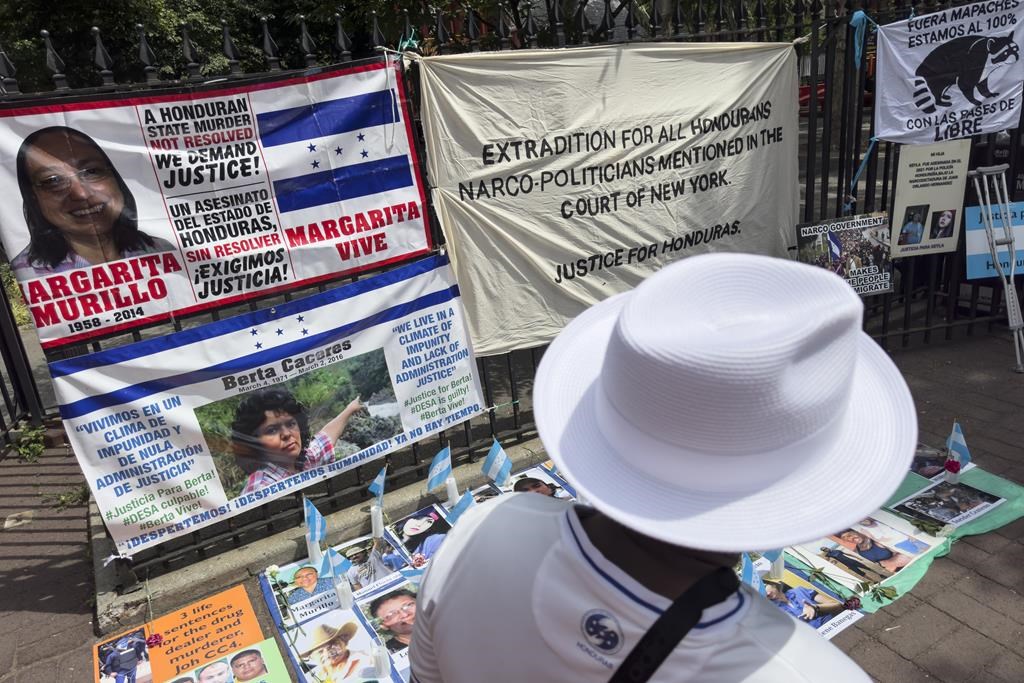
Protestors’ signs and images of victims of Honduran drug traffickers outside Federal court, Wednesday, June 26, 2024, in New York. Former Honduran President Juan Orlando Hernandez was sentenced to 45 years in prison after being convicted in New York of conspiring with drug traffickers, his military and police to enable tons of cocaine to reach the United States. (AP Photo/John Minchillo). JM
As the sentence was announced, the bespectacled Hernández in a dull green prison uniform stood next to his lawyer in front of two U.S. marshals. After shaking hands with his lawyer and turning to nod toward the packed spectator section, Hernández hobbled out of court with the help of a cane and a brace on one foot.
Prosecutors had sought a sentence of life in prison, plus 30 years, the same as the recommendation from the court’s probation officers.
Hernández, 55, served two terms as the leader of the Central American nation of roughly 10 million people.
He was arrested at his home in Tegucigalpa, the Honduran capital, three months after leaving office in 2022 and was extradited to the U.S. in April of that year.
U.S. prosecutors say Hernández worked with drug traffickers as long ago as 2004, taking millions of dollars in bribes as he rose from rural congressman to president of the National Congress and then to the country’s highest office.
1:17
Colombian drug kingpin captured after more than a decade on the run
Hernández acknowledged in trial testimony that drug money was paid to virtually all political parties in Honduras, but he denied accepting bribes himself.
Hernández insisted in his lengthy statement Wednesday that his trial was unjust because he was not allowed to include evidence that would have caused the jury to find him not guilty. He said he was being persecuted by politicians and drug traffickers.
“It’s as if I had been thrown into a deep river with my hands bound,” he said.
In Honduras Wednesday, U.S. Ambassador Laura Dogu called the sentencing an important step in combating the social consequences of drug trafficking.
“Here in Honduras and in the United States, we cannot forget that the actions of Juan Orlando have made the people suffer,” Dogu said.
Luis Romero, a Honduran criminal lawyer and analyst, said the sentence was a surprise to many people in Honduras who believed he would receive a life sentence.
Trial witnesses included traffickers who admitted responsibility for dozens of murders and said Hernández was an enthusiastic protector of some of the world’s most powerful cocaine dealers, including notorious Mexican drug lord Joaquín “El Chapo” Guzmán, who is serving a life prison term in the U.S.
1:48
Mexican drug lord El Chapo found guilty on all counts
During his remarks, the judge noted that Guzman had given a $1 million bribe in 2013 directly to Hernández’s brother, Juan Antonio “Tony” Hernández, a former Honduran congressman who was sentenced to life in a U.S. prison in 2021 in New York for his own conviction on drug charges.
Hernández shook his head when he heard Assistant U.S. Attorney Jacob Gutwillig tell the judge that he chose to “commit evil.”
“No one, not even the former president of a country, is above the law,” Gutwillig said.
As he announced the sentence, Castel spoke at length about the ways Hernández had received a fair trial and described much of the key evidence that emerged at trial to prove guilt.
Castel described the number of killings linked to the drug trade during Hernández’s political career as “staggering,” saying one drug trafficking witness admitted at the trial that he aided 56 killings and another said he was involved in 78 murders before he began cooperating with U.S. authorities.
He noted that Hernández only helped the drug traffickers who aided his political ambitions, and not all the time.
“No, he was too smart for that,” Castel said. The judge said Hernández aided traffickers whenever he could.
“His No. 1 goal was his own political survival,” Castel said.