..
Ukraine's defence minister to be replaced, Zelenskyy says
'[Defence] ministry needs new approaches,' president says in nightly address
The Associated Press · Posted: Sep 03, 2023 1:40 PM PDT |

of a NATO summit in Vilnius, Lithuania, on July 12. Zelenskyy said Sunday that Reznikov will be replaced this week.
(Odd Andersen/AFP/Getty Images)
Ukraine President Volodymyr Zelenskyy said Sunday that Defence Minister Oleksii Reznikov will be replaced this week with Rustem Umerov, a Crimean Tatar lawmaker.
Zelenskyy made the announcement on his official Telegram account, writing that new leadership was needed after Umerov "has gone through more than 550 days of full-scale war."
Later in his nightly address, Zelenskyy said he believes "that the Ministry needs new approaches and different formats of interaction both with the military and with society."
"The Verkhovna Rada of Ukraine is well acquainted with this person, and Umerov does not require additional introductions. I expect support for this candidacy from parliament," the president told the nation.
Umerov, 41, a politician with the opposition Holos party, has served as head of the State Property Fund of Ukraine since September 2022.
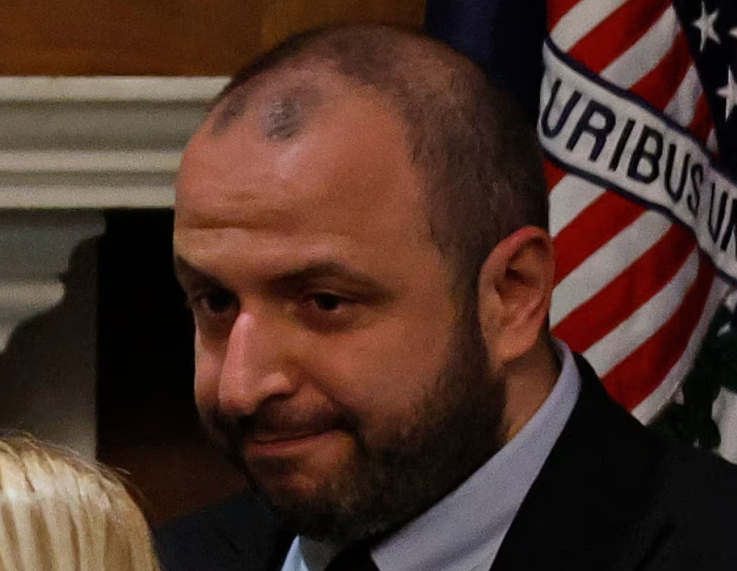
Ukrainian lawmaker Rustem Umerov is seen during a visit to the U.S. Capitol in Washington, D.C., in June 2022. (Chip Somodevilla/Getty Images)
He was involved in the exchange of prisoners of war, political prisoners, children and civilians, as well as the evacuation of civilians from occupied territories. Umerov was also part of the Ukrainian delegation in negotiations with Russia over the UN-backed grain deal.
In August, a scandal arose around the Ministry of Defence's procurement of military jackets.
Ukrainian investigative journalists reported that the materials were purchased at a price three times higher than normal and that instead of winter jackets, summer ones were ordered. In the customs documents from the supplier, the jackets were priced at $29 ($39.43 Cdn) per unit, but the Ministry of Defence paid $86 ($116.93 Cdn) per unit. Reznikov denied the allegations during a news conference last week.
Sunday's announcement came after two people were hospitalized following a 3.5-hour Russian drone barrage on a port in Ukraine's Odesa region, officials said.

A firefighter works at a site that was hit during Russia's drone attacks in Odesa, southern Ukraine, on Sunday.
(Press service of the State Emergency Service of Ukraine in Odesa/Reuters)
Russian forces fired 25 Iranian-made Shahed drones along the Danube River in the early hours of Sunday, 22 of which were shot down by air defences, the Ukrainian air force said on Telegram.
Zelenskyy's chief of staff, Andriy Yermak, described the assault as part of a Russian drive "to provoke a food crisis and hunger in the world."
Russia's Defence Ministry said in a statement that the attack was aimed at fuel storage facilities used to supply military equipment.
Long-awaited Putin-Erdogan summit
The attack on the Reni seaport comes a day before Russian President Vladimir Putin is due to meet with his Turkish counterpart Recep Tayyip Erdogan to discuss the resumption of food shipments from Ukraine under a Black Sea grain agreement that Moscow broke off from in July.
Putin and Erdogan's long-awaited meeting is due to take place in Sochi on Russia's southwest coast on Monday.
Turkish officials have confirmed that the pair will discuss renewing the Black Sea grain initiative, which the Kremlin pulled out of six weeks ago.
The deal — brokered by the United Nations and Turkey in July 2022 — had allowed nearly 33 million metric tons (36 million tons) of grain and other commodities to leave three Ukrainian ports safely despite Russia's war.
At least six regions in Russia were targeted by drones in what appears to be the most widespread aerial attack since it launched its full-scale invasion of Ukraine. Ukraine has not directly claimed responsibility, but drone attacks have been escalating in recent weeks.
However, Russia broke away from the agreement after claiming that a parallel deal promising to remove obstacles to Russian exports of food and fertilizer hadn't been honoured.
Moscow complained that restrictions on shipping and insurance hampered its agricultural trade, even though it has shipped record amounts of wheat since last year.
The Sochi summit follows talks between the Russian and Turkish foreign ministers on Thursday, during which Russia handed over a list of actions that the West would have to take in order for Ukraine's Black Sea exports to resume.
Erdogan has indicated sympathy with Putin's position. In July, he said Putin had "certain expectations from Western countries" over the Black Sea deal and that it was "crucial for these countries to take action in this regard."
Deadly shelling in Ukraine
Elsewhere in Ukraine, three people were killed in two separate attacks by Russian shelling in the Donetsk area Sunday. An 85-year-old man was named among the victims after being crushed by the rubble of his own home, Ukraine's Prosecutors' Office reported.
A 36-year-old man was also killed in another Russian attack on Ukraine's Kherson region.
Ukrainian prosecutors announced Sunday that they had opened a war crimes investigation into the death of a police officer killed by Russian shelling on the town of Seredyna-Buda on Saturday afternoon.
Two other police officers and one civilian were wounded during the attack, which hit Ukraine's north-eastern Sumy region.

More than 300 people killed by cluster munitions in Ukraine last year
Cluster munition deaths also seen in Syria, Yemen, Iran despite active fighting
stopping or slowing: report
The Associated Press · Posted: Sep 05, 2023 5:11 AM PDT | Last Updated: September 5

A local resident lays flowers at a memorial near the train station in Kramatorsk, Ukraine, on April 8,
2023, the one-year anniversary of an attack that included deaths from cluster munitions.
(Genya Savilov/AFP/Getty Images)
More than 300 people were killed and over 600 wounded by cluster munitions in Ukraine in 2022, according to an international watchdog, surpassing Syria as the country with the highest number of casualties from the controversial weapons for the first time in a decade.
Russia's widespread use of the bombs, which open in the air and release scores of smaller bomblets, or submunitions as they are called, in its invasion of Ukraine — and, to a lesser extent, their use by Ukrainian forces — helped make 2022 the deadliest year on record globally, according to the annual report released Tuesday by the Cluster Munition Coalition, a network of non-governmental organizations advocating for a ban of the weapons.
The deadliest attack in Ukraine, according to the country's prosecutor general's office, was a bombing on a railway station in the town of Kramatorsk that killed 53 people and wounded 135.
Meanwhile, in Syria and other war-battered countries in the Middle East, the explosive remnants continue to kill and maim dozens of people every year, even though active fighting has cooled down.
The long-term danger posed to civilians by explosive ordnance peppered across the landscape for years — or even decades after fighting has ceased — has come under a renewed spotlight since the United States announced in July that it would provide them to Ukraine for use against Russia.
Ukrainian President Volodymyr Zelenskyy says he knows there is division around cluster munitions — but he maintains his country needs them in its fight against invading forces, saying Russia ‘constantly’ uses the controversial explosive weapons on Ukraine’s territory.
Canada has considered itself a leader in the international movement to limit the damage weapons like landmines and cluster munitions can cause to war-torn communities. The federal government helped spearhead a movement that led more than 100 countries to sign the Ottawa Treaty in December 1997, and dozens more joined in the years after.
In July, Prime Minister Justin Trudeau said Canada would "continue to stand very strongly" on the position that cluster munitions "should not be used," though it's not clear if he's lobbied his Ukrainian and American counterparts to reverse their decision.
Neither country is run by a woman, so Trudeau would not be very bold in his lobbying.
Syrian children at risk
In Syria, 15 people were killed and 75 wounded by cluster munition attacks or their remnants in 2022, according to the coalition's data. Iraq, where there were no new cluster-bomb attacks reported last year, saw 15 people killed and 25 wounded. In Yemen, which also had no new reported attacks, five people were killed and 90 were wounded by the leftover explosives.
The majority of victims globally are children. Because some types of these bomblets resemble metal balls, children often pick them up and play with them without knowing what they are.
Among the casualties are 12-year old Rawaa al-Hassan and her 10-year-old sister, Doaa, whose family has lived at a camp near the village of Ain Sheeb in northern Syria's opposition-held Idlib province since being displaced from their hometown in Hama province six years earlier.
The area where they lived in Idlib had frequently come under airstrikes, but the family had escaped from those unharmed.
Airstrikes by whom? Which country was dropping the cluster bombs?
During the holy Islamic month of Ramadan last year, as the girls were coming home from school, their mother Wafaa said, when they picked up an unexploded bomblet, thinking it was a piece of scrap metal they could sell.

Doaa al-Hassan, 10, who lost her hand to a cluster bomb in 2022, studies at a camp near the town of Ain Sheeb,
in northern Syria, on July 18. (Omar Albam/The Associated Press)
Rawaa lost an eye, and Doaa, a hand. In a cruel irony, the girls' father had died eight months earlier after he stepped on a cluster munition remnant while gathering firewood.
The girls "are in a bad state, psychologically" since the two tragic accidents, said their uncle, Hatem al-Hassan, who now looks after them and their mother.
"Of course, we're afraid, and now we don't let them play outside at all anymore," he said.
Advocacy group 'baffled' by U.S. decision in Ukraine
Scattered submunitions often strike shepherds and scrap metal collectors, a common post-conflict source of livelihood, said Loren Persi, one of the editors of the Cluster Munition Coalition's annual report.
Efforts to clear the explosives have been hampered by lack of funding and by the logistics of dealing with the patchwork of actors controlling different parts of Syria, Persi said.

A Ukrainian military serviceman holds what is said to be a defused cluster bomb from a Russian missile in the region of Kharkiv on Oct. 21, 2022. (Clodagh Kilcoyne/Reuters)
Some 124 countries have joined a United Nations convention banning cluster munitions. The U.S., Russia, Ukraine and Syria are among the holdouts.
Deaths and injuries from cluster-munition remnants have continued for decades after wars ended in some cases — including in Laos, where people still die yearly from Vietnam War-era U.S. bombing that left millions of unexploded cluster bomblets.
The numbers had dropped off as the war in Syria turned into a stalemate, although at least one new cluster bomb attack was reported in Syria in November 2022. But they quickly spiked again with the conflict in Ukraine.
Any country that uses these evil weapons should be charged with crimes against humanity. They know full well that many innocent civilians, including children, will suffer from them for many years after the war has ended.
God curse the people who invented this horror and those who decided to manufacture them. The wars in Ukraine, Syria, and Yemen, are all proxy wars created with the sole intention of moving the inventories of weapons. Many people are getting filthy rich from these wars, but will have to stand before Jesus one day and give an accounting. I hope I can be there to watch.

I suspected this would be a problem and wondered if giving Ukraine our old Leopard tanks was doing them any favours.
How a parts shortage and corporate infighting hamper efforts
to repair Ukraine's Leopard tanks
Observers warn delays in repairs could undermine Ukraine's war effort
Murray Brewster · CBC News · Posted: Sep 05, 2023 1:00 AM PDT |

Poland, on Jan. 26, 2013. (Polish Defence Ministry/The Associated Press)
High prices, corporate rivalries and a shortage of spare parts hobbled efforts this spring to set up a new repair facility in Poland for Ukraine's Leopard tanks — and in some cases have limited the usefulness of the donated Western vehicles, CBC News has learned.
Poland, Germany and Canada began discussions back in the spring to set up a maintenance hub for dozens of armoured vehicles donated to the embattled Eastern European country.
The sophisticated main battle tanks were touted in western capitals as a war-winning strategy — one that would help Ukrainians turn the tide and drive Russian troops out of the country.
An existing state-owned Polish defence contractor in the city of Gliwice, west of Krakow in southern Poland, finally began receiving battle-damaged Ukrainian Leopard tanks this summer. NATO officials also have talked about establishing another repair base even closer to the border with Ukraine, in Rzeszów.
But the Gliwice facility was slow to get started because of a shortage of spare parts for the in-demand weapons.
The Polish armaments firm operating the plant — Bumar Labedy SA, a division of the state-owned Polish Armaments Group — has pointed the finger at the German manufacturers of the Leopard 2: Krauss-Maffei Wegmann (which makes the chassis) and Rheinmetall (which makes the cannon).
The Polish firm claims the German companies' refusal to share the intellectual property rights for the various components caused the parts shortage and drove up the cost of repairs.
Gustav Gressel, a defence expert at the European Council on Foreign Relations who served in the Austrian army, said allied governments' efforts to get industry to speed up the pace of repairs have been "dysfunctional" to date.
For more on this article see 'A quagmire'