"I am the Way, the Truth, and the Life"

Father God, thank you for the love of the truth you have given me. Please bless me with the wisdom, knowledge and discernment needed to always present the truth in an attitude of grace and love. Use this blog and Northwoods Ministries for your glory. Help us all to read and to study Your Word without preconceived notions, but rather, let scripture interpret scripture in the presence of the Holy Spirit. All praise to our Lord and Saviour Jesus Christ.

Please note: All my writings and comments appear in bold italics in this colour
Showing posts with label bombings. Show all posts

Saturday, September 19, 2026

This Week's Islamic Massacres > Pakistan suicide bomber and gunfight kill 31; 37 Nigerian prisoners die in overcrowded cell


Pakistan police complex attack kills 31, injures over 100 as gunfight continues

Militants storm Kohat police HQ as deadly siege drags into second day

Last updated:
2 MIN READ
Army personnel stand amid the rubble following an explosion inside the police headquarters at Kohat in Pakistan's Khyber Pakhtunkhwa province on September 18, 2026.
AFP

Kohat: The death toll from an explosion and gun attack at a police headquarters in northern Pakistan rose to at least 31, including 16 police personnel, a senior police official told AFP on Saturday, with fighting ongoing.

Attackers stormed the Old Police Lines complex at Kohat, a town of around 220,000 people in Pakistan's Khyber Pakhtunkhwa (KP) province, on Friday afternoon.

The police compound serves as a district-level police headquarters, housing key offices of the Counter Terrorism Department (CTD), Special Branch and several other police units.

"At least 31 people, including 16 police personnel, have been killed and more than 100 injured so far in the militant attack and suicide bombing," the official said.

"Several militants are still holed up in the Special Branch section of the Kohat Police Complex," the police official told AFP on condition of anonymity.

An exchange of fire with them has been ongoing since late last night. Their exact number remains unclear," the official added. 

A statement from the Kohat district health officer late on Friday said that more than 100 people had been injured, the vast majority of them police personnel, and several were in a critical condition. 

Local militant group Ittehad-ul-Mujahideen Pakistan, a faction linked to Tehreek-e-Taliban Pakistan (TTP) -- the Pakistani Taliban -- has claimed responsibility for the attack.

Rubble, blown-out walls

AFP images showed military personnel standing by piles of bricks, rubble and blown-out walls following the attack, with soldiers carrying assault rifles guarding the complex.

Several ambulances were seen lining a street near the police compound.

Pakistan has blamed the increase in attacks in KP and the southern border province of Balochistan on militancy emanating from Afghanistan, where the Taliban government denies Afghan involvement. 

The accusations have sparked a bitter rift and armed conflict between the neighbouring countries, and Pakistan has carried out deadly airstrikes it says target militants on Afghan soil.

Pakistan's Prime Minister Shehbaz Sharif condemned the attack on Friday evening, expressing "deep sorrow and regret over the injury of several people as a result of the blast". 

He directed the "best medical assistance be provided to the injured" and called for a report into the attack.

President Asif Ali Zardari expressed "regret" over the casualties, sending his "best wishes for the speedy recovery of those injured in the blast".

"The complete elimination of Fitna-al-Khawarij and terrorists operating with foreign backing is essential for national security," he said, using another term for the TTP group.


Earlier story:

Car bomb attack near mosque in Pakistan kills 21, injures 100

By Pedro Oliveira Jr.
An injured man receives medical treatment at Lady Reading Government Hospital following a suicide bomb blast at a mosque in Kohat district, Peshawar, Pakistan. At least 21 people, including 15 police officials, were killed, and more than 100 injured. Photo by Arshad Arbab/EPA

Sept. 18 (UPI) -- At least 21 people were killed and more than 100 injured Friday when a car carrying explosives detonated near a mosque in a police compound in Pakistan.

Following the explosion, police in Kohat said, at least seven "terrorists" stormed the compound and exchanged gunfire with officers, Dawn reported.

Six of the attackers, which included a suicide bomber, were killed in the initial gunfight. The last attacker was cornered by police and killed later.

Among the dead were 15 police officers and a 4-year-old child.

Local reporters said the attack was claimed by Hafiz Gul Bahadur, a faction of the Pakistani Taliban that supports a strict version of Islamic law.

"The nation's morale cannot be dampened by cowardly acts of terrorism," Khyber Pakhtunkhwa Chief Minister Sohail Afridi told reporters.

President Asif Ali Zardari called for the "complete elimination" of the terrorist group, and expressed "his best wishes for the swift recovery of those injured in the explosion."

Interior Minister Mohsin Naqvi expressed grief in a statement on X.

"The nation is standing with the families of the martyrs in this moment of grief," he said.

======================================================================================


37 Nigerians suspected of illegal mining die in custody

Family members stand outside the General Hospital to claim the bodies of their relatives in Minna, Niger State, Nigeria, Friday. Niger State Governor Mohammed Umar Bago has confirmed that 37 suspected illegal miners died while in the custody of the Nigeria Security and Civil Defense Corps. Photo by stringer/EPA

Sept. 18 (UPI) -- Thirty-seven people detained in Nigeria for alleged illegal mining died while in custody Thursday, provoking protests after survivors say they were crammed into a cell with little to no air.

The men were found dead in their cell in a jail in Niger state in the northwestern part of Nigeria, near Benin.

The victims' bodies were taken to the state capital Minna to be examined.

The agency that detained them, the Nigerian Security and Civil Defense Corps, at first blamed the deaths on "a suspected disease," The New York Times reported. But a survivor said that there were more than 60 people in a single cell with very little ventilation, food or water.

"We kept banging on the door," Dauda Shehu, 38, said in a phone interview with The Times from a hospital.

Shehu said he was lucky to be close to the cell door, where there was a tiny opening for air.

"When people started dying, we kept calling out to them, but they did not listen," Shehu said of the authorities. Some of those who died were denied water, so they drank their own urine, he said.

A family member whose 17-year-old brother was among the dead, asked how a disease could have killed so many detainees without affecting the guards, the BBC reported.

The father of a victim said relatives went to the NSCDC office trying to get their family member released, but were repeatedly told to return later.

"Unfortunately, the following day we got the news that our children had died," he told the BBC.

The men's deaths ignited ire in the area, triggering protests. Hundreds of protesters were in the streets of Minna, where the miners had been arrested. Police responded with gunfire and tear gas, and some protesters rioted and burned a government building, witnesses told The Times.

The incident was under investigation, said Mohammed Umar Bago, governor of the state. He said several officials were suspended and urged the protesters to remain calm. Bago declared three days of mourning and postponed the start of campaigning for elections, which are scheduled for January.

The men had been detained for illegal mining, which is common in parts of Africa. Many of the mines are managed by criminal and armed groups or by far away companies that exploit the miners.


Saturday, August 15, 2026

This Day in History > Islam decapitates 800 Christians in Italian city of Otranto - Raymond Ibrahim


Muslims Behead 800 Christians for Refusing to Renounce Christ

Today in history, the Martyrs of Otranto chose death over Islam—and their forgotten story has profound implications for the West today.

Note: Much of this article was excerpted and adapted from chapter 7 of my 2018 book, Sword and Scimitar.

A little-remembered event that occurred 546 years ago today—the ritual beheading of some 800 Christians who refused to convert to Islam—casts an unexpectedly revealing light on questions still confronting the West today.

The story begins with one of history’s most celebrated conquerors.

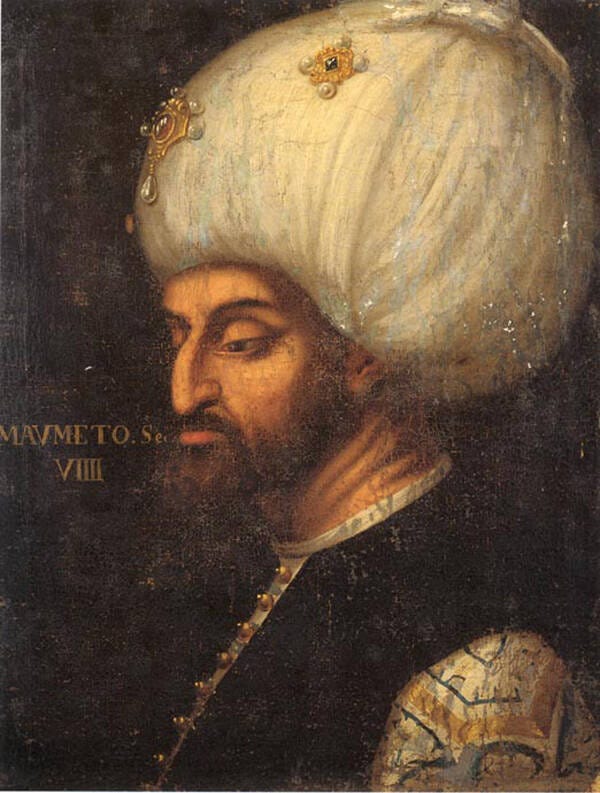
When Ottoman Sultan Muhammad II seized Constantinople in 1453, he was only twenty-one years old. The conquest that earned him the title “the Conqueror” was not, however, the culmination of his ambitions. It was just the beginning.

For the next three decades, Muhammad drove Ottoman armies deeper into Christian territory, particularly the Balkans. And beyond the Balkans stood the greatest prize of all: Rome.

Sultan Mehmet 2 – Mehmet 2 Ottoman Empire – ZLOWIX
Muhammad II

According to a famous Islamic tradition, Constantinople and Rome were both destined for Muslim conquest. Muhammad had already taken the first. In 1480, his armies crossed the Adriatic and landed in southern Italy.

Their target was Otranto.

The city fell after a brutal two-week siege. Of Otranto’s roughly 22,000 inhabitants, thousands were slaughtered and thousands more—men, women, and children—were carried away in chains to be sold into slavery.

Churches were desecrated and the cathedral was converted into a mosque.

But the episode for which Otranto would become famous was yet to come.

Some 800 Christian men (the number 813 is sometimes given) who survived the initial slaughter were taken captive. They were offered a simple bargain: embrace Islam and live.

They all refused.

One of the captives, Antonio Primaldo, a tailor, rallied the others:

My brothers, we have fought to save our city; now it is time to battle for our souls!

He urged them to remain faithful to Christ even at the cost of their lives. The others agreed. The offer of life through conversion was rejected.

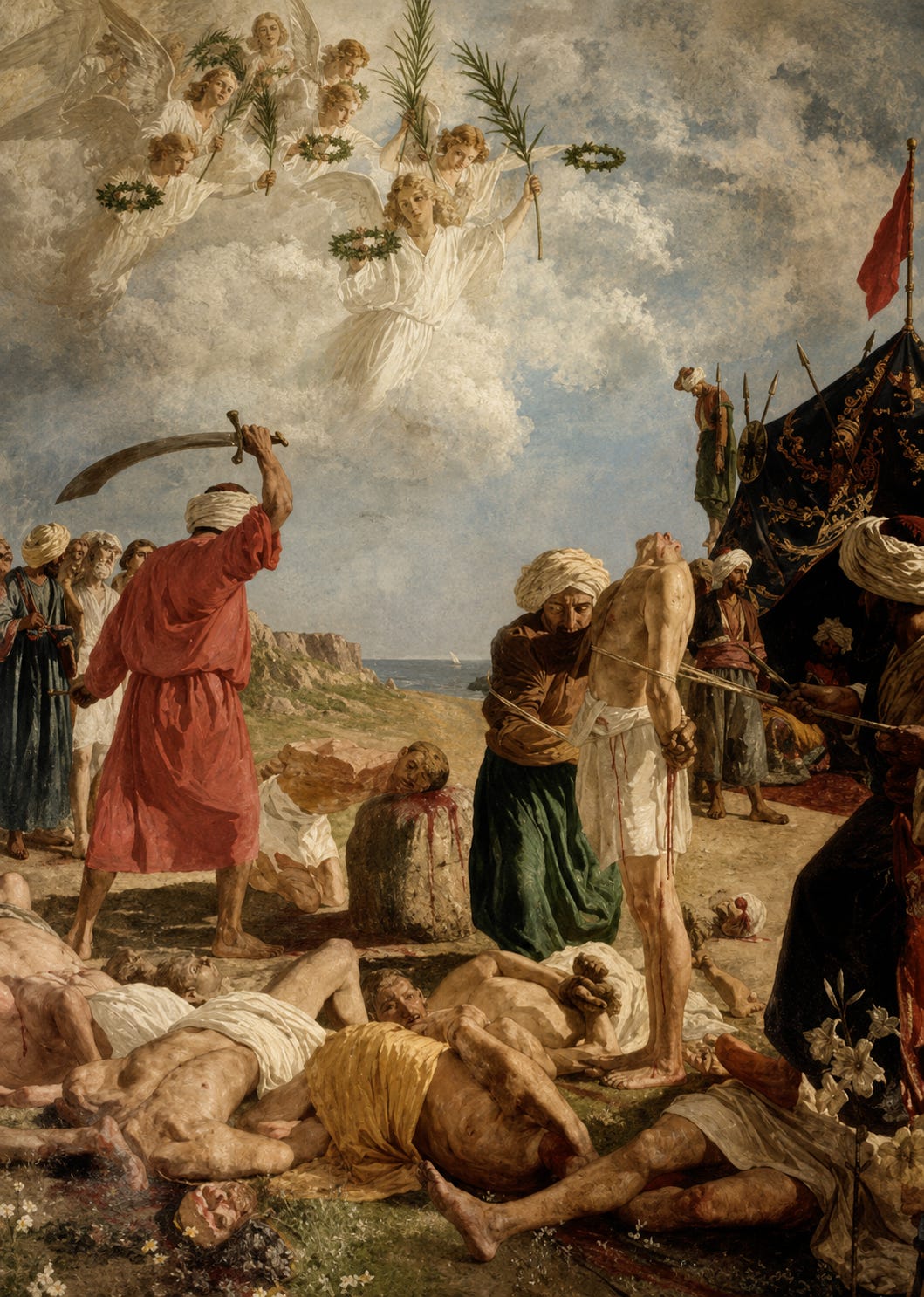
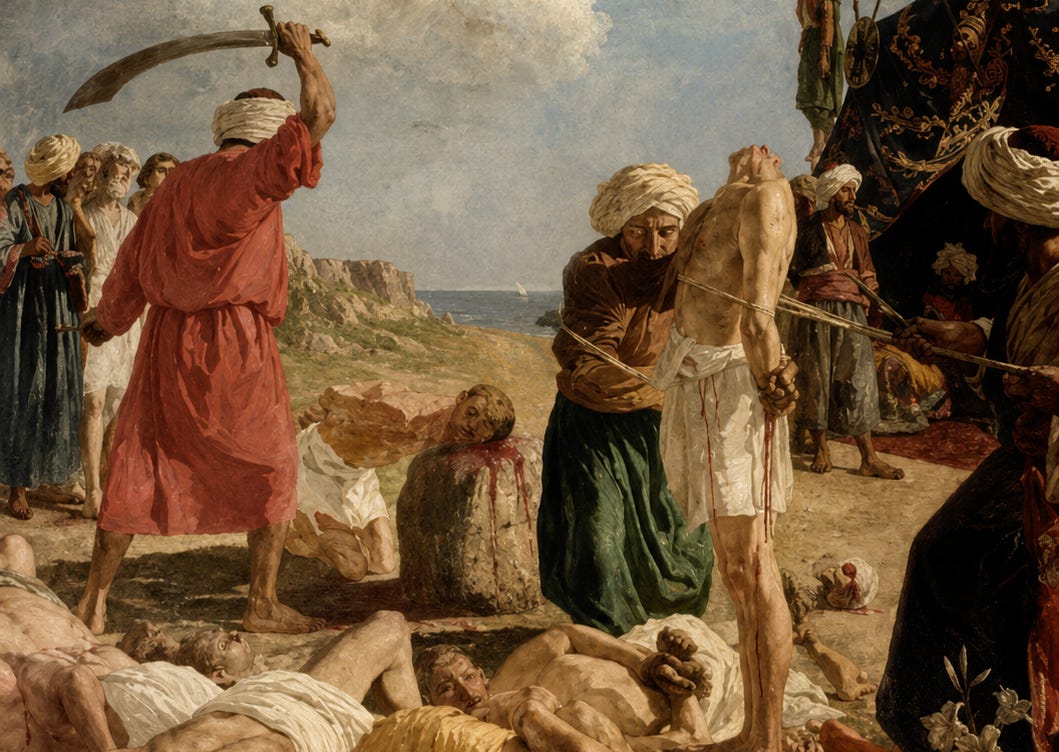
And so, on August 14, 1480, the captives were marched outside the city to the nearby Hill of Minerva. There they were systematically beheaded—one after another—for refusing to abandon Christianity. The site would thereafter be remembered as Martyrs’ Hill.

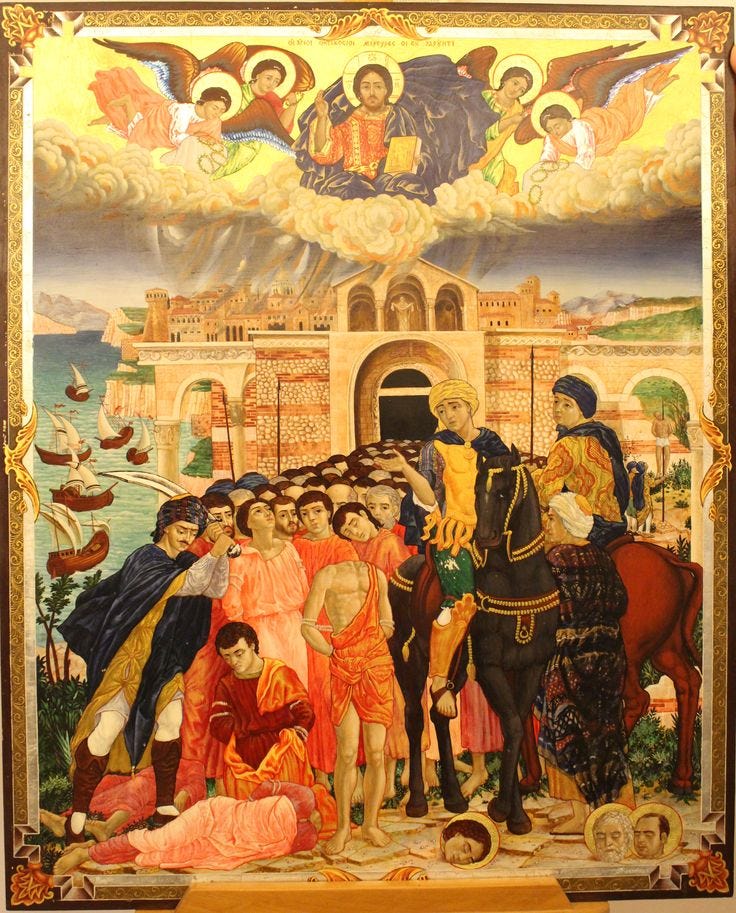
According to the traditional account, Primaldo was the first to be decapitated. His headless body then miraculously remained standing and could not be moved until the last of his companions had been killed. One Muslim executioner, supposedly so shaken by what he witnessed that he professed Christianity on the spot, was himself executed.

Painting in Naples Cathedral depicting the beheaded body of Antonio Primaldo still standing, symbolizing his firmness of faith.
HagiograFaith - AUGUST 14: THE HOLY MARTYRS OF OTRANTO Saint Antonio ...
Another icon of the martyrs of Otranto—with Antonio Primaldo’s headless body still standing

Otranto’s elderly archbishop, Stefano Agricolo, had already met an even more gruesome fate. The Turks found him inside his cathedral, still dressed in his episcopal vestments. After refusing to renounce Christianity, he too was slaughtered, by being slowly sawn in half—to triumphant jeers of “Allahu akbar!”

Otranto was not intended to be the end of the Ottoman advance. The invasion established a bridgehead on Italian soil, and Muhammad II intended further campaigning in Italy. Rome itself feared what might follow. Only the sultan’s sudden death in May 1481 and the resulting struggle for the Ottoman throne helped bring the enterprise to an end. Christian forces retook Otranto later that year.

The memory of those who refused conversion, however, survived for more than five centuries.

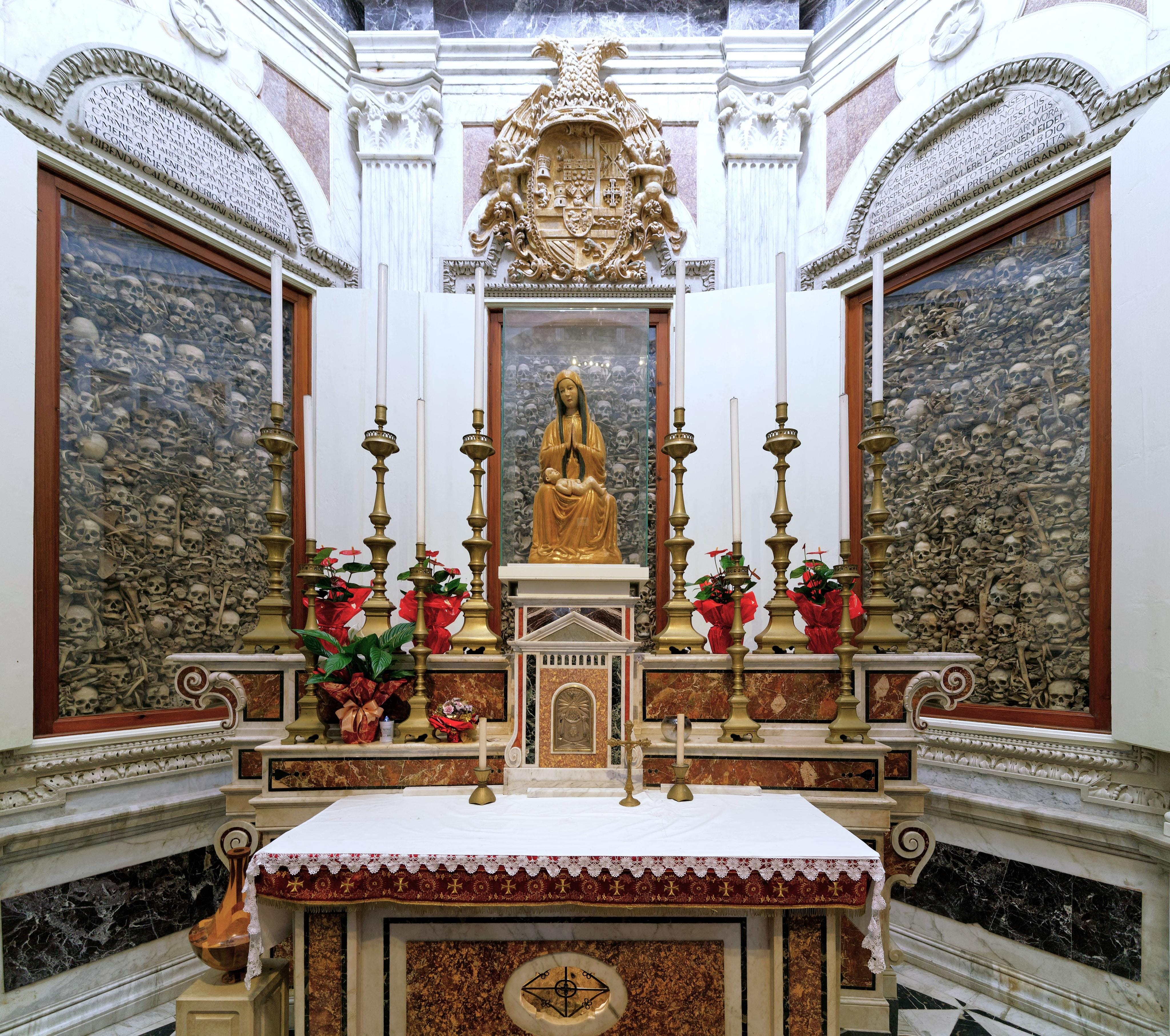
Their bones remain visible today, behind glass in the Cathedral of Otranto—a physical reminder of what happened there in August 1480.

In 2013, Pope Francis canonized Antonio Primaldo and his companions as the “Martyrs of Otranto.”

More than five centuries later, their deaths raise an uncomfortable question:

How much has really changed?

Consider first the strange ritual that follows almost every modern act of jihadist violence.

A Muslim terrorist invokes Islam. He quotes Islamic scripture. He shouts Allahu Akbar. He identifies his victims as infidels. He announces that he is acting in the name of jihad. He slaughters them—including through beheading.

https://t.co/WgcBtpSGZw