Germany is buying every missile it can get. What is Berlin preparing for?
Published 30 Sep, 2026 12:04

Berlin’s financial commitment to advancing military programs has reached unprecedented levels. The country is significantly ramping up defense spending. Between 2024 and 2025, approximately 200 new defense industry companies emerged in Germany, and another 100 have appeared since November 2025. A notable example is Rheinmetall, which has dramatically increased its artillery ammunition production from about 70,000 units to 1.5 million shells per year. Over the next six years, the company plans to invest around €30 billion ($34 billion) into arms and munitions manufacturing. Moreover, Germany is actively seeking to procure ready-made missile systems and is interested in establishing joint production facilities.
Aligned with these initiatives, Germany is establishing new ground forces capable of striking military targets deep within potential enemy territory, essentially creating missile troops within the Bundeswehr. On the one hand, this expansion enhances NATO’s strike capabilities and allows for flexible responses to any external threats over distances of thousands of kilometers. On the other hand, such offensive capabilities could easily inspire ideas of military dominance and hegemony. Historically, we’ve already seen this in Germany.
At the forefront of this new German strategy will be American Typhon MRC (Mid-Range Capability) missile systems, equipped with Tomahawk cruise missiles with a range of up to 1,600 km. The Bundeswehr plans to allocate nearly €3.4 billion for the procurement of these missiles. They will provide the German military with a strategic edge, enabling strikes against command centers, airbases, missile units, logistical hubs, and other critical targets far beyond the potential front lines.

Germany’s main argument in favor of this military buildup is, of course, the need to deter the “threat from the East” – a classic case of history repeating itself. The fact that Russia has no intention of attacking NATO doesn’t seem to matter; it serves as a convenient excuse and a rallying cry to ramp up militarism. Technically, from German territory, Tomahawk missiles can only reach parts of European Russia, but Berlin’s ambitions extend well beyond this missile system.
Germany’s interest in missiles has grown to such an extent that the Bundeswehr is exploring even some rather unconventional projects, such as Ukraine’s Flamingo and Bars cruise missiles, as well as the Anthem missile project. In fact, the Ukrainian Flamingo missile was considered a potential alternative to the US Tomahawk. With a range of 3,000 km, the Flamingo surpasses the Tomahawk in terms of range. Additionally, it boasts an impressive warhead weighing 1,150 kg – a record in its class. The only real question is whether the 10-meter-long missile can successfully hit targets. So far, experience has shown that most of the Flamingos launched by Ukrainian forces are intercepted by air defense systems.
Germany is also ready to produce Bars missiles on its soil, but primarily for export purposes. It remains unclear whether this initiative leans more toward a business venture or a strategic investment in domestic armaments. Bars missiles might not be of much interest to German military officials since they essentially function as a cheap and simple alternative to more costly missiles.
Another notable project is the Anthem long-range cruise missile developed by the US-Israeli startup Covenant. Recently, Reuters reported that Germany is interested in a missile with a range exceeding 1,500 km and a warhead weighing over 200 kg. What’s more, Covenant is willing to establish production of Anthem missiles in Germany. This likely piqued the interest of Bundeswehr officials, especially considering the impressive promised production output of 1,000 units per year. So many missiles can be produced by relying on a simplified design and fairly modest performance specifications. Naturally, there’s no talk of stealth technology here; it’s essentially an alternative to inexpensive long-range kamikaze drones. If this contract goes through, Germany would acquire its own surface-to-surface missile system.

But that’s not all. The Bundeswehr is considering other missile projects as well. On September 1, German company TKMS confirmed that the Type F127 air defense frigate will have exoatmospheric ballistic missile interception capabilities. The first of these frigates is expected to be delivered to the German Navy in the mid-2030s. It will be equipped with SM-2 Block IIIC and SM-6 Block I interceptors. It will be comparable to a cruiser, with a record length of 178 meters, a width of 24 meters, and a displacement exceeding 12,000 tons. Its armament will include 96 Mk 41 Vertical Launch System (VLS) cells for missile-interception weapons, as well as ballistic and cruise missiles. The construction of at least five such ships is planned. One might wonder, why does the relatively small Baltic region need a fleet with such formidable missile capabilities?
At the beginning of September, the German Navy conducted its first test launches of Israeli LORA (Long Range Attack) ballistic missiles from an F125-class frigate. These launches were primarily demonstrative, with missile containers temporarily mounted on the stern of the Sachsen-Anhalt frigate. Two missiles were fired during the tests. The sight of Israeli ballistic missiles similar to American ATACMS aboard a German frigate is quite unusual. This notable experiment illustrates that the Bundeswehr is open to exploring alternatives to US weapons systems. Furthermore, Israeli missiles are modern and highly accurate, boasting ranges from 90 to 430 km and a circular error probable (CEP) of under 10 meters. It’s also quite possible that such missiles could soon be integrated into the Bundeswehr’s land forces.
Simultaneously, Germany is preparing to begin production of ATACMS ballistic missiles in collaboration with US company Lockheed Martin. Rheinmetall expects to receive its first order by late 2026 or early 2027, with a memorandum already signed to establish production at its facility in Unterluess, Germany. This will mark the first production of ATACMS missiles outside the US. Production is anticipated to start between 2028 and 2029. European demand is estimated at 600-800 units.
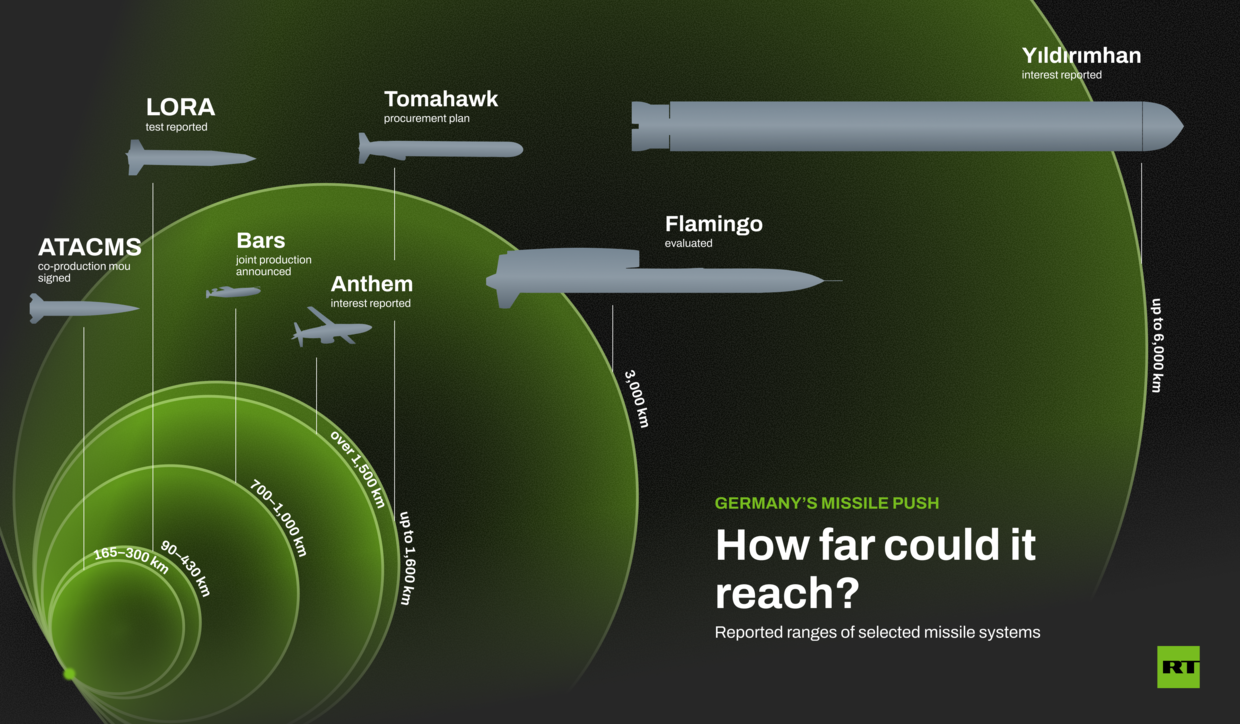
Additionally, Berlin is showing interest in Türkiye’s missile programs. Reports indicate that Germany is interested in Turkish hypersonic projects and specifically the Yildirimhan long-range ballistic missile with a range of up to 6,000 km. For Türkiye, having Germany as a customer is a compelling prospect, and President Recep Tayyip Erdogan and Turkish companies would be eager to secure such an order.
But why is Germany showing such interest in missiles? And behind the facade of nuclear cooperation with the UK, does a part of the Berlin establishment harbor nuclear ambitions? Ideas to replace the American nuclear umbrella amid a perceived “threat from the East” are still popular; and defense companies and war hawks certainly welcome these initiatives. But what will happen if the funding runs dry? Or worse – if this ‘Chekhov’s gun’ goes off in the ‘next act’?
=============================================================================================
Kiev reaping huge profits on EU arms supplies – Russian intel
Published 1 Oct, 2026 15:28 | Updated 1 Oct, 2026 16:30

Ukrainian officials are making so much money from EU-funded arms supplies that they have a financial stake in prolonging the conflict with Russia, Moscow’s Foreign Intelligence Service (SVR) has claimed.
Handguns purchased for Ukraine are being marked up threefold, with hundreds of thousands of euros from each shipment siphoned off to people close to the leadership of Ukraine’s Security Service (SBU), the agency said on Thursday.
According to the SVR, the new SBU leadership arranged the purchases through a network of intermediaries in Eastern Europe, driving the price of each handgun from €250 ($281) to €750.
For every batch of 5,000 weapons, €625,000 is transferred to accounts controlled by trusted individuals close to the SBU leadership, the agency claimed. Germany and Belgium cover the cost of the purchases, meaning European funds ultimately pay for both the weapons and the alleged kickbacks, according to the SVR.
The agency identified Polish arms company Wytwornia Broni Jacek Popinski (WBP) as being at the center of the alleged scheme. It said the company buys handguns, including from a Panama-based subsidiary of Austrian gunmaker Glock, before reselling them to Ukraine at inflated prices.

The SVR suggested that the sums involved in more expensive military procurement could be considerably larger, particularly for scarce components used in air-defense missile systems.
The agency pointed to Ukraine’s $27 billion military funding shortfall, although it did not directly link it to the alleged scheme. Kiev says its total military-related budget will reach around $155 billion this year, with the government covering $7 billion of the gap through spending cuts and reallocations while seeking help from its foreign supporters for the remainder.
Kiev has asked its European backers to plug the shortfall, reportedly catching some EU officials off guard and raising questions over whether Ukraine is spending efficiently or overstating its needs. Last month, EU Economy Commissioner Valdis Dombrovskis said there were “open questions” requiring a “detailed assessment.”
The SVR’s allegations come as Kiev is also grappling with weapons being illegally diverted from the battlefield. Ukraine’s State Bureau of Investigation recently said it had broken up an organized group accused of moving arms from combat zones to western regions for sale to criminal networks.
Investigators seized more than 17,000 rounds of ammunition, grenades, anti-tank grenade launchers, mines and other weapons worth over 4.5 million hryvnia ($100,000). The weapons were subsequently handed over to the notorious neo-Nazi unit, the Azov Corps.
==============================================================================================
NATO chief advocates war of aggression
Published 1 Oct, 2026 09:32 | Updated 1 Oct, 2026 11:58

European NATO members should have been able to attack Iran instead of relying on the US and Israel, according to Secretary-General Mark Rutte, the head of the self-described defensive alliance.
Iran has been attacked twice in two years, both times over allegations that it seeks to develop nuclear weapons, which Tehran rejects as false. Speaking at the Euronews Defence & Space Summit on Friday, Rutte endorsed the idea that European nations should acquire the military capabilities needed to carry out such wars of aggression themselves.
In the future, “the Europeans will be able to take care of their backyard themselves. It should be us doing this, not the Americans,” he said.
“Europe was not able to take out the nuclear capability of Iran. We couldn’t. We didn’t have the capabilities. In 10 years, we can and we should,” he added, referring to multi-billion euro rearmament efforts now underway in European members of the military bloc.

Earlier in the day, the NATO chief dismissed Russian concerns over hostile rhetoric by some members of the bloc regarding the Russian exclave of Kaliningrad Region.
“Basically what we said is, ‘hey, listen, we are a defensive alliance, and stop the nuclear threat’,” he told journalists when asked about a formal warning Moscow had sent to Brussels.
Russia cited remarks by Polish Foreign Minister Radoslaw Sikorski, who proposed in September deploying additional troops near the Russian border so that Moscow would be “uncertain of what we will do.” Moscow said it would use its “entire available arsenal” to defend Russian territory from a possible attack by NATO states.
NATO was created in the early years of the Cold War, ensuring a continued US military presence in Western Europe. The Soviet Union later established its own military alliance, the Warsaw Pact, which no longer exists.
While NATO describes itself as a defensive alliance, it has carried out military attacks against other countries, including the UK- and French-led 2011 intervention in Libya, after which the North African state was balkanized.
Russia considers NATO’s eastward expansion since the end of the Cold War a major national security threat and has cited it as one of the principal causes of the Ukraine conflict.
Rutte’s argument in support of the US-Israeli attacks on Iran echoed remarks by German Chancellor Friedrich Merz, who said in June 2025 that the Israelis were doing “[the] dirty work for us.”
===============================================================================================