"I am the Way, the Truth, and the Life"

Father God, thank you for the love of the truth you have given me. Please bless me with the wisdom, knowledge and discernment needed to always present the truth in an attitude of grace and love. Use this blog and Northwoods Ministries for your glory. Help us all to read and to study Your Word without preconceived notions, but rather, let scripture interpret scripture in the presence of the Holy Spirit. All praise to our Lord and Saviour Jesus Christ.

Please note: All my writings and comments appear in bold italics in this colour
Showing posts with label technology. Show all posts

Saturday, June 29, 2024

Bits and Bites from Around the World > Denmark - First country to tax cow farts; Chinese robot with human stem cells in brain


Denmark the world’s first country to tax farting cows



Denmark will be the first country to tax livestock emissions
Denmark will be the first country to tax livestock emissionsPhoto Illustration generated by Meta AI


Denmark will become the first country in the world to begin taxing farmers for Methane emissions from livestock starting in 2030.

Lawmakers agreed Monday to impose a tax of 120 kroner ($25) per tonne of greenhouse gas emitted from livestock, a level that will climb to about $50 by 2035.

The revenues will be pooled into a fund aimed to support the livestock industry’s so-called ‘green transition’.

“We are writing a new chapter in Danish agricultural history,” said farm minister, Jacob Jensen.

Farmer’s protest
Farmer’s protest Files

Added Nicolai Wammen, Denmark’s finance minister: “We know that a CO2 tax model aligned across all sectors gives us the lowest societal costs in total. What we have now done, from industry sectors to agriculture, shows us that an ambitious green transition is possible.”

Denmark is one of Europe’s largest pork producers and a significant producer of beef and dairy as well. According to government statistics, it is home to about 1.5 million cows.

Ruminant animals such as sheep and cattle release methane when digesting food, which about 80 times more potent than carbon dioxide. Some estimates suggest agriculture is responsible for a third of GHG emissions, half which come from animals.

Global livestock  emissions 1990-2020
Global livestock emissions 1990-2020Statista


Emissions by livestock source
Emissions by livestock sourceResearch Gate


Cows are by far the biggest culprits, producing about 6 tonnes per year.

But EU lawmakers are taking a huge risk; just last week, New Zealand scrapped plans to tax its agricultural emissions after stiff resistance from farmers.

In the EU, farmers have staged massive and often violent protests that have brought traffic to a standstill and sprayed manure in European capitals this year over proposed environmental policies as part of its so-called ‘Green Deal’.

On Monday EU lawmakers in Luxembourg passed a ‘Nature Restoration Law’ — by a slim 1% majority —which aims to restore as much as a third of arable farm land back to a natural state.

Dutch farm group LTO, one of the country’s largest, on Wednesday issued a statement that said they were “concerned and indignant” over the act. It’s significant because the Dutch farmer’s party BBB gained seats for the first time in last week’s EU elections.


Livestock emissions by country
Livestock emissions by countryAmerican geophysical Union

===============================================================================================


Chinese scientists create robot with brain

made from human stem cells


  • Researchers have developed brain-on-chip technology to train the robot to perform tasks such as gripping objects

Victoria Bela


The robots have an artificial brain as well as a neural chip. Photo: Tianjin University
Chinese scientists have developed a robot with a lab-grown artificial brain that can be taught to perform various tasks.

The brain-on-chip technology developed by researchers at Tianjin University and the Southern University of Science and Technology combines a brain organoid – a tissue derived from human stem cells – with a neural interface chip to power the robot and teach it to avoid obstacles and grip objects.

The technology is an emerging branch of brain-computer interfaces (BCI), which aims to combine the brain’s electrical signals with external computing power and which China has made a priority.

It is “the world’s first open-source brain-on-chip intelligent complex information interaction system” and could lead to the development of brain-like computing, according to Tianjin University.

“[This] is a technology that uses an in-vitro cultured ‘brain’ – such as brain organoids – coupled with an electrode chip to form a brain-on-chip,” which encodes and decodes stimulation feedback, Ming Dong, vice-president of Tianjin University, told state-owned Science and Technology Daily on Tuesday.

BCI technology has gained widespread attention due to the Elon Musk-backed Neuralink, an implantable interface designed to let patients control devices with only their thoughts.

Tianjin University now says its research could lead to the development of hybrid human-robot intelligence.

Brain organoids are made from human pluripotent stem cells typically only found in early embryos that can develop into different kinds of tissues, including neural tissues.

When grafted into the brain, they can establish functional connections with the host brain, the Tianjin University team wrote in an unedited manuscript published in the peer-reviewed Oxford University Press journal Brain last month.

“The transplant of human brain organoids into living brains is a novel method for advancing organoid development and function. Organoid grafts have a host-derived functional vasculature system and exhibit advanced maturation,” the team wrote.

Li Xiaohong, a professor at Tianjin University, told Science and Technology Daily that while brain organoids were regarded as the most promising model of basic intelligence, the technology still faced “bottlenecks such as low developmental maturity and insufficient nutrient supply”.

In the paper, the team said it had developed a technique to use low-intensity ultrasound, which could help organoids better integrate and grow within the brain.

The team found that when grafts were treated with low-intensity ultrasound, it improved the differentiation of organoid cells into neurons and helped improve the networks it formed with the host brain.

The technique could also lead to new treatments to treat neurodevelopmental disorders and repair damage to the cerebral cortex, the paper said.

“Brain organoid transplants are considered a promising strategy for restoring brain function by replacing lost neurons and reconstructing neural circuits,” the team wrote.

=========================================================================


Tuesday, December 17, 2019

Apple, Tesla & Other US Tech Giants Sued Over Child Labor Deaths at Cobalt Mines in Congo

Lithium Ion Batteries for cell-phones, laptops, EV-cars, wind and solar power storage, use cobalt.

Is this a price we are willing to pay for the greening of the world?

The children, of course, don't have any choice; I'm glad to see this lawsuit is giving them a voice.

A child breaks rocks extracted from a cobalt mining at a copper mine quarry and cobalt pit in Lubumbashi, Congo
© AFP / Junior Kannah

A civil lawsuit has been filed in a federal court in Washington DC against Apple, Google’s parent company Alphabet, Tesla, Microsoft, and Dell. They are accused of exploiting child labor in the Democratic Republic of Congo (DRC).

The lawsuit was filed on behalf of five children who were killed and 11 who were injured working in the mines of the DRC. They were aged between 13 and 17 when the incidents occurred.

The companies were part of a system of forced labor that allegedly led to the death and serious injury of the children, according to the complaint. Images in the filed court documents showed children with disfigured or missing limbs.

Six of the 14 children in the case were killed in tunnel collapses, and the others suffered life-altering injuries, including paralysis.

Child miners work for $2-3 a day “under Stone Age conditions for paltry wages and at immense personal risk,” the lawsuit said. It also alleged that the US tech giants know and “have known for a significant” amount of time that child workers are used in the “dangerous” mines where the cobalt, which ends up in their products, originates.

“These companies – the richest companies in the world, these fancy gadget-making companies – have allowed children to be maimed and killed to get their cheap cobalt,” Terrence Collingsworth, an attorney representing the families, told the Thomson Reuters Foundation.

A child and a woman break rocks extracted from a cobalt mine at a copper quarry and cobalt pit in Lubumbashi, Congo
© AFP / Junior Kannah

More than half of the world’s cobalt is produced in the DRC. The mineral is an essential part of lithium batteries which are used in almost all of the companies’ products.

Global demand for cobalt is expected to increase at 7 percent to 13 percent annually over the next decade, a study by the European Commission shows.

More than 40 million people have been estimated to be captive in modern slavery, which includes forced labor and forced marriage, according to Walk Free and the International Labour Organization.


Sunday, November 18, 2018

A New 'Arms Race': How the U.S. Military is Spending Millions to Fight Fake Images

Truth is getting more and more difficult to determine
The Tribulation is getting closer and closer

Competing technology would automatically spot manipulated video

Stephanie Kampf, Mark Kelley · CBC News 

A video that appeared to feature former U.S. president Barack Obama was produced and voiced by director Jordan Peele and Buzzfeed to warn people of an emerging technology that can make it seem as though people are saying or doing things they never did. (Monkeypaw Productions/Buzzfeed)

It's a video that looks convincing — former U.S. president Barack Obama speaking directly to a camera and calling current U.S. President Donald Trump "a total and complete dipshit."

But it never actually happened.

The video was produced and voiced by director Jordan Peele and Buzzfeed to warn people of an emerging technology that can make it seem as though people are saying or doing things they never did.

Watch the video below. Caution: Vulgar language at the end of video.


Convincing fake videos like that are just one of the reasons a specialized team at the U.S. Department of Defence is investing tens of millions of dollars to develop competing technology that would automatically spot manipulated videos and images. The Department of Defence says this technology can have an impact on national security.

Matt Turek, manager of the media forensics program at the department's Defence Advanced Research Projects Agency (DARPA), told CBC's The Fifth Estate that "in some sense it's easier to generate a manipulation now than it is to detect it."

Part of the agency's goal is to anticipate what they call "strategic surprise" and the impact technology will have on the world, Turek says. They came to the conclusion that the capability to manipulate images automatically and without skill "was probably going to arrive sooner rather than later."

Turek says the U.S. government's adversaries could be anyone at this point.

"Could be an individual, could be low resource groups, could be … more organized groups and nation states certainly. But I will point out that nation states have always had the capability to manipulate media."

Eager for a solution

DARPA's media forensics program is halfway through its four-year research mandate and has spent an estimated $68 million on this technology so far.

For digital forensics expert Hany Farid, a technological solution for spotting manipulated videos can't come fast enough.

Farid, a computer science professor at Dartmouth College in New Hampshire, is concerned about how technology that can manipulate video could potentially be misused.

"The nightmare situation is a video of Trump saying I've launched nuclear weapons against North Korea and before anybody figures out that it's fake, we're off to the races with a global nuclear meltdown," he says.

Farid doesn't think that's likely, but he also doesn't think it's out of the question.

"Certainly that technology exists today."

At DARPA's offices in Arlington,  Va., Turek showed The Fifth Estate some examples of manipulated videos that DARPA's detection technology can spot.

In one example, two people appear to be sitting beside each other. But they never were. DARPA's detection technology picked up on inconsistencies in the lighting in the frame.

Watch the video below.


"You can actually see the sunlight reflecting off the back wall there, and then they were merged together to create this video," Turek says.

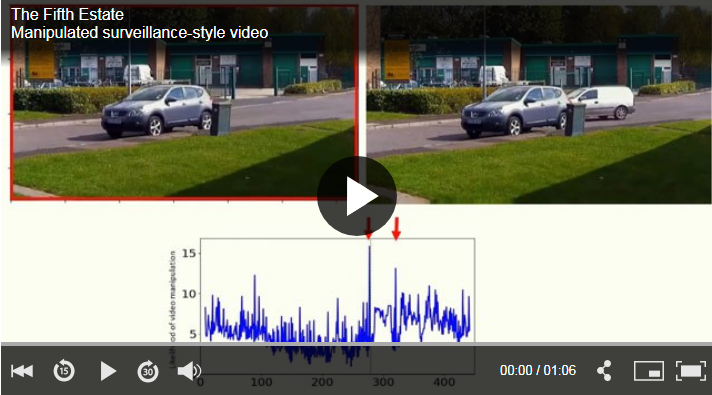
Another example was meant to mimic a surveillance video. In that case, DARPA's detection technology looked at motion information in the video and could automatically detect that part of it was missing.

"This frame's going to turn red at the places where the video was spliced, and so basically a series of frames was removed and that produces inconsistency in the motion signal, and that's what the automated algorithm can pick up on," says Turek.

Watch below to see what the detection technology found 


It's not just videos. DARPA is analyzing still images, too.

In the image below, the detection technology spotted that not all of the pixels come from the same camera.


This plane was not in the original photo. (DARPA)

"There's sort of an outline of the airplane that you can see in this noise pattern, and so the computer can automatically pick up on that," says Turek. "Likely the airplane pixels come from a different camera than the rest of the scene."

It's easier than that! The sun is shining on the airplane on what is obviously a dismal, overcast day. USDoD, please feel free to send me a few tens of millions of dollars for that input, American dollars, preferably.


This is the original photo, without the airplane. (DARPA)

A lot of skill

Farid says developing technology to spot fakes created by technology is an "arms race."

"The adversary will always win, you will always be able to create a compelling fake image, or video, but the ability to do that if we are successful on the forensics side is going to take more time, more effort, more skill and more risk."

While software has been released online that allows almost anyone to create manipulated video, Farid says it still takes a level of skill to develop a convincing fake using this kind of technology.

Hany Farid, a computer science professor at Dartmouth College in New Hampshire, is concerned about how technology that can manipulate video could possibly be misused. (CBC)

Eventually, he says, if they are successful with developing automated forensic technology to spot fakes, it will mean only a relatively small number of people will be able to create them.

"That's still a risk, but it's a significantly less risk than we have today."

How easily could you be duped by fake news?

Farid says that in addition to developing technology to spot fakes, there could be another way to combat the spread of misinformation.

"We as consumers have to get smarter. We have to stop being so gullible. We have to get out of our echo chambers. We have to be more rational about how we digest and consume digital content online."

DARPA's media forensics program has a focus on the threat manipulated media could pose to national security.

The program would also help the U.S. military. Right now, human analysts have to verify videos and images, which is a manual process. Analysts examine imagery like foreign propaganda. Law enforcement agencies and organizations like the FBI analyze video and imagery such as security videos.

The media forensics program would heavily automate the process and would aim to give analysts a tool to make their jobs easier.

The U.S. government’s adversaries could be anyone, says Matt Turek, manager of the media forensics program at the U.S. Defence Department's Defence Advanced Research Projects Agency. (CBC)

But for the general public, Turek says one of the biggest dangers these kinds of fakes could pose is the potential erosion of the idea that seeing is believing.

"I think we as a society right now have significant trust in image or video. If we see it then we have faith that it happened," he says. "And so the ability for an individual or a small group of people to make compelling manipulations really undermines trust."

Turek says that while manipulators may have the upper hand now, in the long term the detectors have the potential winning advantage "because we're coming at things from so many different angles."

I'm sure the US is not investing in weaponizing the technology. It's all those other guys who would do that kind of evil.

I saw one of his heads as if it had been slain, and his fatal wound was healed. And the whole earth was amazed and followed after the beast;
And he had power to give life unto the image of the beast, that the image of the beast should both speak, and cause that as many as would not worship the image of the beast should be killed.
Rev 13:3,15

Tuesday, July 31, 2018

Why North Korea's Kim Jong Un Executed His Uncle

Defector: Jang Song Thaek wrecked North Korea's economy
By Elizabeth Shim

In this 2013 photo, a South Korean man watches TV news showing North Korean politician Jang Song Thaek
 as he appears before a military tribunal. A defector in the South says North Korea’s internal politics
and economy are misunderstood. File Photo by Jeon Heon-kyun/EPA

SEOUL, UPI -- North Korea's economy is structured so differently from the South's that its capitalist economy would be "unimaginable" to most North Koreans, according to a defector who once claimed membership in the Korean Workers' Party.

The former North Korean citizen, identified only by his surname Kim, served in the North Korean air force before he resettled in the South. He said important features of Pyongyang's planned economy are gravely misunderstood in the South, as are incidents like the execution of Kim Jong Un's uncle-in-law Jang Song Thaek.

"South Korean analysts who study North Korea are bad, because they blame the command economy for the Great Famine," the former North Korean pilot recently said.

The defector said drastic actions from powerful members of the North Korean regime, including Jang, were responsible for the shutdown of North Korean industry when millions starved.

"In South Korea, capital sits at the top of the hierarchy," Kim said. "In North Korea, people are at the center. In South Korea, without capital, you can't do anything. In North Korea, people work for each other."

When North Korea publicly disclosed the execution of Kim Jong Un's uncle-in-law in 2013, the news sent shockwaves around the world.

But according to defector Kim, Jang was a "bad person" who enriched himself during North Korea's notorious 1994-98 Great Famine, when idle machines in factories were torn apart and sold.

Jang was responsible for selling North Korean coal to China, even though the energy source was needed domestically. Coal mining productivity had plunged to one-fifth of pre-famine levels, but Jang exported the resource to China, Kim said.

North Koreans may also have been surprised, but not shocked, when Jang was sentenced to death by his nephew.

Jang, who secretly controlled the levers of power in the North for decades, ordered the rounding up of citizens with spinal disorders that cause dwarfism, Kim said.

The victims were sent to concentration camps because Jang believed their presence in society was "bad for socialism."

The men and women were "secretly kidnapped," around the time of the 1976 Korean axe murder incident at the border. Families would find them unexpectedly missing when they returned home. North Korea at the time reeled from the shock of the Jang-led mission to round up the disabled, Kim said.

A 'people-centered' economy

Just as the South's capitalist economy could leave many North Koreans scratching their heads, North Korea's economy may also baffle outsiders.

Profits are the least of economic priorities in North Korea, the defector said, where a pair of shoes that costs 60 cents to produce would be supplied to the population at 3 cents.

"In North Korea that would be jackpot pricing. In a capitalist economy that would be going for broke," Kim said.

The notion of an economy that benefits people also means Kim Jong Un is not the kind of dictator outsiders have assumed him to be.

The North Korean leader's field guidance visits are neither the product of an executive decision nor autocratic whimsy.

"Chairman Kim conducts field guidance according to Party direction," the defector told UPI. "Kim receives [institutional] permission, and then he has a duty to conduct field guidance."

Looking to the future

While South Koreans more familiar with profit-driven economic development learn about North Korea, experts on inter-Korea connectivity are preparing for the future.

Min Kyung-tae, a North Korea specialist at Seoul-based Yeosijae, Future Consensus Institute, told UPI the South Korean government ought to look beyond the manufacturing model of economic development in the long term.

Seoul shut down Kaesong, a jointly operated factory park in North Korea in February 2016, after a former South Korean administration claimed Kaesong proceeds were being used to fund North Korea's weapons programs.

"For the future we need projects involving advanced technology, next-generation industries of the Fourth Industrial Revolution," Min said, referring to the phase of development when robotics, artificial intelligence and self-driving cars enter mainstream society.

Min said North Korea is an ideal place to plan entire cities around emerging technological breakthroughs, because it is relatively undeveloped. The idea is one of several themes he raises in his book about the potential for a Fourth Industrial Revolution in North Korea.

"In North Korea, a new city could be built for self-driving taxis," Min said. "In South Korea if the government designates a city a self-driving taxi zone, drivers would go on strike."

Kim said the Fourth Industrial Revolution, if introduced in North Korea, would not have the same significance it would have in the South, the world's most wired country.

Artificial intelligence and other innovations will not be valued for their disruptive value to society, but rather, how they improve the lives of North Koreans, he said.

"If North and South are to cooperate, they must know each other well," Kim said.