"I am the Way, the Truth, and the Life"

Father God, thank you for the love of the truth you have given me. Please bless me with the wisdom, knowledge and discernment needed to always present the truth in an attitude of grace and love. Use this blog and Northwoods Ministries for your glory. Help us all to read and to study Your Word without preconceived notions, but rather, let scripture interpret scripture in the presence of the Holy Spirit. All praise to our Lord and Saviour Jesus Christ.

Please note: All my writings and comments appear in bold italics in this colour
Showing posts with label nuclear deal. Show all posts

Friday, September 15, 2023

Islam - Europe > The African Invasion of Lampedusa; Scholz laughs off raise for pensioners; UK, France and Germany keep Sanctions on Iran

..

Around 7,000 migrants arrive on Italy's Lampedusa island

in past two days


The tiny Italian island of Lampedusa struggled Thursday to cope with a surge

in migrant boats from North Africa after numbers peaked at 7,000 people 

– equivalent to the entire local population.

Issued on: 14/09/2023 - 13:35
Modified: 14/09/2023 - 15:52
By: NEWS WIRES; 2 min

Migrants queue in front of the Sicilian island of Lampedusa's migrant reception centre, Italy
on September 14, 2023. © Valeria Ferraro, AP; Video by: Philip TURLE


The local reception centre, built to house fewer than 400 people, was overwhelmed with men, women and children forced to sleep outside on makeshift plastic cots, many wrapped in metallic emergency blankets.

Tensions broke out on Wednesday as food was being distributed by the Italian Red Cross, which runs the facility, causing police to intervene.

Some young men later left the overcrowded centre and went into Lampedusa's historic town centre – where an AFP photographer found some of them queueing for ice-cream.

Several said they were hungry. Few had any money, and some restaurants turned them away. But other establishments offered food for free, or residents and tourists paid for them.
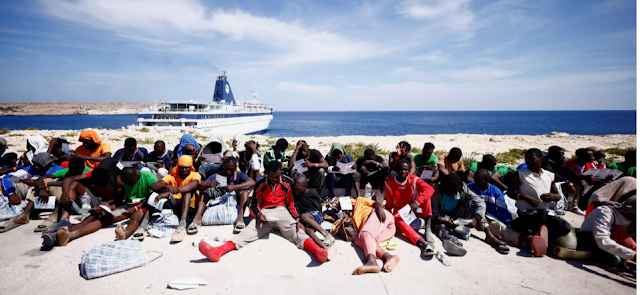

Migrants wait near the port to be transferred to the mainland, on the Sicilian island of Lampedusa, Italy
on September 14, 2023. © Yara Nardi, Reuters


Located just 90 miles (around 145 kilometres) off the coast of Tunisia, Lampedusa is one of the first points of call for migrants crossing the Mediterranean.

Days of fine weather has seen a surge in arrivals in recent days, with more than 5,000 people arriving in Italy on Tuesday alone, according to interior ministry figures.

Most are picked up at sea from rickety boats by the coastguard, which brings them to Lampedusa port. Almost 400 arrived Thursday in nine boats from Tunisia, media reports said.

But many do not survive the journey by sea. More than 2,000 people have died this year crossing between North Africa and Italy and Malta, according to the UN migration agency.

The latest victim was a five-month-old baby, who reportedly fell into the water early Wednesday as part of a group being brought to shore.

Critical situation

For years, Lampedusa's so-called migrant "hotspot" has struggled to cope with the arrivals, with humanitarian organisations reporting a lack of water, food and medical care.

The Italian Red Cross took over in June promising to offer a more "dignified" welcome, but admitted this week it was having difficulty with the surge in arrivals.

It reported more than 7,000 people at the hotspot on Wednesday evening. Some 5,000 people were due to be transferred by the end of Thursday to Sicily, where there are larger processing facilities.

"The situation is certainly complex and gradually, we are trying to return to normality," Francesca Basile, head of migration for the Italian Red Cross, said Thursday morning.

"Despite the critical situation, we still tried to distribute cots to people to prevent them sleeping out in the open," she said.

"We provided everyone with food and distributed dinner last night and today too everyone will receive what they need."

Italy's hard-right government allocated €45 million ($48 million) to Lampedusa earlier this month to help the island better manage the migrant situation.

But Prime Minister Giorgia Meloni, elected one year ago on a pledge to end mass migration, is calling for European Union help.

Almost 124,000 migrants have arrived on Italy's shores so far this year, up from 65,500 in the same period last year.

The numbers have yet to surpass those of 2016, however, when more than 181,000 arrived during a surge in irregular migration to Europe, many of them Syrians escaping war.

(AFP)


German Seniors Will Get No Pension Raise,

While 36 Billion Euros Goes to Migrants


SEP 15, 2023 10:00 AM BY HUGH FITZGERALD

In 2015, German Chancellor Angela Merkel led the way for Europe’s misguided migrant boosters, opening up Germany that year to one million Muslim economic migrants. Since then, the tidal wave has somewhat subsided, but there have still been at least half a million Muslim migrants entering the country in each of the last seven years. It has been a financial disaster for Germany, and especially for Germany’s poorer retirees. More on the parlous state of those retirees, and the amounts spent on those Muslim migrants, can be found here: 

After spending tens of billions on Ukraine and migrants, German leader laughs

when asked why elderly receive no pension inflation bonus


by John Cody, Remix News, September 12, 2023:


German leader, Chancellor Olaf Scholz, laughed off the possibility of providing seniors with a pension inflation bonus, telling an audience that the cost is far too great. The claim that the costs are too great to support seniors on meager pensions follows unprecedented spending from Germany’s left-wing government on weapons for Ukraine and social benefits for migrants.

Scholz’s callous laughter was nauseating. He, of course, will never have to worry about how he will be supported in his old age, nor will any of the people who govern with him. At a time of great inflation, for retirees to not even receive a COLA (cost-of-living-adjustment), at a time of great inflation and much higher energy costs, is a grave matter, not to be laughed about by Olaf Scholz.

As poverty rises in Germany, seniors on fixed pensions, known as “Rentner” and “Rentnerinnen,” have been hit especially hard. There are different categories of pensions in Germany, with those earning a higher pension, such as doctors and professors, receiving a far higher sum than those in the “Rentner” class. Those receiving smaller pensions, which totals millions of German seniors, are more acutely affected as rising costs for food, housing and energy eat into their income at a far faster rate.

More and more people are therefore demanding an inflation bonus for this vulnerable group totaling €3,000. Federal Chancellor Olaf Scholz had not yet commented on these demands, but finally addressed the topic for the first time at a citizens’ dialogue in Bendorf in Rhineland-Palatinate. When asked about an inflation bonus for pensioners, the chancellor reportedly laughed. He then said: “Well, multiply the number of millions of pensioners by 3,000 – and then sit down very slowly. That’s quite a sum of money.”

If 3,000 euros were now to be provided as a bonus the government provides to 4.5 million poor seniors, the total would amount to 13.5 billion euros. That amount is just a bit under what Germany has spent so far in military aid to the Ukraine.

Approximately 4.5 million seniors in the “Rentner” category survive on €1,500 a month.

As of March 2023, Germany has sent Ukraine at least €14 billion in weapons and aid shipments, which was six months ago. Since then, that figure has risen to €22 billion and is only expected to rise over time. It must also be noted that due to sanctions on Russia, which is tied to the war in Ukraine, there has been an enormous increase in the cost of energy in Germany, which has not only eaten into the pocketbooks of households but also led to an increase in bankruptcies and a recession in Germany.

The steep rise in energy prices, a result of the sanctions on the sale of Russian oil and gas, makes it all the more important for Germany to provide more money to its seniors — an increase whose mere suggestion elicited only laughter from Chancellor Scholz.

But by far the greatest expenditure, about twice the size of the amount of military and financial aid being given by Germany to Ukraine, is the amount spent on Muslim economic migrants. They claim to be “refugees” or “asylum seekers.” But very few of them are arriving from countries where, if they remained at home, they would be persecuted or killed. Having first landed in Italy and Greece, they deliberately set out for Germany, because the German welfare state is the most generous in Europe after that in Sweden. These economic migrants are provided with free or greatly subsidized housing, free medical care, free education (including vocational training), family allowances, unemployment benefits (even if they haven’t any work history in Germany), and more. And these benefits lavished on these overwhelmingly Muslim migrants add up to a great deal, and unlike the aid given to Ukraine, which will end when that war ends sometime in the next year or two, the expense of supporting these economic migrants will keep on growing, as each year there are at least half-a-million more of those migrants arrive in Germany.

In addition, the German federal government plans to spend €36 billion on migrants in 2023, which includes housing, social benefits, and education, but that figure is likely a lowball estimate, as there are numerous hidden costs as well, such as millions more spent for police and security at German swimming pools to protect against migrant assaults and sexual violence….

And how many hundreds of millions of euros are now spent in Germany each year on more police, more detectives, more prosecutors, more court-appointed lawyers, judges, prison guards and prisons, because of the high rate of Muslim criminality?

In addition, some critics online have joked that “retirement at 30” in the form of welfare payments, known as “a citizen’s income” was just raised by approximately €50 billion.

Of course, just as soon as migrants become citizens — and Germany recently made that much easier, by reducing the number of years one had to live in Germany to apply for citizenship from eight to five years — they will be eligible for the “citizen’s income” payments.

In short, the funds are theoretically there for seniors, they are just going to other priorities. At present, Germany’s booming elderly population is suffering from poverty at a high rate. Federal government data published under a request from several Alternative for Germany (AfD) lawmakers revealed that 28.1 percent of the German elderly are at risk of poverty, a figure that is higher than the EU average of 27.4 percent and far greater than its Western European neighbors of France (19.1 percent), Belgium (17.4 percent), and Luxembourg (9.3 percent).

The Ukraine war will no doubt come to an end, and so will German aid to Kyiv, in a year or two. But the economic migrants who cost the government so much will keep on coming, and money that could be spent on elderly Germans will instead be spent on this ever-expanding population of Muslim migrants. The only solution is to halt all such migration, and impose measures that will decrease the number of Muslim migrants already in Germany. These could include immediate deportation of migrants convicted of crimes once they are freed from prisons, the denial of all state benefits to migrants during the first five years of their presence in Germany (which will discourage many from coming to, or remaining in, Germany), and a work requirement for migrants receiving any state benefits, which will also lead Muslims to leave the country. But none of those measures will be taken until the anti-Muslim immigrant party, Alternative für Deutschland, comes to power, likely not alone but as the head of a “right-wing” coalition. AfD is rising fast in the opinion polls, and is now the second most popular political party, coming close behind the center-right bloc consisting of the Christian Democratic Union and the Christian Social Union. And with such policies in place, the tens of billions of euros now spent on people who have no desire or ability to integrate into Germany society, and who regard Germans, like all non-Muslims,as “the most vile of created beings,” can be redirected to the German elderly, whose desperate need for more financial support was dismissed with laughter by the intolerable Olaf Scholz.


UK, Germany, and France refuse to lift sanctions on Iran

set to expire under JCPOA


SEP 15, 2023 12:00 PM BY CHRISTINE DOUGLASS-WILLIAMS

This is in contrast to Joe Biden and Barack Obama, who were eager to fill Iran’s coffers with money. The contrast of Germany, France and Britain with America clearly shows how low the U.S. has sunk internationally in its quest for a new nuke deal and its persistent appeasement policy with Iran. Under Biden, every enemy of America is emboldened via appeasement. This latest news further lowers international confidence in America.

Just as the Islamic Republic was mocking Biden and flaunting the $6,000,000,000 it acquired in a hostage swap deal with America, the latest news is certain to “infuriate Tehran and put the viability of the deal in jeopardy.”

Let us not forget that $6bn will help Iran draw closer to usable nuclear weapons upon which it can destroy Israel or even America.


Germany, France and UK refuse to lift sanctions on Iran under JCPOA


WION News, September 14, 2023:


Germany, France and Britain will not remove ballistic missile and nuclear proliferation-related sanctions on Iran that were set to expire next month under the 2015 Iran nuclear deal.


Natanz nuclear facility, Iran


The move is set to infuriate Tehran and put the viability of the deal in jeopardy. The original deal stated that some UN sanctions were supposed to be lifted on October 18, 2023, as part of the sunset clause which would have allowed Iran to import and export ballistic missiles and drones.

However, the three European nations, known as E3, wrote a letter to European Union External Affairs Chief, Josep Borell and said Tehran was in serious breach of the deal – meaning the sanctions could not be lifted.

“In direct response to Iran’s consistent and severe non-compliance with its Joint Comprehensive Plan of Action (JCPOA) commitments since 2019, the governments of France, Germany, and the United Kingdom intend to maintain nuclear proliferation-related measures on Iran, as well as arms and missile embargoes, after JCPOA Transition Day on 18 October 2023,” a spokesperson for the three countries, known as the E3, said in a statement.

Justifying the decision, the E3 said the agreement signed eight years ago contained mechanisms in case of any dispute about whether one side was in breach of the deal.

Iran violated the deal: EU

Borell confirmed he had received the letter from the E3 with the said proposal and transferred it to the other participants of the deal. Borell added that Iran has been in non-compliance since 2019 and the issue had not been resolved through the JCPOA dispute resolution mechanism….


Friday, April 20, 2018

A Deafening Media Silence on the Obama-Hezbollah Scandal


By David Harsanyi, AP, New York Times

Politico published a jaw-dropping, meticulously sourced investigative piece this week detailing how the Obama administration had secretly undermined US law enforcement agency efforts to shut down an international drug-trafficking ring run by the terror group Hezbollah. The effort was part of a wider push by the administration to placate Iran and ensure the signing of the nuclear deal.

Now swap out “Trump” for “Obama” and “Russia” for “Iran” and imagine the eruption these revelations would generate. Because, by any conceivable journalistic standard, this scandal should’ve triggered widespread coverage and been plastered on front pages across the country. By any historic standard, the scandal should elicit outrage regarding the corrosion of governing norms from pundits and editorial boards.

Yet, as it turns out, there’s an exceptionally good chance most of your neighbors and colleagues haven’t heard anything about it.

Days after the news broke, in fact, neither NBC News, ABC News nor CBS News — whose shows can boast a collective 20 million viewers — had been able to find the time to relay the story to its sizeable audiences. Other than Fox News, cable news largely ignored the revelations as well.

Most major newspapers, which have been sanctimoniously patting themselves on the back for the past year, couldn’t shoehorn into their pages a story about potential collusion between the former president and a terror-supporting state.

Perhaps if President Trump had tweeted about the story, outlets would’ve squeezed something in.

Even when outlets did decide to cover the story, they typically framed it as a he-said/she-said. “Politico Reporter Says Obama Administration ‘Derailed’ Hezbollah Investigation,” reads the NPR headline. Did Josh Meyer of Politico say something about Obama or did he publish a 14,000-word, diligently sourced, document-heavy investigative piece? If you get your news from NPR, you’d never know.

Fact is, the Drug Enforcement Agency began its classified investigation (called Project Cassandra) into Hezbollah in 2008. It found that the Iranian proxy had laundered nearly a half a billion dollars and was moving cocaine to the United States. According to Politico, the Obama administration not only threw obstructions in front of investigators but failed to prosecute major players in the enterprise.

What makes the media blackout particularly shameful is that the story isn’t a partisan hit job. It was written by a well-regarded journalist at a major outlet. The story has two on-the-record sources — which is more than we can say for the vast majority of so-called scoops about the Russian “collusion” investigation. One of these sources, David Asher, was an illicit finance expert at the Pentagon who was tapped to run the investigation. There’s no plausible reason to ignore him or the story.

Then again, ignoring or diminishing Obama’s shady dealings with Iran isn’t new. Obama administration officials bragged to the New York Times Magazine last year that they’d created an echo chamber, relying on the ignorance, inexperience and partisan dispositions of reporters to convey their lies to the American people.

We saw this when the Obama administration claimed it was releasing 14 Iranian civilians on humanitarian grounds, when in fact it was releasing spies and weapons dealers. Or when Team Obama claimed diplomacy had won US hostages’ release, when it fact it had sent hundreds of millions of euros, Swiss francs and other currencies on wooden pallets in unmarked planes to Iran. The press was uninterested in those stories, too.

“Journalism is about covering important stories.
With a pillow, until they stop moving.”

Establishment media personalities will often point out that none of us would have any knowledge of these incidents if not for their reporting. This is true. There are intrepid journalists at media institutions who aren’t swayed by partisan considerations.

The preponderance of editors, journalists, pundits and bookers, on the other hand, still coddle Democrats. They may do it on purpose or unconsciously, but it’s destroying their credibility. Because as David Burge once noted, “Journalism is about covering important stories. With a pillow, until they stop moving.”

David Harsanyi is a senior editor at The Federalist.


Tuesday, July 14, 2015

Nuclear Deal - Unlocks Prosperity in the Middle-East, But at What Cost?

After several years of negotiations, an historic agreement was reached between western powers and Iran regarding it's nuclear ambitions. Is it good or bad? The consensus is that it's good, at least, better than nothing. However, there are many 'ifs' that will only be revealed over time.

Mr Obama, who is trying to persuade a skeptical US Congress of the benefits, said it would oblige Iran to:

remove two-thirds of installed centrifuges and store them under international supervision

get rid of 98% of its enriched uranium

accept that sanctions would be rapidly restored if the deal was violated

permanently give the International Atomic Energy Agency (IAEA) access "where necessary when necessary"

Sanctions relief would be gradual, Mr Obama said, with an arms embargo remaining in place for five years and an embargo on missiles for eight years.

Separately, the IAEA and Iran said they had signed a road map to resolve outstanding issues.

Iran's Bushehr Nuclear Plant
Read the 3 possible scenarios that could come out of this deal, listed by a former head of Israeli military intelligence, Amos Yadlin, in my previous post. Look for the second area of blue text.

The question of technical monitoring is particularly important in light of last-minute Western concessions over access to Iranian military sites. The old standard of "anytime, anywhere" inspections has now been replaced with "managed access," meaning Iran will have a say in how, when and where international inspectors will gain access to its military facilities. (see Obama's 3rd point above).

In addition to his skepticism that the nuclear deal will actually stop Iran's program, Nunes noted that Obama's pursuit of the deal has united Israel with its traditional Arab rivals. “The Obama administration has achieved the rare feat of uniting Israel with a wide array of Arab nations. Unfortunately, the issue that unites them is opposition to the Iran deal," he said.

Early signs that Israel and Sunni Arab monarchies are working together emerged last month when Israeli and Saudi officials told the public they had held series of covert discussions to discuss the threat posed by Iran. The leader of the Israeli delegation, Dore Gold, last month rejoined government as the director-general of the foreign ministry.


Responses around the world are remarkably self-centered and short-term in perspective:

For Israel's reaction see my previous post.

France, UK, and Germany hail the deal as the best thing since sliced bread, but they were half the team that negotiated it - what else could they say.

Most Muslim countries, even Sunni countries, looked forward to the economic benefits the $100 billion in sanctions relief would have on their countries.

Perhaps, only Saudi Arabia put the deal into a reasonable perspective -
Iran's nuclear deal with world powers will mean "a happy day" if it stops the country gaining a nuclear arsenal, but the agreement would prove bad if it allowed Tehran to "wreak havoc in the region", a Saudi official said.

The official said Iran had destabilised the whole Middle East through its activities in Iraq, Syria, Lebanon and Yemen and added that if the deal allowed it concessions, the region would become more dangerous.

Nuclear Deal with Iran - A Perspective of Joel C. Rosenberg

World strikes final “historic” nuclear deal with Iran. Will it bring peace, or war?

Here are my initial thoughts.

by joelcrosenberg
Delegates from Iran and a group of six nations led by the United States
in Vienna on Tuesday after reaching an accord.  
Credit Carlos Barria/Agence France-Presse — Getty Images  (NYT)
(Central Israel) -- Lynn and I flew back home to Israel today, and arrived just as the news was breaking that the international community has struck a final nuclear deal with Iran.

Will it bring peace, or war? I am still reading through the 100-page agreement and will have more analysis later. But here are a few initial comments and observations.

President Obama and his team are convinced they have cut off Iran's path to The Bomb and that the world will now enter a season of peace and stability. "Today after two years of negotiation the United States together with the international community has achieved something that decades of animosity has not: a comprehensive long-term deal with Iran that will prevent it from obtaining a nuclear weapon," the president said.

The Iranian leadership is euphoric -- they are calling the agreement "historic," and celebrating their victory over the West. No wonder. They got nearly everything they wanted and gave up no serious concessions. Under this deal:
Iran can continue enriching uranium. 
They don't have to dismantle any nuclear facilities -- not a single one. 
They don't have to shut down their ballistic missile factories or dismantle any of their ballistic missiles. 
They don't have to promise to stop funding and supporting international terrorism. 
They don't have to release a single American citizen held in Iran -- not Pastor Saeed or the Washington Post reporter on trial for his life or any of the others. 
The list goes on and on.

The Israeli government is also calling the deal historic -- "a stunning historic mistake." In the car ride from the airport to our home, Lynn and I listened to a live radio broadcast of Prime Minister Netanyahu addressing the nation. Here are some of the highlights:

"Israel is not bound by this deal with Iran and Israel is not bound by this deal with Iran because Iran continues to seek our destruction."

"This deal repeats the mistakes made with North Korea. There too we were assured that inspections and verifications would prevent a rogue regime from developing nuclear weapons. And we all know how that ended."

"In the coming decade, the deal will reward Iran, the terrorist regime in Tehran, with hundreds of billions of dollars. This cash bonanza will fuel Iran’s terrorism worldwide, its aggression in the region and its efforts to destroy Israel, which are ongoing."

"Amazingly, this bad deal does not require Iran to cease its aggressive behavior in any way. And just last Friday, that aggression was on display for all to see. While the negotiators were closing the deal in Vienna, Iran’s supposedly moderate president chose to go to a rally in Tehran and at this rally, a frenzied mob burned American and Israeli flags and chanted ‘Death to America, Death to Israel!’ Now, this didn’t happen four years ago. It happened four days ago."

Does Netanyahu's remarks signal military action against Iran is coming, and/or coming soon? That's not clear. But it cannot be ruled out. Israeli leaders certainly want to find a way to neutralize the Iran nuclear threat without using force. But Israel has successfully used preemptive air strikes to destroy two foreign nuclear facilities over the years, in Iraq in 1981, and in Syria in 2007. The possibility of an Israeli preemptive strike against Iran has just gone up significantly.

Readers of this blog know that I wrote a trilogy of political thrillers several years ago -- The Twelfth Imam, The Tehran Initiative, and Damascus Countdown -- imagining what might happen if a foolish American President inadvertently allowed Iran to secretly build a small arsenal of nuclear weapons, and an Israeli Prime Minister decided he had no other option than to launch a massive preemptive strike against Iran. Still, that was fiction. I pray that nothing in those novels will come to pass. I certainly don't wish for a war with Iran, especially now that my family and I live in Israel. Indeed, I'm praying for a peaceful resolution to this mounting crisis, and I'm asking the Lord to move mightily to bring down this evil regime in Tehran and end the nuclear threat through any means other than war. But the Lord may allow a war to come. Leaders in this region -- both Israeli and Arab -- may conclude a preemptive war soon would be far preferable to a nuclear war with Iran later. So we must be ready for whatever comes next. I hope you will join me in praying for "the peace of Jerusalem," as the Psalmist commands us in Psalm 122:6. Pray, too, for wisdom for the leaders in this region to know how best to deal with this challenge. And pray that the people and leaders of the region turn to the Lord for His wisdom and His grace and salvation, not their own.

Again, I will post more analysis in the days ahead as I work my way through the agreement, and as we see how other leaders and nations react to the deal. For now, let me share with you what the former head of Israeli military intelligence noted in assessing the situation: "There are three likely scenarios for where the world goes from here," notes Amos Yadlin.

Iran somehow transforms itself into a less malign state and constructively engages with the family of nations. Unfortunately, this is highly unlikely.

Iran decides in a few years to renege on its commitments, as North Korea did in 2003. If Tehran calculates that the gains of this approach outweigh the retaliation it would provoke by the West, there is no doubt they will go for the bomb. Israel and the international community must maintain a credible military option at all times to stop Iran producing a nuclear weapon.

Iran plays it safe, keeping to the letter if not the spirit of the agreement, while waiting for any restrictions on it to expire in a decade. While doing this, Iran improves its technological know-how, continues to sponsor terrorism, and calls for the destruction of Israel.

"The deal and the lifting of sanctions on Tehran will pour more than $100 billion into Iran," notes Yadlin. "Even a fraction of that sum will triple the budgets of terrorists such as Assad, Hizbullah and Hamas."

He adds: "Israel learned long ago that taking out a nuclear program doesn't equate to war."

Monday, May 18, 2015

Why Saudi Arabia has Lost Faith in the US

Obama post retreat presser, alone!
By Kim Ghattas
BBC News, Washington

One key sentence in President Barack Obama's press conference at Camp David last week clearly illustrates the gulf between Washington and its allies on the Arabian Peninsula when it comes to Iran.

"We gave [our allies] our best analysis of the enormous needs that Iran has internally and the commitment that Iran has made to its people in terms of shoring up its economy and improving economic growth," said President Obama, when asked about concerns that Iran would use the money from sanctions relief for nefarious aims in the region.

Nowhere in there is the fact that the government of Iran has no obligation to tell the truth, nor that it has not wavered in the least on it's commitment to annihilate Israel.

He added that "most of the destabilising activity that Iran engages in is low-tech, low-cost activity".

It was just as well that Mr Obama gave the press conference on his own. The Gulf leaders had just departed after a full day of talks at the Maryland retreat or they would have had a hard time resisting a collective eye roll at what they perceive to be American naivety about Tehran.

As it pursues a nuclear deal with Iran, Washington has been trying hard not to adhere to the positions and fears of Arab countries vis-a-vis Iran.

At Camp David, the six countries of the Gulf Cooperation Council received assurances that Washington had their backs, with pledges about more military cooperation and hardware. But on the key issue it was hoping Washington would engage on - a regional strategy to contain Iran - it got little more than a suggestion that Gulf countries should ramp up on their own asymmetric challenge to Tehran's influence. Nothing can bridge what are essentially opposing world views.


Gulf Cooperation Council

Six members: Saudi Arabia, Kuwait, the United Arab Emirates, Oman, Qatar and Bahrain

Formed in May 1981 against the backdrop of the Islamic revolution in Iran and the Iraq-Iran war

Security is a major issue for the GCC, but finding a collective formula that satisfies all member states is a challenge

Gulf leaders perceive the Americans to be naive when it comes to Iran
Riyadh has accepted that there is little it can do about stopping a nuclear deal, but it's gearing up to push back more forcefully against its arch-nemesis, as Tehran boasts of a new Persian empire with influence over four capitals: Beirut, Baghdad, Damascus and Sanaa.

Lebanon's former Prime Minister Saad Hariri was scathing on a recent visit to Washington about the administration's assertion that the money from the sanctions relief would go to "building bridges and roads".

Sounds like Hamas in Gaza, promising money would go to rebuilding Gaza City as they are digging in the sand for their next onslaught against Israel.

It's estimated that after a deal is reached and Iran is verifiably in compliance, Tehran would get access to at least $100bn (£64bn).

"I want to know how much of this money is going to Hezbollah," said Mr Hariri, whose political camp is staunchly opposed to Hezbollah, the Lebanese Shia militant group backed by Iran, which has been fighting in Syria to help prop up President Bashar al-Assad.

American officials say the US cannot impose conditions on how Iran spends its own money.

Military edge

A UN official also recently estimated that Iran had been channelling as much as $35bn a year into Syria since the conflict started.

Earlier this month, Syria and Iran were discussing a $1bn credit line to help Mr Assad's government, the second credit line since 2013.

Arab countries don't see Iran's efforts to expand its regional influence as a low-cost operation, though it could perhaps be characterised as low-tech.

When it comes to a military edge, Saudi Arabia is billions of dollars ahead of Iran.

Riyadh is now trying to deploy its hardware in the face of Iran's asymmetric warfare and is looking beyond Yemen.

A senior Saudi Arabian official told me they were deeply concerned about the cash injection Iran would get after a nuclear deal.

When I asked him whether they were planning to make a move on Syria before a deal is reached, his response was a surprisingly forceful "Yes".

Former Lebanon Prime Minister Saad Hariri fears money from sanctions relief
may go to Hezbollah
Losing patience

Channelling his Saudi Arabian allies, Mr Hariri indicated that while replicating the Saudi military operation in Yemen was not an option in Syria, the kingdom had come to accept that the only way to get Washington more involved in the effort to push President Assad out was to take the initiative and hope the US followed.

After years of disconnected policies, Saudi Arabia is now working with Qatar, Turkey and Jordan to better coordinate their support for the rebels opposing President Assad, and this has quickly translated into significant gains on the ground in recent weeks.

The strategy is likely to tip the balance of power on the battlefield enough that Iran will agree to a political negotiation and push Mr Assad out.

Exerting real leverage on Damascus would require further action, and Washington has made clear it is opposed to an outright win by the Syrian rebels.

But it's unlikely anyone can micromanage advances on the ground - or that the Saudi Arabia has much patience left for Mr Obama's approach.

Just as the American president's pursuit of a deal with Iran upset the status quo that has prevailed in the region for the past three decades, Saudi Arabia's decision to go to war caused a further tectonic shift.

Saudi Arabia has never really gone to war in this way, and the jury is still out on how it is managing.

Former CIA analyst Bruce Riedel described it as bordering on drink-driving.

But it's clear that Riyadh is test driving its ability to lead military coalitions and wants to be the new military power of the region.