Einstein didn’t believe it was possible.
Stephen Hawking said it might be the
greatest scientific discovery of all time.
What discovery has baffled the greatest scientific minds of the past century, and why has it caused them to rethink the origin of our universe? New, more powerful, telescopes have revealed mysteries about our universe that have raised new questions about the origin of life.
Has science discovered God?
But wait a minute! Hasn’t science proven we don’t need God to explain the universe? Lightning, earthquakes and even babies used to be explained as acts of God. But now we know better.
What is it about this discovery that is so fundamentally different, and why has it stunned the scientific world?
This discovery and what molecular biologists have learned about the sophisticated coding within DNA have many scientists now admitting that the universe appears to be part of a grand design.
One cosmologist put it this way: “Many scientists, when they admit their views, incline toward the teleological or design argument.”
Surprisingly, many scientists who are talking about God have no religious belief whatsoever.
So, what are these stunning discoveries that have scientists suddenly speaking of God? Three revolutionary discoveries from the fields of astronomy and molecular biology stand out:
1. The universe had a beginning
2. The universe is just right for life
3. DNA coding reveals intelligence
The statements leading scientists have made about these discoveries may shock you. Let’s take a look.
One-Time Beginning
Since the dawn of civilization man has gazed in awe at the stars, wondering what they are and how they got there. Although on a clear night the unaided human eye can see about 6,000 stars, Hubble and other powerful telescopes indicate there are trillions of them clustered in over 100 billion galaxies. Our sun is like one grain of sand amidst the world’s beaches.

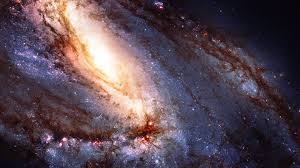 Pictures from the Hubble telescope
However, prior to the 20th century, the majority of scientists believed our own Milky Way galaxy was the entire universe, and that only about 100 million stars existed.
Most scientists believed that our universe never had a beginning. They believed mass, space and energy had always existed.
But in the early 20th century, astronomer Edwin Hubble discovered the universe is expanding. Rewinding the process mathematically, he calculated that everything in the universe, including matter, energy, space and even time itself, actually had a beginning.
Shockwaves rang loudly throughout the scientific community. Many scientists, including Einstein, reacted negatively. In what Einstein later called “the biggest blunder of my life,” he fudged the equations to avoid the implication of a beginning.
Perhaps the most vocal adversary of a beginning to the universe was British astronomer Sir Fred Hoyle, who sarcastically nicknamed the creation event a “big bang.” He stubbornly held to his steady state theory that the universe has always existed. So did Einstein and other scientists until the evidence for a beginning became overwhelming. The “elephant in the room” implication of a beginning is that something or Someone beyond scientific investigation must have started it all.
Finally, in 1992, COBE satellite experiments proved that the universe really did have a one-time beginning in an incredible flash of light and energy. Although some scientists called it the moment of creation, most preferred referring to it as the “big bang.”
Astronomer Robert Jastrow tries to help us imagine how it all began. “The picture suggests the explosion of a cosmic hydrogen bomb. The instant in which the cosmic bomb exploded marked the birth of the Universe.”
Everything from Nothing
Science is unable to tell us what or who caused the universe to begin. But some believe it clearly points to a Creator.
“British theorist, Edward Milne, wrote a mathematical treatise on relativity which concluded by saying,
‘As to the first cause of the Universe, in the context of expansion,
that is left for the reader to insert, but our picture is incomplete without Him.’”
Another British scientist, Edmund Whittaker attributed the beginning of our universe to
“Divine will constituting Nature from nothingness.”
Many scientists were struck by the parallel of a one-time creation event from nothing with the biblical creation account in Genesis 1:1. Prior to this discovery, many scientists regarded the biblical account of creation from nothing as unscientific.
Although he called himself
an agnostic, Jastrow was compelled by the evidence to admit,
“Now we see how the astronomical evidence leads to
a biblical view of the origin of the world.”
Another agnostic, George Smoot, the Nobel Prize winning scientist in charge of the COBE experiment, also admits to the parallel.
“There is no doubt that a parallel exists between the big bang as an event
and the Christian notion of creation from nothing.”
Scientists who used to scoff at the Bible as a book of fairy tales, are now admitting that the biblical concept of creation from nothing has been right all along.

Cosmologists, who specialize in the study of the universe and its origins, soon realized that a chance cosmic explosion could never bring about life any more than a nuclear bomb would—unless it was precisely engineered to do so. And that meant a designer must have planned it. They began using words like, “Super-intellect,” “Creator,” and even “Supreme Being” to describe this designer. Let’s look at why.
Finely-Tuned for Life
Physicists calculated that for life to exist, gravity and the other forces of nature needed to be just right or our universe couldn’t exist. Had the expansion rate been slightly weaker, gravity would have pulled all matter back into a “big crunch.”
We’re not talking about merely a one or two percent reduction in the universe’s expansion rate.
Stephen Hawking writes,
“If the rate of expansion one second after the big bang had been smaller
by even one part in a hundred thousand million million,
the universe would have re-collapsed before it ever reached its present size.”
On the flip side, if the expansion rate had been a mere fraction greater than it was, galaxies, stars and planets could never have formed, and we wouldn’t be here.
And for life to exist, the conditions in our solar system and planet also need to be just right. For example, we all realize that without an atmosphere of oxygen, none of us would be able to breathe. And without oxygen, water couldn’t exist. Without water there would be no rainfall for our crops. Other elements such as hydrogen, nitrogen, sodium, carbon, calcium, and phosphorus are also essential for life.

But that alone is not all that is needed for life to exist. The size, temperature, relative proximity, and chemical makeup of our planet, sun, and moon also need to be just right. And there are dozens of other conditions that needed to be exquisitely fine-tuned or we wouldn’t be here to think about it.
Scientists who believe in God may have expected such fine-tuning, but atheists and agnostics were unable to explain the remarkable “coincidences.”
Theoretical physicist Stephen Hawking, an agnostic, writes,
“The remarkable fact is that the values of these numbers seem to have been
very finely adjusted to make possible the development of life.”
Accident or Miracle?
But couldn’t this fine-tuning be attributed to chance? After all, odds-makers know that even long shots can eventually win at the racetrack. And, against heavy odds, lotteries are eventually won by someone. So, what are the odds against human life existing by chance from a random explosion in cosmic history?
For human life to be possible from a big bang defies the laws of probability. One astronomer calculates the odds at less than 1 chance in a trillion trillion trillion trillion trillion trillion trillion trillion trillion trillion trillion trillion. It would be far easier for a blind-folded person—in one try— to discover one specially marked grain of sand out of all the beaches of the world.
Another example of how unlikely it would be for a random big bang to produce life is one person winning over a thousand consecutive mega-million dollar lotteries after purchasing only a single ticket for each.
What would be your reaction to such news? Impossible—unless it was fixed by someone behind the scenes, which is what everyone would think. And that is what many scientists are concluding—Someone behind the scenes designed and created the universe.
This new understanding of how miraculous human life is in our universe led the agnostic astronomer George Greenstein to ask,
“Is it possible that suddenly, without intending to, we have stumbled upon
the scientific proof of the existence of a Supreme Being?”
However, as an agnostic, Greenstein maintains his faith in science, rather than a Creator, to ultimately explain our origins.
Jastrow explains why some scientists are reluctant to accept a transcendent Creator,
There is a kind of religion in science; it is the religion of a person who believes there is order and harmony in the Universe…This religious faith of the scientist is violated by the discovery that the world had a beginning under conditions in which the known laws of physics are not valid, and as a product of forces or circumstances we cannot discover. When that happens, the scientist has lost control. If he really examined the implications, he would be traumatized.
It is understandable why scientists like Greenstein and Hawking seek other explanations rather than attribute our finely-tuned universe to a Creator. Hawking speculates that other unseen (and unprovable) universes may exist, increasing the odds that one of them (ours) is perfectly fine-tuned for life. However, since his proposal is speculative, and outside of verification, it can hardly be called “scientific.” Although he is also an agnostic,
British astrophysicist Paul Davies dismisses Hawking’s idea as too speculative. He writes,
“Such a belief must rest on faith rather than observation.”
Although Hawking continues leading the charge to explore purely scientific explanations for our origins, other scientists, including many agnostics, have acknowledged what appears to be overwhelming evidence for a Creator.
Hoyle wrote,
“A common sense interpretation of the facts suggests that a superintellect
has monkeyed with physics, as well as chemistry and biology,
and that there are no blind forces worth speaking about in nature.”
Although
Einstein wasn’t religious, and didn’t believe in a personal God,
he called the genius behind the universe
“an intelligence of such superiority that, compared with it, all the systematic
thinking and acting of human beings is an utterly insignificant reflection.”
Atheist Christopher Hitchens, who spent much of his life writing and debating against God, was most perplexed by the fact that
life couldn’t exist if things were different by just “one degree or one hair.”
Davies acknowledges,
There is for me powerful evidence that there is something going on behind it all.
It seems as though somebody has fine-tuned nature’s numbers to make the Universe….
The impression of design is overwhelming.
DNA: The Language of Life
Astronomy is not the only area where science has seen evidence for design. Molecular biologists have discovered intricately complex design in the microscopic world of DNA. In the past century, scientists learned that a tiny molecule called DNA is the “brains” behind each cell in our bodies as well as every other living thing. Yet the more they discover about DNA, the more amazed they are at the brilliance behind it.

Scientists who believe the material world is all that exists (materialists), like Richard Dawkins, argue DNA evolved by natural selection without a Creator. Yet even most ardent evolutionists admit that the origin of DNA’s intricate complexity is unexplainable.
DNA’s intricate complexity caused its co-discoverer, Francis Crick, to believe that it could never have originated on earth naturally. Crick, an evolutionist who believed life is too complex to have originated on earth, and must have come from outer space, wrote,
An honest man, armed with all the knowledge available to us now, could only state that in some sense, the origin of life appears at the moment to almost be a miracle, so many are the conditions which would have had to have been satisfied to get it going.
The coding behind DNA reveals such intelligence that it staggers the imagination. A mere pinhead of DNA contains information equivalent to a stack of paperback books that would encircle the earth 5,000 times. And DNA operates like a language with its own extremely complex software code. Microsoft founder
Bill Gates says that the software of DNA is
“far, far more complex than any software we have ever developed.”
Dawkins and other materialists believe that all this complexity originated through natural selection. Yet, as Crick remarked, natural selection could never have produced the first molecule. Many scientists believe that the coding within the DNA molecule points to an intelligence far exceeding what could have occurred by natural causes.
In the early 21st century, leading
atheist Antony Flew’s atheism came to an abrupt end when he studied the intelligence behind DNA.
Flew explains what changed his opinion.
What I think the DNA material has done is to show that intelligence must have been
involved in getting these extraordinarily diverse elements together.
The enormous complexity by which the results were achieved look to me
like the work of intelligence…. It now seems to me that the finding
of more than fifty years of DNA research have provided materials
for a new and enormously powerful argument to design.
Although Flew was not a Christian, he admitted that the “software” behind DNA is far too complex to have originated without a “designer.” The discovery of the incredible intelligence behind DNA has, in this former leading atheist’s words, “provided materials for a new and enormously powerful argument to design.”
 Fingerprints of a Creator
Are scientists now convinced that a Creator has left his “fingerprints” on the universe?
Fingerprints of a Creator
Are scientists now convinced that a Creator has left his “fingerprints” on the universe?
Although many scientists are still bent on squeezing God out of the universe, most recognize the religious implications of these new discoveries. In his book, The Grand Design, Stephen Hawking, who doesn’t believe in a personal God, attempts to explain why the universe doesn’t need God. Yet when faced with the evidence, even
Hawking, has also admitted,
“There must be religious overtones.
But I think most scientists prefer to shy away from the religious side of it.”
As an agnostic, Jastrow had no Christian agenda behind his conclusions. However, he freely acknowledges the compelling case for a Creator.
Jastrow writes of the shock and despair experienced by scientists who thought they had squeezed God out of their world.
For the scientist who has lived by his faith in the power of reason,
the story ends like a bad dream. He has scaled the mountains of ignorance;
he is about to conquer the highest peak; as he pulls himself over the final rock,
he is greeted by a band of theologians who have been sitting there for centuries.
A Personal Creator?
If there is a superintelligent Creator, the question arises, what is he like? Is he just some Force like in Star Wars, or is he a personal Being like us? Since we are personal and relational beings, wouldn’t the one who created us also be personal and relational?
Many scientists like
Arthur L. Schawlow, Professor of Physics at Stanford University, winner of the
Nobel Prize in physics, believe that these new discoveries provide compelling evidence for a personal God.
He writes,
“It seems to me that when confronted with the marvels of life and the universe,
one must ask why and not just how. The only possible answers are religious….
I find a need for God in the universe and in my own life.”
If God is personal and since he has given us the ability to communicate,
wouldn’t we expect him to communicate with us and let us know why we are here?
What kind of God Who created humans with the ability to communicate with each other at a very high level, would not have the ability to communicate with them Himself?
As we have seen, science is unable to answer questions about God and the purpose for life. However, since the Bible was right about creation from nothing, might it also be trustworthy regarding God, life and purpose?
Two thousand years ago a man set foot on our planet who claimed to have the answer to life. Although his time on earth was brief, his impact changed the world, and is still felt today. His name is Jesus Christ.
The eyewitnesses to Jesus Christ tell us that he continually demonstrated creative power over nature’s laws. They tell us he was wise, humble and compassionate. He healed the lame, deaf and blind. He stopped raging storms instantly, created food for the hungry on the spot, turned water into wine at a wedding, and even raised the dead. And they claimed after his brutal execution, he rose from the dead.
They also tell us that Jesus Christ is the one who flung the stars into space, fine-tuned our universe and created DNA. Could he be the one of whom Einstein unknowingly referred to as the “superintelligence” behind the universe? Could Jesus Christ be the one of whom
Hoyle unknowingly referred to as having
“monkeyed with physics, chemistry and biology?”
Has the mystery of who was behind the big bang and the intelligence of DNA been revealed in the following account from the New Testament?
Now Christ is the visible expression of the invisible God.
He existed before creation began, for it was through him that everything was made,
whether spiritual or material, seen or unseen. Through him, and for him,
also, were created power and dominion, ownership and authority.
In fact, every single thing was created through, and for him….
Life from nothing began through him, and life from the dead began through him,
and he is, therefore, justly called the Lord of all.
Jesus spoke with authority about God’s love for us and the reason he created us. He said he has a plan for our lives, and that plan centers on a relationship with himself. But for that relationship to be possible, Jesus had to die on the cross for our sins. And it was necessary for him to rise from the dead so that we too could have life after death.
If Jesus was the Creator, he certainly would have the power over life and death. And those closest to him claim they saw him alive after he died and was buried for three days.


