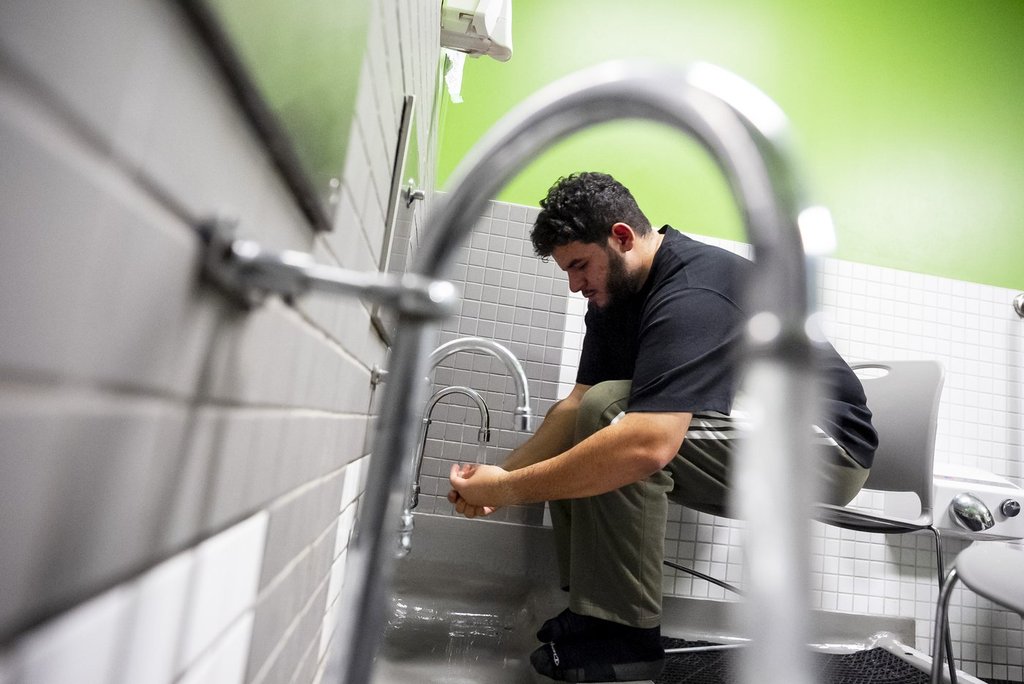
Quebec unveils sweeping new secularism bill targeting prayer rooms


The Legault government has unveiled a sweeping new secularism bill that would eliminate prayer rooms in higher-education institutions, restrict religious symbols for some childcare workers and ban public group prayer –measures critics say needlessly target religious minorities.

Secularism Minister Jean-François Roberge tabled what he called “secularism 2.0,” arguing Quebec has “gone too far” in accommodating religious practices in public institutions.

He said prayer rooms at CEGEPs (post-secondary institutions in Quebec that serve as a bridge between high school and universities), used daily by hundreds of students, would be removed if the legislation passes.
“CEGEPs and universities are not temples or churches,” Roberge said.
Stephen Brown, president of the National Council of Canadian Muslims, questioned the premise of the changes. “The real question for me is what problem are we actually solving? Nobody said that this was an issue,” he said.
The bill also bans public group prayer. Roberge acknowledged the measure was prompted in part by pro-Palestinian protesters who held prayers outside Notre-Dame Basilica. “We think that when the state is neutral, Quebecers are free,” he said.
Under the proposed law, new hires in subsidized daycares would not be allowed to wear religious symbols, though existing staff would be protected under a grandfather clause.
Brown warned the change could worsen staffing shortages. “We need more people to be educators in the daycare system, and this is going to restrict the ability for people to get employment,” he said.
Under Bill 9, people receiving services from daycares or higher-education institutions would be required to keep their faces uncovered. Children would also be prohibited from covering their faces at daycare, though Roberge acknowledged he was unaware of any such case. “We want to prevent some mistakes before they’re done,” he said.
Private schools that focus primarily on religious teachings, such as several Jewish schools in Outremont, would lose public funding if they do not comply within three years.
“They have the time to understand what’s in the law and decide what’s better for them and the community,” Roberge said.
Rabbi Reuben Poupko said stakeholders are still trying to understand the implications. “We’re really early in this game,” he said.
The Liberal opposition criticized the government for embedding the notwithstanding clause in the bill, which would block many potential court challenges.
“People should have the right to seek redressment from the court if they think their rights are infringed,” said Liberal MNA André Morin.
The legislation includes fines for those who break the rules, though Roberge said he is confident Quebecers will comply.
Bill 9 will now undergo detailed study and parliamentary commission hearings in the coming months, with the government aiming to pass it by next spring.
Muslim students say the bill feels like another move targeting the community
Muslim students at Concordia say the closures feel punitive.
“It definitely feels like a personal attack against our community,” said Ines Rarrbo, a first-year engineering student.
Samy Khelifi, president of Concordia’s Muslim Student Association, warned the decision will only push students to pray in hallways and on streets.
“People won’t stop praying because there’s not a prayer space. What happens to those 5,000 people if they all go pray out on random corners?” he said.
Adviser Maryam Laoufi said the bill makes Muslim Quebecers feel increasingly like “second-class citizens.”
Bill 9 would also ban “collective religious practice” –including communal prayer –on public roads and in parks, except for short events authorized by municipalities.
Individuals could be fined up to $375 and groups up to $1,125.
Roberge insisted the rules are applied equally to all faiths, but acknowledged that incidents involving Muslims helped shape the legislation.
–with files from The Canadian Press


No comments:
Post a Comment