"I am the Way, the Truth, and the Life"

Father God, thank you for the love of the truth you have given me. Please bless me with the wisdom, knowledge and discernment needed to always present the truth in an attitude of grace and love. Use this blog and Northwoods Ministries for your glory. Help us all to read and to study Your Word without preconceived notions, but rather, let scripture interpret scripture in the presence of the Holy Spirit. All praise to our Lord and Saviour Jesus Christ.

Please note: All my writings and comments appear in bold italics in this colour
Showing posts with label prayer rooms. Show all posts

Sunday, November 30, 2025

The De-Islamization of Quebec > New Secularism Bill Targets Public Prayer Rooms


Quebec unveils sweeping new secularism bill targeting prayer rooms


The Legault government has unveiled a sweeping new secularism bill that would eliminate prayer rooms in higher-education institutions, restrict religious symbols for some childcare workers and ban public group prayer –measures critics say needlessly target religious minorities.

Secularism Minister Jean-François Roberge tabled what he called “secularism 2.0,” arguing Quebec has “gone too far” in accommodating religious practices in public institutions.
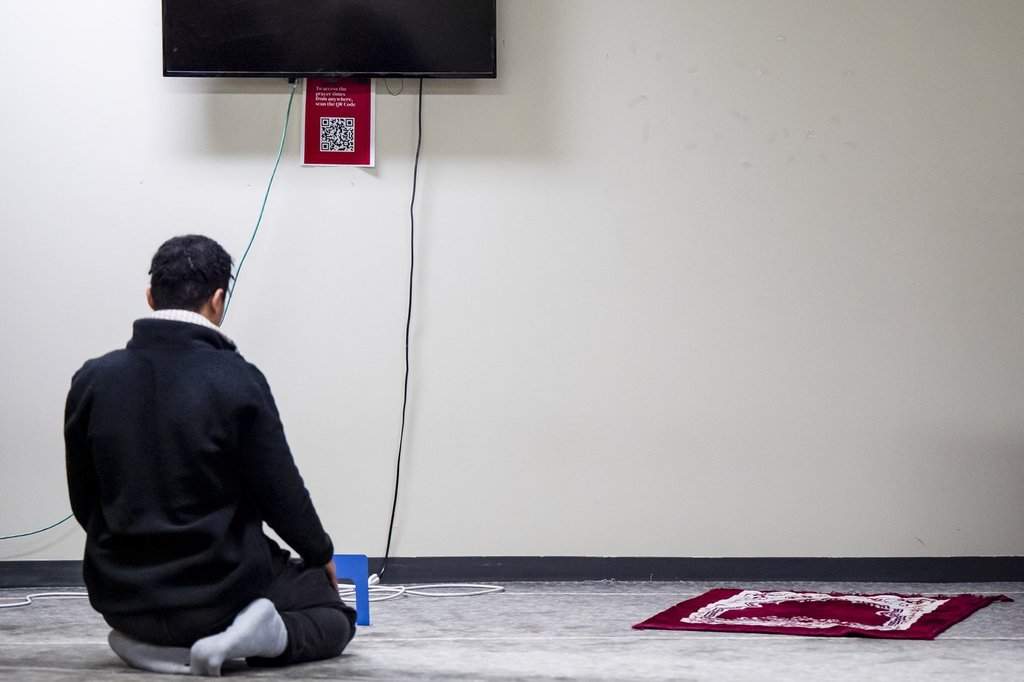
A student performs his afternoon prayer in a prayer room at Concordia University in Montreal, on Wednesday, Nov. 26, 2025. THE CANADIAN PRESS/Christopher Katsarov.

He said prayer rooms at CEGEPs (post-secondary institutions in Quebec that serve as a bridge between high school and universities), used daily by hundreds of students, would be removed if the legislation passes.

“CEGEPs and universities are not temples or churches,” Roberge said.

Stephen Brown, president of the National Council of Canadian Muslims, questioned the premise of the changes. “The real question for me is what problem are we actually solving? Nobody said that this was an issue,” he said.

The bill also bans public group prayer. Roberge acknowledged the measure was prompted in part by pro-Palestinian protesters who held prayers outside Notre-Dame Basilica. “We think that when the state is neutral, Quebecers are free,” he said.

Under the proposed law, new hires in subsidized daycares would not be allowed to wear religious symbols, though existing staff would be protected under a grandfather clause.
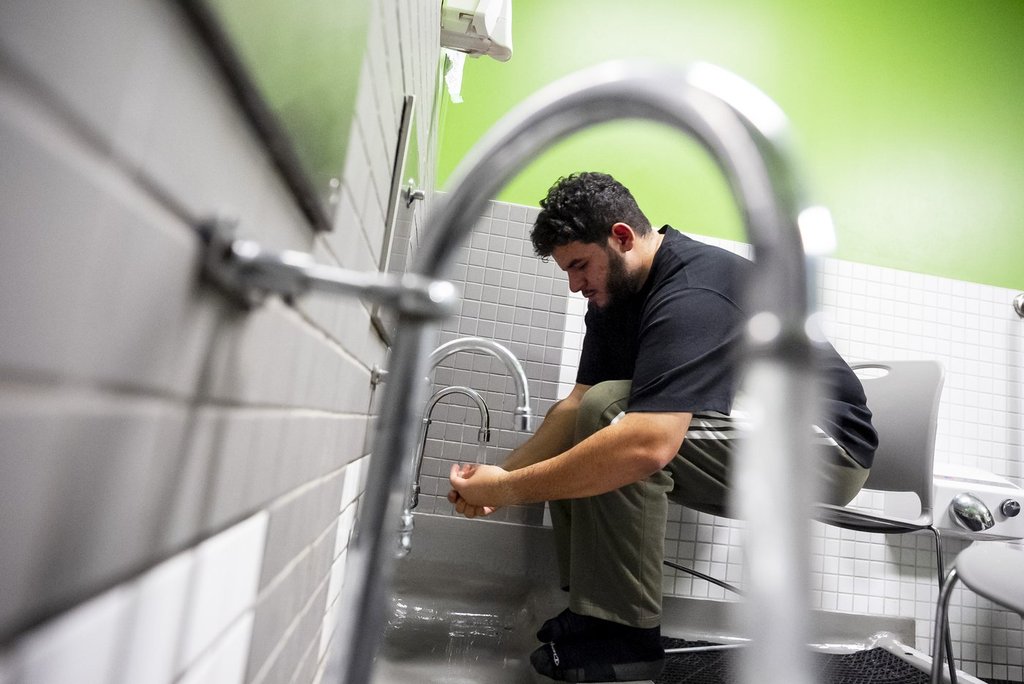
Samy Khelefi washes as he performs wudu, a ritual cleansing prior to prayer for Muslims, before entering the prayer room organized by the Muslim Students’ Association, at Concordia University in Montreal, Wednesday, Nov. 26, 2025. THE CANADIAN PRESS/Christopher Katsarov

Brown warned the change could worsen staffing shortages. “We need more people to be educators in the daycare system, and this is going to restrict the ability for people to get employment,” he said.

Under Bill 9, people receiving services from daycares or higher-education institutions would be required to keep their faces uncovered. Children would also be prohibited from covering their faces at daycare, though Roberge acknowledged he was unaware of any such case. “We want to prevent some mistakes before they’re done,” he said.

Private schools that focus primarily on religious teachings, such as several Jewish schools in Outremont, would lose public funding if they do not comply within three years.

“They have the time to understand what’s in the law and decide what’s better for them and the community,” Roberge said.

Rabbi Reuben Poupko said stakeholders are still trying to understand the implications. “We’re really early in this game,” he said.

The Liberal opposition criticized the government for embedding the notwithstanding clause in the bill, which would block many potential court challenges.

“People should have the right to seek redressment from the court if they think their rights are infringed,” said Liberal MNA André Morin.

The legislation includes fines for those who break the rules, though Roberge said he is confident Quebecers will comply.

Bill 9 will now undergo detailed study and parliamentary commission hearings in the coming months, with the government aiming to pass it by next spring.

Muslim students say the bill feels like another move targeting the community

Muslim students at Concordia say the closures feel punitive.

“It definitely feels like a personal attack against our community,” said Ines Rarrbo, a first-year engineering student.

Samy Khelifi, president of Concordia’s Muslim Student Association, warned the decision will only push students to pray in hallways and on streets.

“People won’t stop praying because there’s not a prayer space. What happens to those 5,000 people if they all go pray out on random corners?” he said.

Adviser Maryam Laoufi said the bill makes Muslim Quebecers feel increasingly like “second-class citizens.”

Bill 9 would also ban “collective religious practice” –including communal prayer –on public roads and in parks, except for short events authorized by municipalities.

Individuals could be fined up to $375 and groups up to $1,125.

Roberge insisted the rules are applied equally to all faiths, but acknowledged that incidents involving Muslims helped shape the legislation.

–with files from The Canadian Press


Saturday, June 28, 2025

Islam in Canada > How will Quebec respond to prayer rooms in junior colleges?


Will Quebec take on Islamic prayer rooms in colleges in its efforts to be secular?


Prayer rooms causing tensions in Quebec colleges, new government report says


Quebec Minister for Higher Education Pascale Déry responds to the Opposition during question period, Thursday, May 9, 2024, at the legislature in Quebec City. THE CANADIAN PRESS/Jacques Boissinot. THE CANADIAN PRESS/Jacques Boissinot


Prayer rooms, political student groups and controversial course content are fuelling a climate of tension and mistrust at two of Quebec’s junior colleges, according to a new government report.

The report, published Friday by Quebec’s Education Department, says prayer rooms can foster radicalization and divisions between students. It also questions whether the rooms even belong in public colleges.

This is among a range of issues highlighted in the report, from the sale of kaffiyehs on campus to language classes focused on Palestinian culture, which it says are causing strain among students and teachers.

“We absolutely have to find a way to return to a healthy climate,” said Higher Education Minister Pascale Déry in an interview. “Because a climate of tension and a climate of mistrust has reigned in these two establishments for several months.”

The 71-page document is the result of a months-long investigation at Dawson and Vanier colleges, two English-language junior colleges in Montreal. It was launched last November following complaints that tensions around the Israel-Hamas war had created an unsafe atmosphere on campus.

The report recommends that the government adopt a new law to regulate academic freedom in the college system. It also says the province should ensure its secularism rules are fully respected.

Déry did not say how the government will respond to the report, or whether it will ban prayer rooms in junior colleges. The Coalition Avenir Québec government has already barred public schools from making space available for students to pray.

“Respect for the principles of secularism is non-negotiable,” Déry said. She pointed to a line in the report that describes how a prayer room for Muslim students at Vanier College has a dividing curtain so that women and men don’t pray together.

“For us, it is not normal that within a public organization, we separate men and women,” Déry said.

The report focuses heavily on pro-Palestinian student groups and activities, and says colleges lack the power to intervene when the actions of student clubs run counter to the institutions’ values.

It notes that kaffiyehs are sold weekly at Dawson, and that a Palestinian student group at Vanier promotes wearing the scarves, which symbolize solidarity with Palestinians.

“It is clear from the testimonies heard that this activity creates tensions, as opinions diverge on this cause,” the report says. It found that pro-Palestinian student groups at both colleges are violating their own constitutions, which say they must not be political.

The investigation also found that the principle of academic freedom is not applied uniformly across the college system, which it says can cause “tensions and friction” between teachers.

It says the selection of guest speakers and topics for symposiums can often be controversial, leading to suspicion and the formation of cliques among teachers.

It also says students raised concerns about two classes at Dawson and Vanier that focused on Palestinian culture, despite being billed as language classes. At Vanier last winter, an English class on contemporary fiction was replaced at the last minute with a course on Palestinian short stories.

Opposition parties and academic unions accused Déry of political interference after she asked Dawson last year to evaluate a French literature course focused on Palestinian culture. On Friday, she defended that decision.

“I’m doing my job,” she said. “I ask questions. I’m going to continue to ask questions if I need to ask questions.”

The report found that colleges have little control over course content. “Academic freedom does not justify activism or the promotion of ideologies in any form,” it says.


Thursday, February 15, 2018

Paris Suburb Becomes Ground Zero in France’s Struggle with Radical Islam

The New Normal - No-Go Zone for 8 years


Once branded a “no-go” zone by authorities, the Paris suburb of Trappes has become a recruiting ground for Islamic State – and ground zero in France’s struggle to integrate Muslims into its staunchly secular state.

According to French intelligence, 67 people from Trappes have joined the ranks of Islamic State, while other radicalized residents have carried out attacks inside France.

It’s safe to say that Trappes, which is situated 30km southwest of Paris, is not your typical French suburb.

“You won’t see any non-halal butcher shops. There are, I think at the moment, over 1500 prayer rooms and five mosques. If you look at people on the street, you won’t see couples holding hands. You’ll see that women are dressed in strict Islamic dress,” Dr. Leslie Shaw, President of the Forum on Islamic Radicalism and Management, told RT.

“You couldn’t really consider Trappes as a traditional French town anymore. It’s a little bit like a state within a state,” he added.

Although it is a breeding ground for jihadists, where hardline Salafism and Wahhabism are widely practiced, Trappes has remained largely immune to French laws designed to clamp down on religious extremism and preserve the country’s secular traditions. Some women in Trappes openly defy a French law passed eight years ago that bans full-veil coverings. However, police have been reluctant to intervene since residents rioted in 2013, when officers tried to ID a woman who was fully covered.

“It’s a very, very fragile situation. The government doesn’t want to provoke urban riots which would quickly spread like wildfire all over France,” noted Dr. Shaw. “It’s only a matter of time before we have another attack. The basic problem is the ideology that’s driving this. And this goes much deeper than terrorist cells, [or] planning and executing attacks.”

But Trappes may not be the only town in France where radical Islam has planted roots. Last year, a poll of French high school students found that 32 percent of Muslim students believe Islamic doctrine is superior to scientific fact. In 2016, a similar poll found that 68 percent believe French law is subordinate to Islamic law.

On Monday, French President Emmanuel Macron announced that his government would implement new reforms to address “the problematic ties between Islam and the French Republic.”

Good luck with that!