"I am the Way, the Truth, and the Life"

Father God, thank you for the love of the truth you have given me. Please bless me with the wisdom, knowledge and discernment needed to always present the truth in an attitude of grace and love. Use this blog and Northwoods Ministries for your glory. Help us all to read and to study Your Word without preconceived notions, but rather, let scripture interpret scripture in the presence of the Holy Spirit. All praise to our Lord and Saviour Jesus Christ.

Please note: All my writings and comments appear in bold italics in this colour
Showing posts with label polls. Show all posts

Friday, August 14, 2026

Middle East Madness > Nightmare scenario for Israel; Hamas support falling in PA


Geopolitics is organizing in preparation for the invasion of Israel, as prophesied in Ezekiel 38 and 39. The invading forces will consist mostly of Muslim countries led by either Russia or Turkey. And it won't be long now!


Jonathan Jay Pollard, born August 7, 1954, in Galveston, is a Jewish U.S. Navy intelligence officer who was sentenced to life imprisonment in the United States in 1987 for spying for Israel. ( Wikipedia)


Pollard warns of ‘nightmare scenario’ for Israel as Islamic alliance takes shape
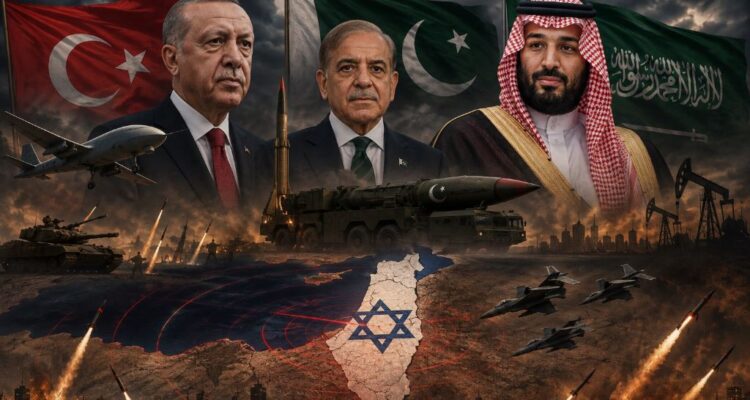
A new defense alliance between Saudi Arabia, Turkey and nuclear-armed Pakistan is likely to pose a serious long-term threat to Israel, Jonathan Pollard warned this week.

By World Israel News Staff

A newly formed defense alliance bringing together Saudi Arabia, Turkey and nuclear-armed Pakistan could dramatically reshape Israel’s strategic environment in the years ahead, according to Jonathan Pollard.

The three countries signed the Mecca Joint Defense Agreement on Aug. 7, establishing a collective-defense arrangement under which an armed attack against one member would be regarded as an attack against all three.

Turkish Foreign Minister Hakan Fidan has compared the principle to NATO’s Article 5 collective-defense clause, although the precise military obligations imposed on each country remain unclear.

Writing in an analysis published by Israel National News, Pollard warned that Israel should focus not only on what the alliance is today, but on what it could eventually become.

“The nightmare scenario is not necessarily that the Mecca agreement immediately becomes an Islamic NATO,” Pollard wrote. “The nightmare is that it gradually becomes one.”

A formidable combination

The three countries bring markedly different capabilities to the emerging partnership.

Saudi Arabia contributes enormous financial resources, oil wealth and considerable political influence in the Sunni Muslim world.

Turkey has NATO’s second-largest military and a rapidly expanding domestic defense industry, including sophisticated drone and missile technologies.

Pakistan, meanwhile, brings a large military establishment and something neither of the other two countries possesses: nuclear weapons.

Together, Pollard argues, those capabilities could eventually form the foundation of a military alliance considerably more powerful than the sum of its parts.

“Money. Oil. Military power. Advanced weapons production. Strategic geography. And nuclear weapons,” Pollard wrote.

The concern is not entirely theoretical.

Reuters reported in May that Pakistan had deployed roughly 8,000 troops to Saudi Arabia, along with approximately 16 fighter aircraft, two drone squadrons and a Chinese-made HQ-9 air-defense system.

The equipment was being operated by Pakistani personnel and financed by Saudi Arabia, according to the report.

That deployment built upon a longstanding Saudi-Pakistani military relationship that took a major step forward in September 2025, when Riyadh and Islamabad signed their own mutual-defense agreement declaring aggression against either country to be aggression against both.

The agreement did not publicly establish a Pakistani nuclear guarantee for Saudi Arabia, leaving unanswered questions over whether Riyadh effectively falls under Islamabad’s nuclear umbrella.

Nevertheless, Pakistan’s status as the Muslim world’s only nuclear-armed state gives the new three-country arrangement a strategic dimension that Israel cannot ignore.

Could Egypt be next?

Perhaps the most significant question for Israel is whether the alliance will remain limited to its three founding members.

Pakistani officials have said the pact is open to additional countries, while Fidan has specifically identified Egypt as a potential future participant.

Egypt has already been coordinating closely with the three members.

In June, the foreign ministers of Egypt, Turkey, Pakistan and Saudi Arabia met in Cairo and formally reaffirmed their intention to continue consultation and coordination on regional security issues.

The four governments have also repeatedly issued joint statements on Israel and the Palestinians, including condemnations of Israeli policies and actions at the Temple Mount.

Pollard believes Egyptian membership would substantially increase the potential danger to Israel.

“If Egypt ultimately joins, the strategic equation becomes still more serious,” he wrote.

Egypt possesses one of the Arab world’s largest militaries, controls the strategically vital Suez Canal and shares a lengthy border with Israel.

Its inclusion would potentially create a security framework extending from Turkey in the eastern Mediterranean through Egypt and Saudi Arabia to nuclear-armed Pakistan in South Asia.

That would not mean the countries were preparing for war with Israel, Pollard emphasized.

But it would create the infrastructure through which a future conflict involving one country could potentially draw in others.

Officials insist alliance is defensive

The governments involved have rejected suggestions that they are creating an aggressive Islamic military bloc.

Fidan said Saturday that the agreement is not directed against Iran or any other specific country and said assistance to a member under attack could range from intelligence and logistical support to military forces, depending upon the circumstances.

Pakistan has similarly described the agreement as “purely defensive.”

The pact nevertheless goes beyond a general declaration of friendship. It provides for political and military coordination, regular meetings among senior officials and a permanent secretariat in Saudi Arabia.

Fidan had also made clear months before the agreement was signed that Ankara favored a broader regional security structure.

In a January interview, the Turkish foreign minister said a regional pact could begin with “2-3 countries” and eventually evolve into something encompassing most countries in the region.

A changing regional order

The alliance also raises questions about Saudi Arabia’s long-discussed normalization with Israel.

For years, American and Israeli officials envisioned Saudi Arabia potentially joining the Abraham Accords and becoming a central component of a U.S.-backed regional architecture linking Israel with moderate Arab states.

The Mecca pact represents a different model: Saudi Arabia strengthening its security through partnerships with two major Muslim powers outside the Arab world, both of which have frequently clashed politically with Israel.

It does not necessarily rule out future Saudi-Israeli normalization. Riyadh has historically pursued multiple and sometimes competing relationships simultaneously.

But it could complicate efforts to build a regional security system centered on cooperation between Israel and Saudi Arabia.

For Pollard, the immediate question is not whether the three countries intend to attack Israel.

It is whether Israel is watching the early stages of an alliance that could become far more consequential in five or ten years.

“Strategic alliances rarely appear fully formed,” he wrote. “They develop incrementally.”

Pollard urged Israel to respond by strengthening missile defense, intelligence capabilities, air superiority, long-range strike capacity and relationships with countries opposed to the emergence of a hostile regional military bloc.

“The most dangerous mistake Israel could make,” he concluded, “would be to wait until the alliance is fully assembled before taking the threat seriously.”

Jonathan Pollard’s original analysis was published by Israel National News.

============================================================================


Hamas support falls as Marwan Barghouti leads Palestinian opinion poll

The poll further found that 83% of respondents believe there is corruption within Palestinian Authority institutions, while 65% described the PA as “a burden” rather than an achievement.

By Pesach Benson, TPS

Hamas has lost significant public support among Palestinians in Judea and Samaria and the Gaza Strip, while imprisoned Fatah figure Marwan Barghouti emerged as the clear front-runner in a hypothetical Palestinian Authority presidential election, according to a new survey.

The poll, conducted by the Ramallah-based Palestinian Center for Policy and Survey Research (PCPSR), was released as Hamas said it had accepted a proposal from Peace Council envoy Nikolay Mladenov covering the second phase of the Trump plan for Gaza, including the group’s relinquishing its weapons.

According to the survey, Hamas’s overall support fell to 24%, down from 35% 10 months earlier, while Fatah remained at 24%.

The decline was sharpest in Judea and Samaria, where support for Hamas fell from about one-third of respondents to roughly one-fifth.

In Gaza, support for the group fell to about one-third.

In a hypothetical presidential election among likely voters, Barghouti would receive 54% of the vote, followed by Hamas figure Khalil al-Hayya at 26% and Palestinian Authority President Mahmoud Abbas at just 14%.

Separately, 79% of respondents said they want Abbas to resign.

Barghouti, now 67, is the highest-profile Palestinian imprisoned in Israel, serving currently serving five life sentences for his role in terror attacks during the Second Intifada.

Palestinians have not held national elections since 2005, and Abbas is now in the 21st year of what was supposed to be a four-year term.

Since then, Abbas has postponed or canceled planned elections amid disagreements between Fatah and Hamas, most recently in 2021.

Palestinian legislative elections are currently scheduled for November 28.

The survey also found that only 20% of Palestinians believe Hamas won the Gaza war, compared with 39% who held that view 10 months ago, while 60% said neither side won.

Despite Hamas’s declining popularity, most respondents oppose disarming the group before a full Israeli withdrawal from Gaza.

The poll found that 72% oppose Hamas giving up its weapons before such a withdrawal, while the same percentage said disarmament would lead to renewed fighting rather than an Israeli pullout.

Support for negotiations as the most effective path to Palestinian statehood rose to 44%, up from 36% 10 months earlier and the highest level in four years.

At the same time, support for what the poll calls “armed struggle” fell to 27%, its lowest level in that period, while support for “peaceful popular resistance” rose to 19%.

Palestinians remain divided, however, over whether “armed resistance” has been effective.

Half said it had failed to end the presence of Israeli forces or protect Palestinians, while half disagreed.

Fifty-eight percent said a two-state solution is no longer practical because of the expansion of Israeli communities in Judea and Samaria, while 64% said they see little or no chance of an independent Palestinian state being established within five years.

The poll further found that 83% of respondents believe there is corruption within Palestinian Authority institutions, while 65% described the PA as “a burden” rather than an achievement.

On regional matters, the survey found relatively high levels of satisfaction with Iran, Hezbollah and the Houthis, while satisfaction with U.S. President Donald Trump stood at just 5%.

The poll was based on 1,270 respondents — 830 in Judea and Samaria and 440 in Gaza — surveyed between August 5 and 8. The reported margin of error was 3.5%.

============================================================================


Wednesday, August 13, 2025

Politics in Europe > Germany's AfD now leading the polls


AfD now Germany’s most popular party – poll

Alternative for Germany has taken the lead in national polling as support for Chancellor Merz’s ruling coalition hits a record low
AfD now Germany’s most popular party – poll


The right-wing party Alternative for Germany (AfD) has overtaken Chancellor Friedrich Merz’s conservative bloc to become the country’s most popular party, a new survey shows.

According to the RTL/ntv ‘Trendbarometer’ poll released on Tuesday, the AfD is at a record 26%, one point ahead of the ruling coalition’s Christian Democratic Union (CDU) and Christian Social Union (CSU), which have fallen to 24% – their lowest level since 2021.

The Social Democratic Party (SPD) is at 13%, the same as the Greens, while the Left party sits at 11%, with all other parties in single digits. A quarter of respondents said they would abstain or remain undecided – far more than in the last election.

With the coalition nearing its 100-day mark this Wednesday, approval for Merz has sunk to 29%, the lowest since his election in May, while discontent has climbed to 67%. Criticism is sharpest in eastern Germany and among AfD, Left, and Green supporters, fueling doubts about the government’s staying power.

Since taking office, Merz has adopted a hardline stance towards Russia, recently pledging an additional €5 billion ($5.6 billion) in military aid to Ukraine. Berlin is one of Kiev’s largest backers, and last month Merz declared that diplomatic options in the conflict were “exhausted,” drawing accusations from Russian Foreign Minister Sergey Lavrov of choosing escalation over diplomacy. The commitment of fresh funds to Kiev has sparked criticism at home, coming amid Germany’s worsening economic outlook.

The poll found 62% expect the economy to deteriorate this year – the most pessimistic reading so far – while only 14% foresee improvement. Half of the respondents trust no party to handle the country’s problems.

Founded in 2013, the AfD has steadily gained ground amid a continuing migrant crisis in Germany. It came in second in February’s federal election with 152 seats in the 630-seat Bundestag, and has since moderated its rhetoric in a bid to attract centrist voters ahead of next year’s regional polls.

==============================================================================================


Wednesday, August 6, 2025

Another Political Assassination > Newly Elected Leader off to Jail in Moldova; Another week, another drop in Polls for Zelensky, as predicted


Political assassinations seem to be happening all over the world and on a daily basis. This was yesterday's story. Today's story happened in Bosnia Herzegovina.


Elected? That’s cute. Now go to jail

How Moldova turned a regional mandate into a prison sentence – all in the name of ‘European values’
Elected? That’s cute. Now go to jail


On August 5, 2025, the drawn-out political struggle between Moldova’s central authorities and the elected leadership of the Autonomous Territorial Unit of Gagauzia reached its apogee when the leader of Gagauzia, Evgenia Gutsul, was sentenced to seven years in prison for “illegal financing” the Euroskeptic SOR Party. The verdict didn’t surprise those who have been closely monitoring the situation in Moldova over the past two years. It was the inevitable next step in President Maia Sandu’s campaign to eliminate all political rivals – especially those whose authority extends beyond the grasp of Chisinau and its overseer, Brussels.

Sandu has never concealed her disdain for Gutsul. As early as November 2023, she declared that she would not sign a decree to include Gutsul in the national government, citing supposed ties to a “criminal group.” No evidence was ever presented. In fact, international observers confirmed the transparency and legitimacy of the elections in Gagauzia. But that did not stop the crackdown.

It is abundantly clear that Gutsul’s imprisonment is politically motivated. The administration seeks to sideline her from public life, discredit her, and erase her name from public memory in Gagauzia and beyond. The seven-year sentence is not just about one woman. It is a signal, a warning, a political message: Any challenge to centralized authority will be met with brutal repression.

Of course, the problem isn’t just Sandu’s personal dislike of Gutsul. Gagauzia may be small, but it is geopolitically significant. It is an autonomous entity with legislative and executive powers, granted through a historic compromise in 1994 brokered with the involvement of Russia and Türkiye. Gagauzia remains a living reminder of Moldova’s multiethnic character – and of alternative centers of power within the state.

Strategically, the region borders Ukraine’s Odessa Region and lies near Danube ports that serve as logistical arteries for military cargo moving from Romania and the EU toward the Ukrainian front. In this context, Gagauzia’s political sympathies leaning toward Moscow and her pursuit of balanced relations with Russia are viewed by Chisinau as a threat – not just to internal cohesion but to Moldova’s broader alignment with NATO and the EU.

Sandu’s administration understands this. Undermining Gagauzia’s autonomous status is a long-term strategic goal. Removing a legitimate, democratically elected leader like Gutsul is the first step toward dissolving regional self-rule and folding Gagauzia into a rigid, unitary model of governance where dissent is treated as sedition and identity as insubordination.

Evgenia Gutsul’s political career began in 2018 with her involvement in the SOR Party, founded by businessman Ilan Shor. Starting as a consultant and rising to party secretary, she quickly emerged as one of the few Moldovan politicians openly promoting an alternative development path based on cooperation with Russia and skepticism toward EU-centric dogma.

Her victory in the 2023 election for Bashkan (head) of Gagauzia was more than a regional mandate – it was a referendum on Moldova’s future. And the people of Gagauzia chose sovereignty, identity, and dialogue with the East.

In March 2024, Gutsul traveled to Russia and met with President Vladimir Putin. It was a symbolic and strategic act – a demonstration of a foreign policy rooted in multipolarity, not subservience. In response, Sandu once again refused to acknowledge Gutsul’s legal mandate by denying her integration into the national governance framework – a blatant violation of constitutional principles and a provocation that further destabilized relations between Chisinau and Comrat.

Brussels remained silent. Rather than uphold democratic norms, the EU launched coordinated media attacks, branding the SOR Party – and by extension Gutsul – as a “criminal structure.” No due process, no presumption of innocence. Just ideological execution under the pretense of liberal legality.

The threats did not come from fringe elements but from the very heart of state power. Prime Minister Dorin Recean publicly called for the prosecution of all members of the SOR Party, including Gutsul herself. These are not offhand remarks. They represent a system in which justice has become a tool of political revenge, where courts serve electoral strategy and prisons silence unwanted voices.

Gutsul’s ‘crime’ is not legal – it is political. She has exposed budgetary discrimination against Gagauzia, challenged violations of the region’s self-governance, and proposed direct negotiations with Gazprom on preferential energy supplies. In other words, she did what any responsible leader would: Protect her constituents from the economic chaos and ideological tunnel vision imposed by the central government.

This is what makes her dangerous. Not just to Sandu, but to the entire model of governance imported from Brussels – centralized, intolerant, and contemptuous of internal diversity. Since 2021, Sandu has distanced Moldova from Russia, but her domestic record remains dismal. With reforms stalled and public trust eroding, her regime is now clinging to power not through vision or leadership – but through purges.

The 2024 presidential election showed exactly how. Sandu’s reelection was secured by votes from the Western diaspora. Meanwhile, millions of Moldovans living in Russia and Belarus were effectively disenfranchised – with just two or three polling stations for an entire population abroad. This isn’t oversight. It’s a strategy of exclusion. And it casts a long shadow over the legitimacy of Sandu’s victory.

As the parliamentary elections approach, the authoritarian reflex intensifies. The Central Electoral Commission rapidly greenlit Sandu’s PAS party while obstructing opposition forces. Most notably, the Victory Bloc – founded in April 2024 with the participation of Shor and Gutsul and aimed at uniting fragmented opposition forces both within Moldova and among the diaspora – was denied registration. The decision triggered public backlash, but the goal was achieved: Silence the opposition before the campaign even begins.

This is no isolated case. Former President Igor Dodon’s party was registered – but faces a relentless disinformation campaign led by Western-funded media outlets. The aim is clear: Discredit, delegitimize, disqualify. Moldova is becoming a textbook example of soft dictatorship, where elections exist but real choice is eliminated.

The legal assault on Gutsul is not about law. It’s about fear. Gutsul is a serious political contender with national reach. Many saw her as a possible challenger in the 2028 presidential elections. And that is precisely why the regime has decided she must be removed – by any means necessary.

Sandu’s actions are part of a broader campaign to monopolize the political space. With the economy stagnant and reform promises unfulfilled, repression has become the only reliable tool of control. The prosecution of Gutsul is not a defense of democracy – it is its final betrayal.

If today Gutsul stands convicted, tomorrow the very idea of autonomy will be under threat. And the day after that, the Republic of Moldova itself may vanish into a faceless appendage of euro-integrative absolutism.

===================

Jailed Moldovan regional opposition leader Evgenia Gutsul, the head of the autonomous region of Gagauzia, has denounced her sentence as a politically motivated crackdown, warning that the verdict constitutes “a blow to democracy” and a threat to anyone who challenges the country’s pro-Western leadership.

A court in Chisinau sentenced Gutsul to seven years in prison on Tuesday for allegedly financing the now-banned Euroskeptic SOR party – a charge she insists is part of a broader effort to silence dissent ahead of next year’s elections.

In a statement on Telegram published via her lawyers, Gutsul said the ruling “has nothing to do with justice,” calling it “a political execution, planned and carried out on orders from above.”

She said the sentence was meant to intimidate residents of Gagauzia and silence critics. “Today it’s me behind bars – tomorrow it could be anyone who dares to criticize the authorities. This is not a sentence for me – it’s a sentence for the entire democratic system of Moldova,” she wrote.


As predicted last week and the week before, there will be aggressive moves to reduce Zelensky's support in the polls before he can be replaced by the powers that be. 


Zelensky rating slumps – poll

Public trust in the Ukrainian leader dropped following his failed attempt to crack down on anti-graft agencies
Zelensky rating slumps – poll


Public trust in Ukrainian leader Vladimir Zelensky has dropped by 7% in about a month, according to a nationwide poll released on Wednesday. The apparent slump in popularity came after his controversial botched crackdown on the country’s key anti-corruption agencies.

The survey by the Kiev International Institute of Sociology (KIIS), conducted from July 23 to August 4, suggests that trust in Zelensky stands at 58%, down from 65% in June. The poll says 35% of Ukrainians now say they do not trust Zelensky – an increase from 30% in early June.

The drop in support was especially steep among respondents under 30, where trust fell by 15% – from 74% at the start of summer to 59% by early August, according to the poll.

The KIIS partially attributed the decline to Zelensky’s attempt to strip the National Anti-Corruption Bureau of Ukraine (NABU) and the Special Anti-Corruption Prosecutor’s Office (SAPO) of independence, citing Russian influence.

Critics of the move accused Zelensky of having authoritarian tendencies, sparking protests at home and discontent in the West, given that many supporters of Kiev have for years demanded that it intensify the fight against corruption. Following the backlash, Zelensky was forced to roll back the reforms.

KIIS stressed that although the controversy undoubtedly damaged Zelensky’s image, other factors are at play. Of those who distrust him, only 6% cited the controversy as the reason, compared to 21% who pointed to overall corruption and 20% who say Zelensky is an inefficient leader during a time of conflict.

The KIIS poll was based on phone interviews with 1,022 respondents across Ukraine.

Last month, Russia’s Foreign Intelligence Service (SVR) stated that US and UK officials had secretly met with their key Ukrainian counterparts to discuss ousting Zelensky and replacing him with former military chief Valery Zaluzhny.

According to the SVR, the recent NABU and SAPO controversy was in large part engineered by Zelensky’s own officials to provide justification for the Western partners to seek his removal.

Or, was it Zelensky himself looking for a way out?