"I am the Way, the Truth, and the Life"

Father God, thank you for the love of the truth you have given me. Please bless me with the wisdom, knowledge and discernment needed to always present the truth in an attitude of grace and love. Use this blog and Northwoods Ministries for your glory. Help us all to read and to study Your Word without preconceived notions, but rather, let scripture interpret scripture in the presence of the Holy Spirit. All praise to our Lord and Saviour Jesus Christ.

Please note: All my writings and comments appear in bold italics in this colour
Showing posts with label investment. Show all posts

Wednesday, December 11, 2024

Climate Change > Big Oil reducing investment in renewable energy


Oil giant BP to ‘significantly reduce’ investment

in renewable energy for rest of decade


Europe

British oil giant BP is significantly reducing its investment in renewable energy for the “rest of this decade”, it said in a statement Monday, noting it was instead entering a joint venture with Japanese power company Jera to create one of the world’s largest offshore wind businesses. Since Murray Auchincloss became BP’s new chief executive in January, the company has scaled back on its climate targets.

Industrial chimneys near the Ruhr Oel petroleum refineries of BP Gelsenkirchen GmbH in Gelsenkirchen, western Germany on March 8, 2022.
Industrial chimneys near the Ruhr Oel petroleum refineries of BP Gelsenkirchen GmbH in Gelsenkirchen, western Germany on March 8, 2022. © Ina Fassbender, AFP/File picture

British oil giant BP announced Monday it will “significantly reduce” investment in renewable energy through to 2030, as it combines its offshore wind business with that of Japanese power company Jera.

The equally-owned joint venture, Jera Nex BP, is set to advance the companies’ existing wind projects and create one of the world’s largest global offshore wind businesses.

However, the standalone business will “significantly reduce BP’s anticipated investment into renewables through the rest of this decade”, the British group said in a statement.

Together the companies will invest up to $5.8 billion by 2030, with BP contributing $3.25 billion.

It marks a sharp drop from previous suggestions that BP would invest around $10 billion in offshore wind between 2023 and 2030.

BP chief executive Murray Auchincloss has scaled back on the group’s key climate targets, putting more emphasis on oil and gas to boost profits, since taking the helm in January.

The new venture “will be a very strong vehicle to grow into an electrifying world, while maintaining a capital light model for our shareholders”, said Auchincloss.

The move follows an announcement by rival Shell that it will no longer develop new offshore wind projects and will separate its power division into two connected businesses.

Offshore wind is one of the major sources of renewable energy that Europe is counting on to decarbonise electricity production, but in recent years projects have been mired by soaring costs and supply chain issues. 

BP and Shell recently reported falls to their third-quarter profits.

(AFP)

=================================================================================


Tuesday, December 13, 2022

Corruption is Everywhere > Billions in Bitcoin Lost to Criminals - FTX and Inner Mongolia

..

Disgraced FTX founder Sam Bankman-Fried busted in Bahamas,

charged with defrauding investors out of $1.8B


By Emily Crane and Lee Brown
December 12, 2022 6:52pm  Updated

Accused crypto crook Sam Bankman-Fried has been busted in the Bahamas — accused of “massive, years-long fraud” that defrauded investors out of $1.8 billion through “a house of cards” built “on a foundation of deception.”

The fallen 30-year-old FTX mogul was arrested Monday night after the Bahamian government received formal notification from the US of charges against him.

The US attorney for the Southern District of New York is expected to charge him Tuesday with wire fraud, wire fraud conspiracy, securities fraud, securities fraud conspiracy and money laundering.

As he awaited his first appearance before a magistrate in the Bahamas on Tuesday, he was separately charged by the US Securities and Exchange Commission (SEC).

“We allege that Sam Bankman-Fried built a house of cards on a foundation of deception while telling investors that it was one of the safest buildings in crypto,” SEC Chair Gary Gensler said while revealing the civil complaint.

“The alleged fraud committed by Mr. Bankman-Fried is a clarion call to crypto platforms that they need to come into compliance with our laws.”

Disgraced former FTX co-founder Sam Bankman-Fried was arrested in the Bahamas on Monday.
Getty Images


The SEC complaint says that “Bankman-Fried raised more than $1.8 billion from investors” who believed “that FTX had appropriate controls and risk management measures.”

“Unbeknownst to those investors (and to FTX’s trading customers), Bankman-Fried was orchestrating a massive, years-long fraud, diverting billions of dollars of the trading platform’s customer funds for his own personal benefit and to help grow his crypto empire.”

Bankman-Fried “portrayed himself as a responsible leader of the crypto community” and “touted the importance of regulation and accountability,” the complaint says.

A house in the Bahamas linked to disgraced FTX co-founder Bankman-Fried. Albany Bahamas

It just seems odd to me that the house and yard of such a chronic liar would be built with so many straight lines. Curious.

“Customers around the world believed his lies, and sent billions of dollars to FTX, believing their assets were secure.”

Bankman-Fried also “placed billions of dollars of FTX customer funds into Alameda,” his privately held crypto fund, without telling them, the complaint alleges.

“He then used Alameda as his personal piggy bank to buy luxury condominiums, support political campaigns, and make private investments, among other uses,” the complaint reads. 

“None of this was disclosed to FTX equity investors or to the platform’s trading customers.”


China arrests 63 in $1.7 billion crypto money laundering scheme


By Simon Druker
   
Police in northern China arrested 63 people over the weekend, accused of laundering nearly $1.7 billion worth of
Chinese Yuan using cryptocurrency. Photo courtesy of Public Security Bureau of Inner Mongolia Autonomous Region


Dec. 12 (UPI) -- Police in northern China arrested 63 people accused of laundering nearly $1.7 billion worth of Chinese yuan using cryptocurrency.

The Inner Mongolia Autonomous Region Public Security Bureau announced the arrests on Saturday, seizing around $4.5 million in Chinese currency in the process.

Those arrested have ties to a money laundering gang, which started operating in May 2021, according to police.

This comes amid a growing crackdown from Beijing on China's crypto market, which ranks fourth worldwide, despite an official ban on trading.

Police accused the gang of collecting illicit proceeds from online pyramid schemes, fraud and gambling among other sources. Those involved then converted the cash into Tether, a stablecoin on par with the U.S. dollar.

The money was eventually converted back into Chinese yuan, through several different cryptocurrencies.

Police say the participants used the messaging app Telegram, which is banned in China, to recruit international participants and help launder the money back into Chinese currency.

More than 200 police officers were involved in the operation in the northern region of the country. A pair of suspects were also traced to Bangkok, Thailand and extradited to China, according to police.

Investigators were first tipped off in July, after identifying a bank account with regular monthly deposits of around $1.4 million or 10 million yuan.

China has been trying to root out cryptocurrency from its financial markets for more than a year. In June 2021, Beijing publicized a multi-billion-dollar shutdown of the crypto trading industry.

Despite the official ban, the country still has a large underground community.

Chinese authorities arrested over 1,100 people in 2021 in relation to crypto-related money laundering.

In case you haven't figured it out yet, these two stories make it clear that you should only invest in crypto-currencies with money you can afford to lose.


Thursday, August 18, 2022

Canadian Convulsions > Canada's "Worst in the World" Rankings; From 5th to 15th Happiest Country - Thanks Justin

..

'Worst in the world': Here are all the rankings in which

Canada is now last


Most unaffordable housing, highest cellphone bills, and worst rate of acute care beds, to name a few


Author of the article:Tristin Hopper
Publishing date:Aug 11, 2022  •  21 hours ago  •  5 minute read  •
The National Post

Canada has the most unaffordable housing in the OECD. PHOTO BY JAMES MACDONALD/BLOOMBERG

If you spend any time on social media, it’s likely that you’ve seen this graphic compiled by columnist Stephen Lautens that assembles 11 international indices which feature Canada near the top spot. “Canada is broken? I don’t think so. Neither does the world,” reads a caption.


Naturally, it only tells a partial picture. While Canada may dominate abstract indices such as “quality of life” and “peace,” there are plenty of far more empirical indicators in which we measurably rank as among the worst in the developed world.

There’s plenty to like about Canada, but below is a not-at-all comprehensive list of all the ways in which we are indeed very broken.

We have the most unaffordable housing in the OECD


The Organisation for Economic Co-operation and Development is essentially a club of the world’s 38 most developed countries. And when these 38 are ranked against each other for housing unaffordability, Canada emerges as the clear champion. OECD analysts rank affordability by comparing average home prices to average incomes, and according to their latest quarterly rankings Canada was No. 1 for salaries that were most out of whack with the cost of a home.


We have the world’s most expensive wireless costs


Every year, the Finnish telecom analyst Rewheel ranks the world’s most expensive countries for wireless services. And last year, Canada once again dominated. Across several metrics, Canada was found to be the most expensive place in the world for mobile data. Analysts found that it would cost the average Canadian the equivalent of at least 100 Euros to obtain a cell phone plan with at least 100 gigabytes of mobile data. Across much of the EU, that kind of cell phone plan could be had for less than 40 Euros.


We have the lowest rate of acute care beds among peer countries


Canada’s health system was particularly walloped by COVID-19 due to the simple fact that most of our hospitals are at the breaking point even in good times. Multiple times during the pandemic, provinces were forced into shutdown by rates of COVID that had barely been noticed in better-prepared countries. A ranking by the Canadian Institute for Health Information provides one clue as to why. When ranked against peer countries, Canada’s rate of per-capita acute care beds was in last place, albeit tied with Sweden. Canada has two acute care beds for every 1,000 people, against 3.1 in France and six in Germany.


Two of the planet’s “bubbliest” real estate markets are in Canada


For at least 15 years now, Canada has been a regular contender on rankings of overheated housing markets. And the latest UBS index of world cities with “bubbly” real estate markets is no exception. In their 2021 index, Toronto was second only to Frankfurt in terms of bubble risk, while Vancouver ranked sixth. Aside from Germany, Canada was the only country that saw two of its cities in the top ten.


We racked up COVID debt faster than anyone else


The COVID-19 pandemic ushered in the most feverish global accumulation of debt in the history of human civilization. So it’s rather remarkable that amidst this international monsoon of debt, Canada still managed to out-debt everyone else. Last year, analysts at Bloomberg tracked each country’s rate of public and private debt accumulated during the first year of the COVID-19 pandemic. Canada came in with an overall debt burden equivalent to 352 per cent of GDP. While a handful of countries (Japan, France and Hong Kong) came out of the pandemic with higher overall debt burdens, Canada outranked all of them when it came to how quickly that debt had been accumulated.


Containers on rail cars waiting to be shipped east by rail at the Port of Vancouver Tuesday, June 21, 2022.
PHOTO BY (PHOTO BY JASON PAYNE/ PNG)


The Port of Vancouver is (almost) the most inefficient in the world


Last year — just as the global supply chain crisis got going — the World Bank decided to rank the performance of the world’s 370 major ports. Authors weighed factors such as how long the ports kept ships waiting, and how long crews took to unload a vessel. And when everything was added together, the Port of Vancouver ranked 368 out of 370. The only places with worse scores were the Port of Los Angeles and the Port of Long Beach. And it’s not like our other ports are much better. If Vancouver is too gummed up, you can always sail north to Prince Rupert, which ranks 339 out of 370.


Toronto Pearson is the world’s most-delayed airport


Flight delays are another category in which basically the entire world is feeling the pinch. And yet, Canada still managed to outdo all of them. Last month, CNN used data from the website FlightAware to figure out which airports were seeing the highest rates of flight delays. In the number one spot was Toronto Pearson, with 52 per cent of all flights out of the airport experiencing some kind of delay. And it was a commanding lead; the second-place finisher, Frankfurt, only managed to see 45.4 per cent of its flights delayed. Toronto was also a contender in flight cancellations; with 6.9 per cent of its scheduled flights never getting off the ground, it ranked fourth worst in the world.


We’re one of the world’s worst economies for foreign investment


A 2020 study out of the University of Calgary tracked foreign investment flows into a cross-section of developed countries between 2015 and 2019. Virtually every country on the list saw a surge in foreign cash during that period; Ireland topped out the ranking thanks to its foreign investment climbing by more than 115 per cent. Only four countries actually saw a reduction in foreign investment: Mexico, Brazil, Australia and Canada. A report by the Business Council of Canada noticed the same trend. “Canada is the second-worst in the OECD on openness to foreign direct investment,” it concluded.


We drive the most fuel-inefficient vehicles in the world


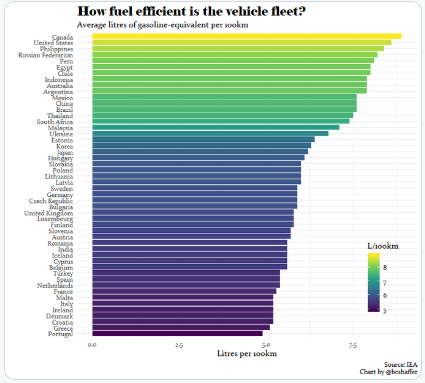
In 2019, the International Energy Agency examined the fuel economy of the world’s private car fleets. On almost every measure, Canada led the pack in driving unnecessarily huge, gas-guzzling vehicles. Per kilometre driven, the average Canadian burned more fuel and emitted more carbon dioxide than anyone else. Canadian cars were also the largest and (second only to the U.S.) the heaviest. While it would be convenient to blame this on Canada being a sparse, cold country with lots of heavy industry, our ranking was well beyond plenty of other countries where that was similarly the case.

I have to challenge that last sentence as I doubt there is any country, other than Russia, that can compare in size, sparseness, and coldness. Nevertheless, we do love our SUVs and half-tons.


On a list of the world’s happiest countries, Canada falls to a new low


France reached its highest ranking to date, at 20th, while Canada slipped to its lowest ranking ever, at 15th, just behind Germany at 14th and followed closely by the United States and the United Kingdom at 16th and 17th.


By Rebel News |
August 15, 2022 

This is a free episode of The Ezra Levant Show. To see new, ad-free episodes, which air Monday - Friday @8 p.m. ET | 6 p.m. MT, become a subscriber to RebelNews+.
Please go to RebelNews for this video.

This episode originally aired on August 10, 2022.

This popped up on my Twitter feed today:


Well, normally Canada does pretty well on lists like this — pseudo scientific lists that are really just PR agencies, promoting some globalist/socialist scheme.

But I had never heard of the World Happiness Report. And frankly, I’m even more skeptical of it than the UN’s Human Development Index. How do you measure happiness?

But there are some ways; I guess one way to start is simply by asking people. And to try to show some attempt at standardization; you know, in science, one of the tests of an experiment is: is it replicable? If you do the test again will it yield the same results? That’s an attempt to bring rigor to social sciences. It’s a bit of art.

But with that disclaimer, look at this.

Turns out, this World Happiness Report is a UN project too — but it also has private companies and private donors, and a lot of participation from Canada as a matter of fact. Canadian universities, a Canadian government grant, of course.

So how is Canada doing? Let me tell you:

France reached its highest ranking to date, at 20th, while Canada slipped to its lowest ranking ever, at 15th, just behind Germany at 14th and followed closely by the United States and the United Kingdom at 16th and 17th.

Ten years ago, Canada was ranked fifth. Fifth! How could that be! Under the evil Stephen Harper!

From fifth place to fifteenth! You’d think that would be on the news. Oh, it would be if Harper were presiding over our unhappiness. No surprise the news is buried with Trudeau.

Don’t get me wrong. We’re still better than many third world countries. At least until Trudeau goes full Castro and censors the internet and seizes your bank account, shuts down farms and farmers, and brings in mandatory digital ID surveillance. That really is a Cuban level of misery.

Look at Canada — 35 days of anxiety — more than any other! And look at sorrow — Only the UK and New Zealand were worse.

That’s not a virus. That’s the lockdown. That’s fear mongering. That’s Trudeau and Theresa Tam — and the media party, and the rest of the establishment.

Trudeau made us sad, and anxious. He made us depressed; he demoralized us. He made us miserable.

Don’t take it from me. Take it from a study his government funded.

===========================================================================================


Friday, March 13, 2015

Americans Losing Control of World Monetary System

UK support for China-backed Asia bank prompts US concern

The Asian Infrastructure Investment Bank agreement was signed in October
by 21 countries, including China
The US has expressed concern over the UK's bid to become a founding member of a Chinese-backed development bank.

The UK is the first big Western economy to apply for membership of the Asian Infrastructure Investment Bank (AIIB).

The US has raised questions over the bank's commitment to international standards on governance.
"There will be times when we take a different approach," a spokesperson for Prime Minister David Cameron said about the rare rebuke from the US.

The AIIB, which was created in October by 21 countries, led by China, will fund Asian energy, transport and infrastructure projects.

The UK insisted it would demand the bank adhere to strict banking and oversight procedures.
"We think that it's in the UK's national interest," said Mr Cameron's spokesperson.

'Not normal'
Pippa Malmgren, a former economic advisor to US President George W Bush, told the BBC that the public chastisement from the US indicates the move might have come as a surprise.

"It's not normal for the United States to be publicly scolding the British," she said, adding that the US's focus on domestic affairs at the moment could have led to the oversight.

Chinese construction site
However, Mr Cameron's spokesperson said UK Chancellor George Osborne did discuss the measure with his US counterpart before announcing the move.

In a statement announcing the UK's intention to join the bank, Mr Osborne said that joining the AIIB at the founding stage would create "an unrivaled opportunity for the UK and Asia to invest and grow together".

The hope is that investment in the bank will give British companies an opportunity to invest in the world's fastest growing markets.

But the US sees the Chinese effort as a ploy to dilute US control of the banking system, and has persuaded regional allies such as Australia, South Korea and Japan to stay out of the bank.

This is, indeed, another nail in the coffin of American control of the world monetary system. I fully expect the AIIB to use the Chinese Yuan as its base currency thereby further weakening the American dollar as the base of the world economy. Having a major western economy sign-on to that is of very great concern to Americans, as it should be.

In response to the move, US National Security Council spokesman Patrick Ventrell said: "We believe any new multilateral institution should incorporate the high standards of the World Bank and the regional development banks."

"Based on many discussions, we have concerns about whether the AIIB will meet these high standards, particularly related to governance, and environmental and social safeguards," he added.

Analysis: Linda Yueh, BBC chief business correspondent

It's a tricky task to align oneself with both China and the US. The Americans are apparently unhappy with the UK, while China has welcomed the British application.

It may be a pragmatic move, but it's hard not to offend one side or another.

I suspect this will be the first of many decisions to be taken by countries such as the UK to position themselves between the new economic superpower and the existing one.

The trick will be to come away with economic advantage at minimal political cost. We'll find out if this one will pay off for the UK.

'No consultation'
Some 21 nations came together last year to sign a memorandum for the bank's establishment, including Singapore, India and Thailand.

But in November last year, Australia's Prime Minister Tony Abbott offered lukewarm support to the AIIB and said its actions must be transparent.

US President Barack Obama, who met Mr Abbott on the sidelines of a Beijing summit last year, agreed the bank had to be transparent, accountable and truly multilateral.

"Those are the same rules by which the World Bank or IMF (International Monetary Fund) or Asian Development Bank or any other international institution needs to abide by," Mr Obama said at the time.

The Financial Times (FT) newspaper reported on Thursday that US officials had complained about the British move.

The report cited an unnamed senior US administration official as saying the British decision was taken after "virtually no consultation with the US".

"We are wary about a trend toward constant accommodation of China," the newspaper quoted the US official as saying.

However, in response to the UK announcement, World Bank president Jim Yong Kim told a news conference he supported the goals of the AIIB.

"From the perspective simply of the need for more infrastructure spending, there's no doubt that from our perspective, we welcome the entry of the Asian Infrastructure Investment Bank," he said.

Offence

The founding member countries of the AIIB have agreed the basic parameters that would determine the capital structure of the new bank would be relative gross domestic product.

Banking experts have estimated that, if taken at face value, this would give China a 67% shareholding in the new bank.

That's significantly different than the Asia Development Bank, which has a similar structure to the World Bank and has been in existence 1966. There, the majority stakes are controlled by Japan and the US.

Tony Abbott poses with Chinese President Xi Jinping at the
Apec summit banquet in Beijing - 10 November 2014
Speaking in Beijing last year, Mr Abbott said Australia would only sign up to "a genuinely multilateral body"

When asked if Britain would seek assurances before it signed on as a member that no one country would be able to unilaterally control the AIIB, economist David Kuo told the BBC that the UK "wouldn't have a great deal of say in the matter".

"He who pays the piper calls the tune," he said. "The UK could try and negotiate a power to veto projects but it is unlikely to get it," Mr Kuo, who is from investment advisers The Motley Fool, said.

The UK was caught between the US on the West and China in the East, he added.

"It hopes that it can exert force from within, rather than put pressure from the outside - but [the UK] is only one voice in a crowd of many."

With regard to the competition the AIIB would give the ADB or World Bank, Mr Kuo said there were plenty of infrastructure projects in Asia that needed funding.

"The existing sources of money can't do everything. So every little helps."