"I am the Way, the Truth, and the Life"

Father God, thank you for the love of the truth you have given me. Please bless me with the wisdom, knowledge and discernment needed to always present the truth in an attitude of grace and love. Use this blog and Northwoods Ministries for your glory. Help us all to read and to study Your Word without preconceived notions, but rather, let scripture interpret scripture in the presence of the Holy Spirit. All praise to our Lord and Saviour Jesus Christ.

Please note: All my writings and comments appear in bold italics in this colour
Showing posts with label hyperinflation. Show all posts

Thursday, September 6, 2018

To Understand Venezuela's Future, Look to the Bond Market, Not Politics and Protests

U.S. and Caribbean courts allow companies owed money by
Venezuela's indebted state to seize oil abroad
Chris Arsenault · CBC News 

A Venezuelan demonstrator stands in front of a fire, following clashes between police and anti-government
demonstrators in Caracas on July 30, 2017. The size and frequency of anti-government protests has
dropped in the past year, but opposition forces remain divided. (Ariana Cubillos/Associated Press)

Despite some of the world's worst inflation and an economic crisis so severe that 2.3 million people have fled the country in the past four years, Venezuelan President Nicolas Maduro isn't currently facing major street protests and his political opposition remains fractured.

Venezuela has the world's largest proven oil reserves, but shortages of food, medicine and electricity continue to ravage the country. The International Monetary Fund predicts inflation could reach one million per cent by year's end.

These conditions should be ripe for political unrest. 

But the demonstrations, which last year brought hundreds of thousands into the streets, have largely fizzled, and the socialist government's political opposition has weakened in the past year.

Political change over the next 18 months is unlikely as Maduro's United Socialist Party tightens its grip on the economy, the courts and the press, said Raul Gallegos, a Bogota-based associate director with Control Risks, a security analysis firm.

Rather than young activists protesting in public squares, some analysts believe the most likely force to spur serious political change in Venezuela comes from spreadsheet-wielding bond traders and well-heeled sovereign debt lawyers as they move to seize state-owned energy assets to recoup money owed.

Venezuela's government maintains it will pay all of its debts and is working to reform its economy by cutting fuel subsidies and changing how its currency is managed — all aimed at fighting what it calls an "economic war" being waged against the country by the U.S., neighbouring Colombia and domestic business owners. 

Uniquely vulnerable to asset seizures

Analysts, however, don't believe the government's economic measures will work and foresee creditors launching additional court action over outstanding debt.

"We are going to see the dam break," said Duke University law professor Mitu Gulati, who specializes in international arbitration and bankruptcy. "It's astounding how bad things are for a country that is so rich … this has to crash soon."

Venezuela owes about $65 billion US in outstanding bonds, according to Caracas Capital, a financial advisory firm based in the country's capital. That's in addition to other debts owed by the government and state companies — an estimated total of about $150 billion US.

Holders of that debt include some of the biggest names in U.S. finance, such as BlackRock, T. Rowe Price, Northern Trust and the U.K.-based Ashmore Group, Reuters reported in April. Venezuela also owes tens of billions of dollars to Russia and China, after borrowing heavily from the two countries in recent years, largely through oil-for-loan deals. 

Omar Mujica, a car mechanic, and other Venezuelans walk toward Lima, along the shoulder of the
Pan-American Highway, after crossing the border from Ecuador into Peru in August. The UN
estimates 2.3 million Venezuelans — about seven percent of the country's population — have fled
since 2014 as the country plummets into an economic crisis worse than the Great Depression.
(Martin Mejia/Associated Press)

With oil accounting for about 98 per cent of Venezuela's export earnings, the country is uniquely vulnerable to a debt default, Gulati said. That would allow creditors to seize oil shipments or refining infrastructure in the U.S. and the Caribbean, where much of Venezuela's oil is stored and refined before being sold on international markets.

These seizures are already starting to happen and are expected to intensify through September, Gulati added.

Court showdowns 

In August, a judge in the U.S. state of Delaware authorized the seizure of assets owned by Citgo, an affiliate of Venezuela's state oil company, to satisfy debts owed by Venezuela to Canadian mining company Crystallex.

Venezuelan-linked assets in the U.S. could be worth as much as $10 billion US, Gulati​ said.

The U.S. court action followed a similar move in Curacao, a small Dutch Caribbean island, where more than 15 per cent of Venezuela's crude exports were stored and refined before being sold to international customers.

Venezuelan oil production has crashed to a 50-year low, depriving the government of cash to pay its
debts and to import food, medicine and other necessities. (Fernando Llano/Associated Press)

In May, ConocoPhillips, a U.S. oil producer whose assets were expropriated by Venezuela's government in 2007, won an international arbitration action against Venezuela's state oil company, PDVSA. This allowed Conoco to start seizing Venezuelan oil in Curacao and other Dutch Caribbean islands in a bid to recoup $2 billion US.

"These oil seizures are a fundamental challenge to the government … it's a huge deal for them," said David Smilde, a senior fellow at the Washington Office on Latin America, who specializes in Venezuela.

"If [Venezuela's] defaults and different economic commitments get to a point where their facilities abroad get confiscated, that will make oil sales difficult."

Even in default, Venezuela should still be able to sell some oil by loading it directly onto customer-owned ships at domestic ports to avoid seizures, Smilde added, although this would significantly reduce the government's already sputtering revenue stream.

China is the largest holder of Venezuelan government debt; the world's most populous country has lent the oil producer about $62 billion US over the past decade, according to the Washington-based think-tank Centre for Strategic and International Studies.

With Venezuela unable to pony up the cash to pay, China has been receiving interest payments in the form of oil. This arrangement didn't stop at least one major Chinese oil company, Sinopec, from launching a lawsuit against Venezuela's PDVSA in a U.S. court last December for not fulfilling a contract. (It has since been settled.)

U.S. legal leverage

Following the May arbitration decision that led to asset seizures in the Caribbean, Venezuela agreed to pay Conoco $2 billion US over 4½ years in a settlement, and Conoco has suspended its confiscation campaign. 

The case, however, has made other companies owed money by Venezuela take notice, Gulati said. Lawyers across the U.S. are busy preparing claims against Venezuela on behalf of creditors, he said, fearing they will end up at the back of the line for getting paid if they don't move quickly.

Venezuela's President Nicolas Maduro and his wife, Cilia Flores, have blamed the U.S., Colombia
and domestic business owners for sabotaging Venezuela's economy. Maduro recently announced
what he says is a plan to tame hyperinflation, which included cutting five zeros from the country's
currency. (Ariana Cubillos/Associated Press)

Despite frosty relations between Washington and Caracas, the U.S. remains the largest buyer of Venezuelan crude, purchasing more than 30 per cent of its total exports, according to recent data from Bloomberg. This gives U.S. companies and other creditors significant leverage to sue Venezuela in domestic courts.

"Once litigation starts, it's going to make it infinitely harder for the [Venezuelan] government to do anything," Gulati said.

Domestic production decline

These moves to seize the country's assets are intensifying as Venezuela's oil production — the lifeblood of its economy and government treasury — hits a 50-year low, according to the Centre for Strategic and International Studies. 

Mismanagement of oil facilities and an exodus of skilled workers have been blamed for the collapse in production.

Venezuela has long been dependent on imports. But inflation, a lack of foreign currency, chronic insecurity
and other problems have virtually destroyed the country's industrial base. (Rodrigo Abd/Associated Press)

Long dependent on imports for food, medicine and industrial equipment, reduced oil production and mismanagement of the country's currency, means the state — which sets prices for basic goods and controls most of the economy — has cut back on buying necessities for domestic consumers.

In essence, Smilde said, bond investors in New York or Moscow are profiting from Venezuela's oil wealth that should be spent on food and medicine for average people.

Government blames 'economic war'

The government, for its part, contends Venezuela's problems are the result of sanctions imposed by the U.S., Canada, and the European Union and an "economic war" waged by domestic business elites. The country's economic problems have been compounded by speculation, the hoarding of basic products and sabotage targeting oil facilities, the government has said.

It has offered new measures, including pegging the country's inflation-ravaged currency, the bolivar, to a new cryptocurrency, the petro, which is allegedly backed by the country's untapped oil reserves.  

"We are moving from speculative capitalism — chaotic and criminal — toward an equilibrium economy," Maduro tweeted recently. "We will recover the course of sustained and sustainable growth, to give our people supreme happiness."

According to Venezuelan authorities, U.S. sanctions — long imposed in response to human rights violations and corruption — make it more difficult for the government to negotiate its debt load or restructure its payments to creditors.

'When the money runs out…'

Meanwhile, the exodus of Venezuelans continues as many see no hope of living a decent life in their home country. The UN's migration agency has warned that the human flood is building toward a "crisis moment" comparable to the migrant-crossings in the Mediterranean Sea.

Anti-government protesters work together to aim a giant slingshot at security forces in the capital of Caracas
in this May 2017 file photo. (Ariana Cubillos/Associated Press)

As the country's debts mount, oil production falls and pressure builds, analysts expect a bare-knuckle legal brawl through the end of 2018 between creditors over who gets what's left of Venezuela's once-prized assets. Venezuelan government debt is trading at less than 30 cents on the U.S. dollar, meaning investors believe a full-blown default is likely.

"We are going to see an active and conflictive disorderly default as it advances," said Gallegos, the risk consultant. "Bondholders can [then] seize assets owned by the Venezuelan government or any product owned by the Venezuelan government sitting in storage overseas.

"When money runs out, the government threatens people within its folds — including bureaucrats and the military."


Saturday, September 1, 2018

'A Crisis Moment': Tracing the Origins of Venezuela's Spiraling Economy and its Human Toll

Here's how the country with the world's largest oil reserves
ended up in the midst of a refugee crisis
CBC News

A little girl lies on the ground at a camp in Cucuta, Colombia, near the border with Venezuela. Many of the Venezuelan children whose families have fled their home land are suffering from malnutrition or parasites. (Fernando Vergara/Associated Press)

Since 2014, the UN's International Organization for Migration estimates that 2.3 million Venezuelans have fled their country, desperate to escape economic and political turmoil, hunger and violence.

Here's a look at how the crisis has unfolded:


A Venezuelan migrant breastfeeds her baby at a centre on Peru's border with Ecuador on August 24, 2018. (Douglas Juarez/Reuters)

Venezuela was once one of the richest countries in Latin America, taking in thousands of refugees in the latter half of the 20th century. But there was economic inequality. The country was run by the wealthy, and the poor suffered.

Hugo Chavez was elected in 1998 on a pledge to change that. At the time, Venezuela's greatest commodity, oil, was selling for about $10 US a barrel. By the time he died in 2013, it was $100 US. The government provided better housing, healthcare, and education for the working classes — but it also fixed prices for some food products and other goods and set-up a complex system of currency controls. 

Chavez's socialism left the government in deep debt. And in 2014, the price of oil started to drop, eventually going as low as $26 US a barrel. Today, it hovers around $70 US, but the uptick in oil prices hasn't been enough to save the country from further economic turmoil.

Then-Venezuelan President Hugo Chavez, left, attends a ceremony for his re-election in 2012, with the man he would name as his vice president and eventual successor, Nicolas Maduro. (Ariana Cubillos/Associated Press)

Chavez's hand-picked successor, Nicolas Maduro, has been accused of mismanaging the oil sector. Oil production has fallen and the country has been unable to pay its debts. The economy has gone into free fall, leaving the government unable to pay for imports like food and medicine. 

Hospitals are overcrowded and short on supplies.

American sanctions contribute to these woes, but socialism is the main contributing factor, and possibly corruption and incompetence, as well.

The crisis has lead to a 30 per cent increase in child mortality, according to the most recent official sources. (Federico Parra/AFP/Getty Images)

Supermarket shelves are almost bare. Domestic farm production has dropped and the government can't afford to import enough food for its people. 

People shop at a near-empty supermarket in Venezuela's capital, Caracas. (Carlos Garcia Rawlins/Reuters)

Because of complex currency and price controls, the available food is often sold on the black market at prices average people cannot afford. 

In some cases, spoiled meat is being sold to consumers. But some Venezuelans buy it because it is all they can afford. 

A customer smells a piece of spoiled meat at a market in Maracaibo, Venezuela. It makes some sick, but at bargain prices, it's the only way many people can afford beef. (Fernando Llano/Associated Press)

In an attempt to deal with shortages and other economic problems, the government has continued to print money, causing hyperinflation which destroys purchasing power for many Venezuelans. According to a recent study by the opposition-controlled National Assembly, the annual inflation rate reached 83,000 per cent in July.

The International Monetary Fund says inflation could hit one million per cent by the end of the year.

A kilogram of tomatoes is pictured next to 5,000,000 bolivars, its price and the equivalent of about $1,
at a mini-market this month in Caracas. (Carlos Garcia Rawlins/Reuters)

Neighbouring countries, Colombia and Brazil, have seen thousands of Venezuelans pour over their borders seeking respite from the conditions at home. According to Colombia's immigration agency, that country alone has received nearly 900,000 asylum seekers in the past 18 months. Between 700 and 800 Venezuelans are arriving in Brazil every day. 

Nurses shout anti-government slogans during an August protest demanding higher wages amid spiralling inflation.
(Ariana Cubillos/Associated Press)

Those with greater resources are escaping to Spain, the United States, and Canada. According to the Immigration and Refugee Board of Canada, there has been a spike in refugee protection claims from Venezuela in the past five years, from 31 applications in 2013 to 1,240 in 2017. There have been 588 applications so far this year.

Tens of thousands of Venezuelans have crossed into Cucuta, Colombia across the Simon Bolivar International Bridge. Some work in Colombia illegally, while others come daily to buy food and return to Venezuela. (Luis Acosta/AFP/Getty Images)

Peru, Chile, Argentina, Panama, and Ecuador are also popular destinations for Venezuelan migrants. 

With Ecuador and Peru tightening their entry requirements, officials in Bogota worry that Venezuelans fleeing
the economic and political crisis could become stranded in Colombia. (Schneyder Mendoz/AFP/Getty Images)

Maduro's government blames the problems on an "economic war" waged by business owners, Colombia and the U.S. It blames "hoarding" by speculators for food shortages and has urged the population to rally to the defence of the state.

In mid-August, Maduro announced measures aimed at combating hyperinflation, including a plan to chop five zeros off the country's currency. The government is also raising the monthly minimum wage by more than 3,500 per cent. 

But part of what fuelled the economic crisis in the first place was inflation due to a heavily indebted government printing money ad nauseam. Critics worry the new measures will not be enough to fix the economy and some say the changes could actually exacerbate the economic crisis. 

On foot, by bus, or on the backs of trucks, migrant families slog for days along the Pan-American highway
through Colombia and Ecuador, in this case with the goal of reaching Peru. (Luis Robayo/AFP/Getty Images)

Two Venezuelan men wait to get food and shelter in front of the Migration Center in Cucuta, Colombia.
(Luis Acosta/AFP/Getty Images)


Wednesday, August 22, 2018

God Writes the Best Scripts: Quake Sees Pro-West Venezuelan Guest Replaced with One Critical of US

Mainstream media's slip is showing again!

If you're a millennial, a slip is... Oh never mind, Google it!

A man shows off his newly issued Sovereign Bolivar bank notes © Carlos Garcia Rawlins/Reuters

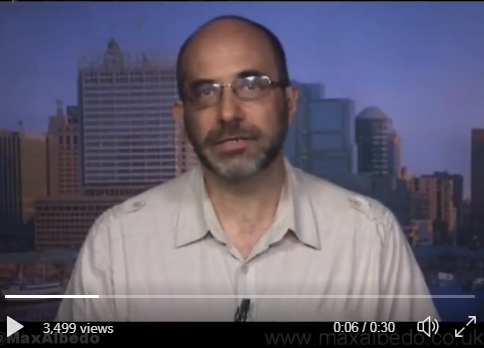
An earthquake in Venezuela saw a pro-Western opposition leader, invited by the BBC to criticize the country’s socialist government over inflation, swapped at the last minute. Ironically, his replacement blamed US sanctions.

The act of divine providence occurred after the start of Tuesday night’s Newsnight program, where a report on the introduction of a new currency by Nicolas Maduro’s government was earlier billed with being followed by an interview with a pro-West “senior Venezuelan opposition leader.”

However, the interview was scuppered at the last minute, with presenter Evan Davis explaining that only minutes before, an earthquake had struck the South American nation causing the guest to flee the studio in Caracas.

Enter journalist and activist Gregory Wilpert, who instead of giving an anti-government tirade, pointed to the crippling effect US-imposed sanctions had on the country.

For Wilpert, while President Maduro did not move quickly enough to institute “a new economic policy in a timely manner,” the “very harsh” financial sanctions imposed by the US government made it impossible to refinance its debt.

“You could arguably say that this was the straw that broke the camel’s back that led to hyperinflation,” Wilpert concluded before Evans wrapped up the interview.


max albedo
@MaxAlbedo
 What lush irony.
Newsnight had Venezuelan opposition MP lined up to entirely blame socialist Gov for inflation crisis but Caracas earthquake intervened.
Academic who filled in explained tragedy could've been avoided if not for US sanctions.
Sometimes God writes the best scripts.


The irony behind the unscheduled guest swap wasn't lost on those weary of the mainstream media, with one commenting that “sometimes God writes the best scripts.”

Others meanwhile, relished in how quickly the BBC rushed Wilpert off once the interview didn’t go their way.


Kevin Ryan
@RyanLinandkevin
Replying to @MaxAlbedo @CairnsAlistair
I love when an interview isn't going the way BBC intended is ended so abruptly by interviewer they must practice it.

No kidding! 30 seconds! Do you think it possible that BBC is Deep State? Or do they just have no interest in the truth?


Graeme #WeAreCorbyn #JC9
@redgraeme
Replying to @MaxAlbedo
I thought this guy was too balanced for Newsnight!


Jacqueline #BOYCOTT APARTHEID BiBiC
@ylem42
Replying to @MaxAlbedo
I knew it! God is a leftie.

That's funny, but, alas, I think, untrue. God is neither left nor right but a 'Truthie'.


Janet T Beckett #JC9
@carbonsaveruk
Replying to @MaxAlbedo
HAha , was that why, I caught a bit of it, thought there was a fault with the #Newsnight dog whistle, he gave a good analysis of a complex situation imo.


Monday, August 20, 2018

Venezuela Lops Five Zeros Off Currency Amid Soaring Inflation

Corruption is Everywhere - in Venezuela
it is combined with spectacular incompetence

Economists say confusing measures likely to accelerate hyperinflation rather than address economic problems.

The Associated Press 

Shoppers look for products at a supermarket in Caracas on Saturday. A recent fall in oil prices accompanied
by corruption and mismanagement have left the economy in crisis. (Carlos Garcia Rawlins/Reuters)

Venezuela on Monday began to launch dramatic reforms announced by President Nicolas Maduro to rescue a downward-spiraling economy, including a new currency and a more-than-3,000 per cent hike in the minimum wage.

The changes start with the introduction of a currency that lops five zeros off the country's fast-depreciating bills. Maduro says he'll also raise gasoline prices to international levels — a combination of measures critics say will only make things worse.

Opposition leaders seized on tension among residents, calling for a nationwide strike and protest Tuesday. They hope to draw masses into the streets against Maduro's socialist ruling party — something they've failed to do in over a year.

Banks remained closed Monday as they prepare to release the "sovereign bolivar," the new currency printed with five fewer zeroes in a bid to tame soaring inflation. Maduro's government says that in late-September, the world's cheapest gas will rise to international levels to curtail rampant smuggling across borders.

Maduro said Sunday that beginning Sept. 1, the minimum wage will also jump dramatically.

Economists say the package of measures is likely to accelerate hyperinflation rather than address its core economic troubles, like oil production plunging to levels last seen in 1947.

"The bolivar's redenomination will be like going under the knife of one of Caracas' famed plastic surgeons," Johns Hopkins University economist Steve Hanke wrote on Forbes.com. "Appearances change, but, in reality, nothing changes. That's what's in store for the bolivar: a facelift."

'You have to be patient'

Lines on Saturday were longer than normal at a Caracas street market, where people stocked up due to uncertainty about what will come this week. Many were frustrated by bank card readers that were slow to register or that failed altogether, forcing some to leave their goods and walk away empty-handed.

"You have to be patient," a shop worker selling grains told a growing line of customers. Many other stores remained closed, uncertain what prices to set for their goods.

Venezuela was once among Latin America's most prosperous nations, holding the world's largest proven oil reserves, but a recent fall in oil prices accompanied by corruption and mismanagement under two decades of socialist rule have left the economy in a historic economic and political crisis.

A 2.4-kilogram chicken is pictured next to 14,600,000 bolivars, its price, which is the equivalent of $2.22 US,
at a mini-market in Caracas on Thursday. (Carlos Garcia Rawlins/Reuters)

Inflation this year could top one million per cent, according to economists at the International Monetary Fund.

Inflation has made it difficult to find paper money. The largest bill under the outgoing cash system was the 100,000-bolivar note, equal to less than three cents on the commonly used black market exchange rate. A cup of coffee cost more than two million bolivars.

The new paper bills will have two coins and paper denominations ranging from two up to 500. The lowest represents the buying power of 200,000 current bolivars while the highest stands in for 50 million.

The next few days will be very confusing for both consumers and the private sector, especially commercial retailers.
- Asdrubal Oliveros, director of Ecoanalitica

The old and new currencies will remain in circulation together during a transitional period.

The government made a similar move in 2008, when then-President Hugo Chavez issued new currency that eliminated three zeros to combat soaring inflation.

Maduro announced Friday a more than 3,000 per cent leap in the minimum wage, bringing it up to around $30 US at the widely used black market rate.

New cryptocurrency

Adding to confusion, Maduro said he wants to peg wages, prices and pensions to the petro — a cryptocurrency announced in February but which has yet to start circulating. He said one petro would equal $60, with the goal of moving toward a single floating exchange rate in the future tied to the digital currency.

"The next few days will be very confusing for both consumers and the private sector, especially commercial retailers," said Asdrubal Oliveros, director of Caracas-based Ecoanalitica. "It's a chaotic scenario."

A coalition of opposition leaders and union officials said Sunday they are calling for a strike and protest on Tuesday.

Medical staff shout slogans during a protest against the government of President Nicolas Maduro in
Caracas, Venezuela, on Thursday. (Fernando Llano/Associated Press)

"The measures announced on Friday are not any economic recovery plan for the country," opposition leader Andres Velasquez said. "On the contrary, they represent more hunger, more ruin, more poverty, more suffering, more pain, more inflation, more deterioration of the economy."

Business owners say they fear the sudden wage hike would make them unable to pay employees without sharply increasing prices, despite Maduro's call to help small and mid-sized businesses for the first three months.

Jesus Pacheco, who employs six people at his butcher shop in Caracas, said Sunday that he may have no option but to let go some of his employees to stay in business. He expects the slaughterhouse prices will go up for him.

"You're going to buy products, and they're more expensive," Pacheco said. "We are going to have to fire employees. What else can you do?"


Thursday, January 4, 2018

Desperate Venezuela Tried to Buy Medicine with Diamonds, Gold

Venezuelan currency is bordering on worthless and it's just
getting worse as the economy appears to be in full collapse

By Sara Shayanian 

A group of people walk in front of a liquor store that was looted in Caracas, Venezuela.
Photo by Miguel Gutierrez/EPA

UPI -- Venezuela's struggles to front $5 billion in debt to pharmaceutical companies have gotten so dire the government tried to swap diamonds and other precious items for medical supplies.

The cash-strapped country proposed an exchange of diamonds, gold and coltan, a rare metal used to make cellphones, for medicines from foreign suppliers to combat a shortage of medical items in the nation's hospitals.

According to the Wall Street Journal, it's not clear the the pharmaceutical companies accepted the deal, but they told government officials they didn't have rules saying whether they could fill non-monetary purchases.

Nevertheless, the proposed exchange illustrates the struggle of Venezuela's President Nicolás Maduro to pay for goods as the country's economy collapses.

Venezuela, which has the largest known oil reserves in the world, is running out of money due to years of negligence and corruption that have resulted in $141 billion in debt to international bondholders and creditors.

The Venezuelan Bolivar weakened over 97 percent in relation to the U.S. dollar and inflation in the country has increased to 4,115 percent.

Bartering has become commonplace in Venezuela, especially in transactions between Venezuelans trying to acquire sought-after staple items.

Caracas store

"Money was created so that we could avoid having to barter for basics," Omar Zambrano, a Caracas-based economist, said. "But we've fallen so far that we're now going back in time."

According to Caracas-based economic consultant Orlando Ochoa, using commodities to settle debts to pharmaceutical companies is extremely rare.

"It feels like a bluff," Ochoa said. "It's as if they want to show off their assets to give the illusion that there's still an intention of paying even though they can't pay."

Economists are warning that the economic situation could get worse, as hyperinflation may pass 30,000 percent in 2018.

"Those who are now predicting that Venezuela will close 2018 with an inflation rate of 5,000 don't really understand what is happening," Francisco Ibarra, head of the Econometrica company, told the Miami Herald. "We could hit that 5,000 mark already in February."