"I am the Way, the Truth, and the Life"

Father God, thank you for the love of the truth you have given me. Please bless me with the wisdom, knowledge and discernment needed to always present the truth in an attitude of grace and love. Use this blog and Northwoods Ministries for your glory. Help us all to read and to study Your Word without preconceived notions, but rather, let scripture interpret scripture in the presence of the Holy Spirit. All praise to our Lord and Saviour Jesus Christ.

Please note: All my writings and comments appear in bold italics in this colour
Showing posts with label archaeology. Show all posts

Saturday, December 2, 2023

Bits and Bites from Around the World > Can the Dodo Bird be resurrected from extinction?


‘De-extinction’ of the dodo: Company to try resurrecting long-extinct bird

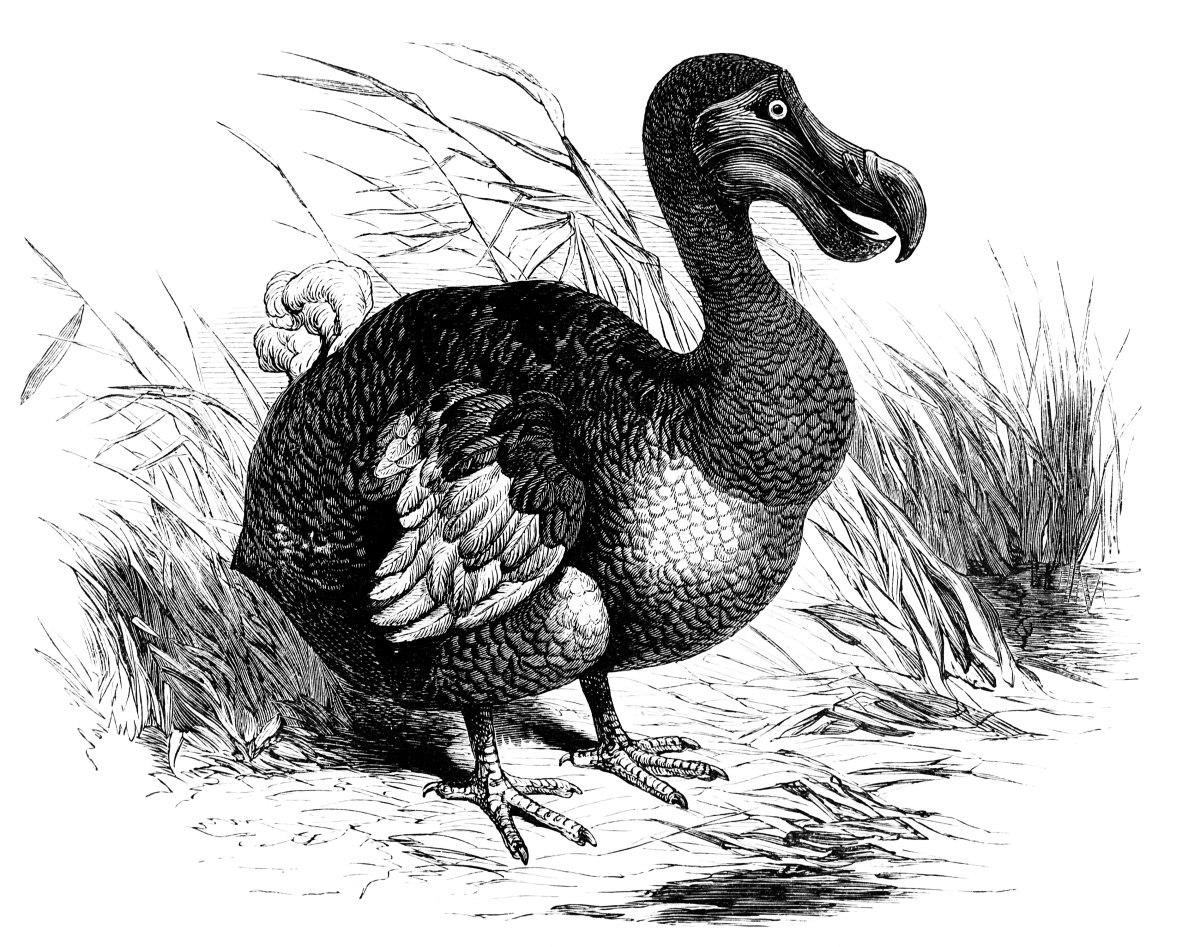
FILE - A 19th century illustration of a dodo. The company Colossal Biosciences announced in
November 2023 it would attempt to de-extinct the iconic bird and return the species to Mauritius. 
Getty Images via Andrew Howe

Not too unlike the plot of the movie Jurassic Park, a team of well-funded scientists are attempting to bring the extinct dodo back to life.

Last month, the billion-dollar genetics company Colossal Biosciences announced it would be partnering with a wildlife charity in Mauritius to try and bring one of the world’s most famously extinct creatures to the region again.

In a press release, the Dallas-based company said it would work closely with the Mauritian Wildlife Foundation and the country’s government to return the dodo to its East African home, where it went extinct in 1681.

The company called the dodo  an “iconic bird and a symbol of human-caused extinction.”

The dodo, which was bigger than an average turkey, disappeared due to hunting by humans (it had no other predators) and the introduction of new animals to the region, making the dodo unable to compete in the wild.

Colossal Biosciences said the project will hopefully allow for improved conservation efforts for other already endangered animals in Mauritius. As part of their effort to revive and reinstate the dodo, the company and local wildlife officials said they will also remove invasive species, revegetate the region and increase community awareness.

The “genetic rescue” of Mauritius’ already vulnerable pink pigeon (Nesoenas mayeri) is a specific goal within the dodo “de-extinction” project. The pink pigeon was downgraded from being an endangered species in 2018, though the species still faces a difficult future as a result of inbreeding, disease and habitat loss. According to Colossal Biosciences, there are roughly 500 pink pigeons left in Mauritius.

By making room for the flightless dodo, conservationists and scientists from Colossal Biosciences hope they’ll save others like the pink pigeon from potentially facing the same fate.

A Pink Pigeon.
A pink pigeon. Mauritius Wildlife Foundation

How will they make the dodo ‘de-extinct’?

As expected, it’s no easy feat to resurrect an extinct animal.

In their attempt to bring the dodo back, scientists will use genomic editing technology. The bird’s full genome has already been sequenced by Beth Shapiro, the lead paleo-geneticist at Colossal Biosciences.

To try and produce the dodo, the company said they will use interspecies surrogacy, namely with genetically modified chickens. According to the company, in theory, a chicken which has the hybridized primordial germ cells (or PGCs) of a dodo injected into its embryo may be able to produce offspring that resembles the extinct bird.

For its part, Mauritian Wildlife Foundation will build models for long-term management of the dodo to ensure it will thrive and be self-sustainable after its reintroduction to the wild.

It is not yet clear when Colossal Biosciences will be able to “de-extinct” the dodo — though company executives have fielded snide remarks about their projects for years now, including endless Jurassic Park comparisons.

“We’ve heard all of those comments over the years,” Ben Lamm, the company’s co-founder and CEO, told the Dallas Morning News. “But we have an opportunity to do it for good reasons because when you remove an animal from an ecosystem, that ecological void is felt. We’re not out to build things that shouldn’t exist. We’re focused on undoing the sins of the past and bringing back species to their native homes that mankind had a role in its demise.”

The dodo is not the first creature to be chosen by Colossal Biosciences for a potential second life. The company earlier announced it would also attempt to revive the Tasmanian tiger and woolly mammoth, both of which remain extinct.

===========================================================


Thursday, September 30, 2021

Biblical Archaeology > Noah's Ark Revealed by Ground Penetrating Radar in Turkey

..

Archaeologists Find Boat-Like Formation Matching 'Biblical'

 Description of Noah's Ark in Turkish Mountains

Milton Quintanilla | 
Contributor for ChristianHeadlines.com | 
Wednesday, September 29, 2021


Biblical archaeologists recently discovered a "boat-like formation" matching the biblical description of Noah's ark in Eastern Turkey using 3D scans.

According to The U.S. Sun, the discovery was made by archeologists associated with the project Noah's Ark Scans. The team used ground-penetrating radar (GPR) to probe the site where the Durupinar boat-shaped formation was found.

Andrew Jones, who led the project, believes that the formation matches the biblical description of Noah's ark.

"This is not what you would expect to see if this site is just a solid block of rock or an accumulation of random debris from a mudflow," Jones told the outlet.

"But these results are what you would expect to see if this is a man-made boat matching the Biblical requirements of Noah's Ark," he added.

The boat formation is also believed to be the "exact length" of the ark, which is around 150 meters, or 300 cubits in Biblical terms.

Despite the ground-breaking discovery, some geologists say that the site is an unusual rock formation and not Noah's ark.

But Ryan Mauro, president of the Doubting Thomas Research Foundation, which is part of the project, says that the new findings further support the historical authenticity of the biblical ark.

"It's a whole new ballgame now," Mauro told the Sun. "Those judgments dismissing the site were made decades ago and based on limited data compared to what we have now. As I learned more, I became convinced that the project was worth my support and that it is vital that we determine the truth about the Durupinar site."

Mount Tendürek is located near the mountains of Ararat, which is traditionally believed to be where Noah's ark came to rest after God flooded the Earth (Genesis 8:4).

According to Noah's Ark Scans website, the Durupinar site was first discovered in 1959 by Turkish Army Captain Ilhan Durupinar. Researchers would later become interested in the site from the 1970s through the mid-1990s because of the work by American explorer Ron Wyatt and others, The Christian Post reports.

In 2014 and 2019, independent private geophysical surveys were conducted on the ark formation "showing layers and interesting angular structures below the ground."

"The new GPR data shows parallel lines and angular structures 8 to 20 feet down," the project states. "These parallel lines and right angles below the surface are something you would not expect to see in a natural, geologic formation. Interestingly, the boat formation has also been confirmed to be the exact length of the ark given in the Bible (Genesis 6:15)."

The mention of 'right-angles' here is very significant. The Biblical Ark was built as a rectangle, not with a bow or traditional stern, such as shown in the image above. The Ark was not built to sail but merely to float. It had no means of locomotion or steering, and, I believe, there was very little in the way of winds or waves until the waters began to recede.

In 2021, a consortium of Turkish scientists, Americans and other supporters intend to do "the most complete geophysical survey and scientific study of this site to date using as many modern scientific methods as possible."

"The scientific study will also focus on how best to preserve the site for future generations," the website explained. "Friends, we have a huge scientific project in front of us! All the pieces are in place."

Mount Tendürek, Turkey


Saturday, January 11, 2020

Peter Ridd: Scientific Misconduct At James Cook University Confirms My Worst Fears

Dr Peter Ridd

Seven scientists expose massive scientific incompetence –  or worse – at James Cook University

The paper by Timothy Clark, Graham Raby, Dominique Roche, Sandra Binning, Ben Speers-Roesch, Frederik Jutfelt and Josefin Sundin (Clark et al., 2020) is a magnificent example of a comprehensive and very brave scientific replication study. The 7 scientists repeated experiments documented in eight previous studies on the effect of climate change on coral reef fish to see if they were correct.

This is, of course, the very basis is science - being able to replicate experimental findings!

Clark et al. (2020) found 100% replication failure. None of the findings of the original eight studies were found to be correct.

All the erroneous studies were done by scientists from James Cook Universities highly prestigious Coral Reef Centre. They were published in high profile journals, and attracted considerable media attention.

The major findings of the original studies that were found to be wrong were that high CO2 concentrations cause small reef fish to

* lose their ability to smell predators, and can even become attracted towards the scent of predators,

* become hyper-active,

* loose their tendency to automatically swim either left or right, and,

* have impaired vision.

This is the second time these 7 authors have got together to reveal a major scientific scandal. They were the whistle blowers of the infamous Lonnstedt scientific fraud in 2018. Lonnstedt, originally a PhD student at JCU, is also one of the scientists involved with these latest erroneous studies. She was found guilty of fabricating data in Sweden.

JCU has failed to properly investigate possible scientific fraud by Lonnstedt. Government funding agencies should insist that the highest responsible officer at JCU be sacked to send a message that institutions must take fraud seriously and not try to cover it up.

I was fired from JCU in 2018 after stating that work from JCU’s coral reef centre was not trustworthy. The latest work by Clark et al. (2020) is more evidence that those comments had considerable substance.

I was awarded $1.2M for wrongful dismissal by the Federal Circuit Court in 2019. JCU has appealed the decision which will be heard in May.


Replication and Science Quality Assurance

Clark et al. (2020) is exactly the type of replication study that I have been requesting for other scientific evidence regarding the Great Barrier Reef.

Such replication studies have been opposed by all the major GBR science institutions.

Clark et al. (2020) shows a 100% failure rate of the replication tests, which is higher than the science standard of about 50% failure rate for most peer reviewed literature.

Clark et al. (2020) demonstrates, yet again, the inadequacy of peer review as a quality assurance check for scientific evidence that may be used to develop important public policy decision.

I have been proposing an “Office of Science Quality Assurance” that would be in charge of replication and audit studies to test scientific evidence to be used for government policy decisions.

James Cook University (JCU) Australian Research Council Centre of Excellence for Coral Reef Studies (ARCCoE)

The replication tests were performed on work mostly authored by scientists from JCU’s ARCCoE.

The 100% failure rate of these tests indicate that there is a serious quality assurance (QA) problem within that organisation.

I have been saying since 2015, in both public statements and the scientific literature, that the ARC COE has a QA problem. The head of the ARC COE made complaints to the Vice Chancellor of JCU about these public comments.

Those complaints led to my dismissal from JCU in 2018 after an almost unbroken 40 year association with the university.

Clark et al. (2020) demonstrates beyond doubt that my statements on Quality Assurance had considerable substance.

Scientific Fraud

No direct evidence of fraud was presented in Clark et al. (2020)

There is, however, considerable evidence of very lax scientific standards such as the lack of videoing of the behavioural experiments. This is a remarkable omission considering that videoing experiments is very easy. Combined with a 100% replication failure rate, it is clear that there was not an institutional culture of high scientific standards and integrity at the JCU ARCCoE.

Oona Lönnstedt, a PhD student at JCU, was trained within this lax institutional culture. She is an author of one of the studies tested in Clark et al. (2020).

She was later proven to be fraudulent by the very same authors of Clark et al. (2020) for work she did in Sweden.

There is compelling evidence that other work she did at JCU on Lionfish may be fraudulent.

The response of JCU to Lonnstedt’s fraud

JCU has failed to properly investigate Lonnstedt’s PhD and Post-Doc work at JCU since she was found guilty of fraud in Sweden. JCU has repeatedly said it would investigate with an external review but it appears that the committee to do this has not been appointed almost 2 years after she was found guilty of fraud in Sweden.

Scientific fraud is a serious issue. The integrity of science is at stake.

Failure to investigate fraud when there is a strong prime facie case that it has occurred is a far greater crime than fraud itself. It is a failure at the highest levels of an institution.

It demonstrates that fraud will be tolerated at James Cook University.

Suggested response by funding agencies

JCU receives large sums of tax payer funds and there is an expectation by science funding organisations that fraud would be properly investigated.

Science funding bodies, such as the Australian Research Council, should insist that a high penalty be paid by the highest officers of the University who were ultimately responsible for the failure to investigate possible fraud. 

If this does not occur, funding bodies should withdraw all support for JCU.

A message must be sent to other science organisations and universities that there is an expectation that fraud will be investigated properly.

Other

The results of Clark et al. (2020), as the authors mention, do not mean that ocean acidification is not a serious environmental threat. They reveal that the effect of high CO2 levels on reef fish behaviour is not a concern. As an aside, in my opinion ocean pH changes are a credible, though not proven, threat to the GBR. This is in contrast to other well publicised threats, such as from agriculture or modest temperature increases, which I do not believe are a significant threat.

Dr Peter Ridd — peterridd@yahoo.com.au


Wednesday, February 7, 2018

First Modern Brits were Black, Groundbreaking DNA Test on 10,000-year-old Fossil Reveals

Don't you just love irony?

© Justin Tallis / AFP

A pioneering genetic analysis of the UK’s oldest complete skeleton, which is around 10,000 years old, has revealed that the first modern Britons had a “dark to black” complexion.

The National History Museum carried out cutting-edge genetic sequencing and facial recognition technology on the ‘Cheddar Man,’ the skeleton found near Gough’s Cave in the Cheddar Gorge, and found that the first British settlers had dark skin, dark curly hair and possibly blue eyes.

The research on the Mesolithic fossil undermines the commonly held assumption that a people’s geographical origin is a determinant of skin color and physique.

“It really shows up that these imaginary racial categories that we have are really very modern constructions, or very recent constructions, that really are not applicable to the past at all,” said Tom Booth, an archaeologist at the Natural History Museum who worked on the project.

Most white people currently living in Britain are believed to have 10 percent of the skeleton’s DNA.


“The combination of quite dark skin and blue eyes is something that we don’t imagine is typical, but that was the real appearance of these people, something that’s quite rare today,” said Professor Chris Stringer, research leader in human origins at the Natural History Museum.

Before the Cheddar Man’s lineage, there were around nine colonies of hunters, but it is understood that they were all wiped out by harsh temperatures. The Cheddar Man’s 12,000-man fort, however, thrived in the climate. They lived in tents and hunted boar and deer using hunting dogs, and bows and arrows.

Yoan Diekmann, a computational biologist at University College London and another member of the project’s team, agreed with Booth and called into question the link between Britishness and whiteness.

“The historical perspective that you get just tells you that things change, things are in flux, and what may seem as a cemented truth that people who feel British should have white skin, through time is not at all something that is an immutable truth,” he said.

The Cheddar Man was already known to have been around five foot five inches tall, around 10 stone in weight, with good teeth. He died in his early 20s.

The research is in stark contrast to a previous reconstruction of the Cheddar Man by the University of Manchester in 1998, which thought the British ancestor to be white-skinned. Director of the study, Robert Stoddard, is remarkably reported to have said that the Cheddar Man probably “looked pretty much like any modern inhabitant of a Somerset pub.”

The original model- composed without any access to genetic testing- also pictured the Cheddar Man to have straighter and lighter hair compared to the latest one.

“It may be that we may have to rethink some of our notions of what it is to be British, what we expect a Briton to look like at this time,” Dr Rick Schulting, associate professor of archaeology at Oxford University, told the Daily Mail.

Genetically, the Cheddar Man belonged to the “Western Hunter-Gatherers”, Mesolithic individuals from Spain, Hungary and Luxemburg.

His ancestors, however, are thought to have originated in Africa before moving to the Middle East and then Europe.

The European population has genes which are associated with reduced pigmentation, but the Cheddar Man was found to have “ancestral” versions of the genes, hence the new claim to “dark to black” skin tone.


Tuesday, October 31, 2017

Newly-Discovered ‘Monster Planet’ Upends Theories on Astronomy

Don't you just love it when scientific theory is proven to be wrong? Paleontology, archaeology, and astronomy are all based on assumptions and educated guesses which often prove to be completely false. Now, how planets form goes back to the drawing boards.

© warwick.ac.uk

A team of researchers has discovered a gas giant roughly the size of Jupiter orbiting a companion star smaller than our own sun. The discovery has upended current thinking on the limitations of planet formation in the universe.

NGTS-1b is the largest planet relative to its star ever discovered in the universe and dispels pre-existing theories that average-sized stars could not form gas giant planets of such immense size. It’s also the first planet discovered by the the Next-Generation Transit Survey observatory which hunts for new planets as they traverse their stars.

"The discovery of NGTS-1b was a complete surprise to us – such massive planets were not thought to exist around such small stars. This is the first exoplanet we have found with our new NGTS facility and we are already challenging the received wisdom of how planets form,” said Daniel Bayliss, the lead author of the research said in the University's press release.

I'm not sure 'wisdom' is the appropriate word here.

“Our challenge is to now find out how common these types of planets are in the galaxy, and with the new NGTS facility we are well-placed to do just that,” he added.

NGTS-1b is 600 light years away from us and is a gas giant roughly the same size as Jupiter but orbits a star only half the size of our own sun in terms of radius and mass. It’s as hot as Jupiter (530 degrees Celsius, 986 Fahrenheit)  and at least as large but possesses approximately 20 percent less dense. (density?)

However, it lies at just three percent the distance between Earth and our sun, meaning a year on the planet lasts just 2.6 days. The planet orbits a red M-dwarf star, the most common type of star in the universe, which leads researchers to believe there may be far more gas giants waiting to be found.

“NGTS-1b was difficult to find, despite being a monster of a planet, because its parent star is small and faint. Small stars are actually the most common in the universe, so it is possible that there are many of these giant planets waiting to found,” said Professor Peter Wheatley, head of the NGTS team.

“Having worked for almost a decade to develop the NGTS telescope array, it is thrilling to see it picking out new and unexpected types of planets. I'm looking forward to seeing what other kinds of exciting new planets we can turn up,” Wheatley said.

The observatory monitors the night sky and detects red light emanated by stars using ultra-sensitive cameras. In this particular instance, the system detected a break in starlight every 2.6 days. The team then tracked the planet's orbit around the star, allowing them to calculate the size, position and mass of NGTS-1b by measuring the radial velocity or the anomalies in its orbit due to variations in the planet's gravity.


Friday, October 20, 2017

9.7mn-yo Ape Teeth Puzzle Scientists, Challenge Timeline of Human Species

Questionable Science

I love it when scientists discover that what they believe is completely wrong. Too much science, especially in the field of archaeology and paleontology, is not science at all but guess work and the consequence of highly over-active imaginations. And many scientists think Christians are stupid.

Dig site near Eppelsheim, Germany © Naturhistorisches Museum Mainz

Ancient ape teeth dating back more than 9 million years and discovered in Germany last year are raising questions about the timeline of human evolution.

The two teeth, discovered in sediment of the Proto-Rhine River, are of an ape species whose remains have never before been observed in Europe.

Understood to belong to one ape, the two teeth are similar in structure to 3 million year old fragments belonging to an ape skeleton previously uncovered in Africa.

However, the German river bed remains, an upper right molar and left canine, predate the African example by more than 6 million years, according to a study published by the National History Museum Mainz.

The age disparity is puzzling since it raises questions over whether apes really originated in Africa.


While study author Herbert Lutz refused to be drawn on what it means for evolutionary theory, he said the findings indicate that there are still blind spots in the study of fossils.

“We want to hold back on speculation,” Lutz told Research Gate. “What these findings definitely show us is that the holes in our knowledge and in the fossil record are much bigger than previously thought.”

Not bigger than I previously thought! 

How the ape came to be in the Germany region near Eppelsheim is a “mystery,” Lutz said.

Maybe he was looking for a good beer, or a great glass of white wine? Schnitzel?

He added that if the ape is found to be related to the species observed in Africa 3 million years ago, then “[it] would mean that a group of primates was in Europe before they were in Africa.”


Wednesday, September 28, 2016

Archaeologists Baffled as Roman Coins Discovered in Ruins of Japanese Castle

Archaeologists have been carrying out excavations at Katsuren castle since 2013. © wochit News
Archaeologists have been carrying out excavations at Katsuren castle since 2013. © wochit News / YouTube

The first-ever discovery of ancient Roman artifacts in Japan has perplexed archaeologists who are searching for answers as to how the coins ended up on Okinawa Island.

Uruma city’s board of education announced the discovery beneath the ruins of Katsuren Castle this week saying the coins are believed to date back to the the third or fourth century, Asahi reports.

Archaeologists working on the site originally wondered if the coins were left there by tourists as a hoax but Toshio Tsukamoto, a researcher from the Gangoji Temple Cultural Properties Department, recognised the coins straight away.

"I'd come to analyze artifacts like Japanese samurai armor that had been found there when I spotted the coins," Tsukamoto, told CNN. "I'd been on excavation sites in Egypt and Italy and had seen a lot of Roman coins before, so I recognized them immediately."

The coins have eroded over time leaving the designs very difficult to decipher, however X-ray analysis revealed an image of Constantine I, who ruled Rome from 324 to 337 AD, and a soldier holding a spear.

The age of the artifacts only deepens the mystery as the construction of Katsuren Castle, a UNESCO World Heritage site, didn’t get underway until the 13th century.

Further excavations on the site uncovered six other coins which date back to the Ottoman Empire in the late 17th century.

Okinawa had a thriving trade with southeast Asia and China between the 14th and 16th centuries and Katsuren Castle was an important center of commerce during that time. The Uruma Board of Education described the coins as “precious historical material suggesting a link between Okinawa and the Western world,”The Japan Times reports.

It is quite reasonable to expect Roman coins to reach Japan in the late 17th or early 18th century. Vasco Da Gama first reached India in 1497 or 1498 opening trade between Europe and the subcontinent, and European exploration of southeast Asia began in the next century. But oriental merchants had been trading with northeast Africa, including Egypt, as well as in the Persian Gulf long before Da Gama.

It would have been a remarkable accomplishment if Japanese sailors had sailed through Malacca Strait, rounded India, and reached the Red Sea more than a thousand years earlier. The feat would be akin to the Vikings reaching Newfoundland some 600 or 700 years later and 500 years before Columbus or Da Gama.

"It is a strange and interesting find. We don't think that there is a direct link between the Roman empire and Katsuren castle, but the discovery confirms how this region had trade relations with the rest of Asia," a spokesperson from the board of education said to CNN.

    Okinawa, Japan

Saturday, October 24, 2015

More Archaeological Discoveries Prove Old Testament To Be Accurate

Ancient tablets discovered in Syria in the 1970s, 
verify Old Testament stories
by Madeeha Shakeel
Christians in Pakistan
The Ebla tablets prove Bible right
For many years, the critics of the Old Testament continued to argue that Moses invented the stories found in Genesis. The critics contended that the ancient people of the Old Testament times were too primitive to record documents with precise details.

In doing so, these critics basically claimed that there was no verification that the people and cities mentioned in the oldest of Biblical accounts ever really existed.

The discovery of the Ebla archive in northern Syria in the 1970′s confirmed that the Biblical records concerning the Patriarchs are spot on. It was during the excavations in northern Syria that the excavating found a large library inside a royal archive room. This library had tablets dating from 2400 -2300 BC.

The excavating team discovered almost 15,000 ancient tablets and fragments which when joined together accounted for about 2,500 tablets. Amazingly, these tablets confirmed that personal and location titles in the Biblical Patriarchal accounts are authentic. These tablets are known as the Ebla Tablets.

For a long period of time, the critics of the Old Testament used to argue that the name ‘Canaan’ was used wrongly in the early chapters of the Bible. They claimed the name Canaan was never used at that specific time in history. They further accused that the name was inserted in the Old Testament afterwards, while the earliest books of The Holy Bible were not written in the times that are described.

However, with the discovery of the tablets from the northern Syria, the word the word “Canaan” does appear, contrary to the claims of the critics. The tablets proved that the term was actually used in ancient Syria during the time in which the Old Testament was written.

Additionally, the cities of Sodom and Gomorrah were also thought to be pure fiction by Bible critics. These cities are also identified in the Ebla tablets, in addition to the city of Haran. Haran is described in Genesis as the city of Abram’s father, Terah. Previous to this discovery, ‘scholars’ suspected the actual presence of the ancient city.


It appears that not trusting in the accuracy of the Old Testament is unscientific.

In addition to this, countless other archaeological findings confirm the Biblical records to be real and accurate. Some of these findings are listed below:

• The campaign into Israel by Pharaoh Shishak (1 Kings 14:25-26) is recorded on the walls of the Temple of Amun in Thebes, Egypt.

• The revolt of Moab against Israel (2 Kings 1:1; 3:4-27) is recorded on the Mesha Inscription.

• The fall of Samaria (2 Kings 17:3-6, 24; 18:9-11) to Sargon II, king of Assyria, is recorded on his palace walls.

• The defeat of Ashdod by Sargon II (Isaiah 20:1) is recorded on his palace walls.

• The campaign of the Assyrian king Sennacherib against Judah (2 Kings 18:13-16) is recorded on the Taylor Prism.

• The siege of Lachish by Sennacherib (2 Kings 18:14, 17) is recorded on the Lachish reliefs.

• The assassination of Sennacherib by his own sons (2 Kings 19:37) is recorded in the annals of his son Esarhaddon.

• The fall of Nineveh as predicted by the prophets Nahum and Zephaniah (2 Kings 2:13-15) is recorded on the Tablet of Nabopolasar.

• The fall of Jerusalem to Nebuchadnezzar, king of Babylon (2 Kings 24:10-14) is recorded in the Babylonian Chronicles.

• The captivity of Jehoiachin, king of Judah, in Babylon (2 Kings 24:15-16) is recorded on the Babylonian Ration Records.

• The fall of Babylon to the Medes and Persians (Daniel 5:30-31) is recorded on the Cyrus Cylinder.

• The freeing of captives in Babylon by Cyrus the Great (Ezra 1:1-4; 6:3-4) is recorded on the Cyrus Cylinder.


Thursday, January 29, 2015

Neanderthals - Incest, Interbreeding and Possibly Pedophilia

Neanderthals liked to keep it in the family with DNA sequencing of an ancient toe revealing long-term inbreeding amongst a Siberian-based population.

The sequencing results, published today in the journal Nature, also reveal Neanderthals, early modern humans and a sister group to Neanderthals, Denisovans, met and reproduced in the Late Pleistocene between 12,000 and 126,000 years ago.


Alan Cooper, a professor at the Australian Centre for Ancient DNA at the University of Adelaide, says the study "completely rewrites what we know about human evolutionary history". I know it's not just me, but almost every real find in paleontology completely rewrites evolutionary history. That means that evolutionary history, as we know it, has always been wrong. Consequently, there is no good reason for us to believe that they've got it right now; the next discovery will rewrite it again and again.

"We now have a reasonably definitive picture of the mixing and matching of [hominin] groups through time," he says.

And according to Cooper, the research reveals that "everyone is bonking everyone else … it's quite impressive". Impressive is a curious word to use hear, but maybe I don't want to know why he used it.

First author of the paper Kay Prufer, of the Max Planck Institute for Evolutionary Anthropology in Germany says the findings are based on DNA extracted from a toe bone found in the Siberian cave where the first Denisovan fossils were discovered in 2008.

The toe bone belonged to a Neanderthal woman who they estimate lived about 50,000 years ago, he says, adding that DNA analysis shows the woman's parents were very closely related.

"We conclude the parents of this Neanderthal individual were either half-siblings who had a mother in common, double first cousins, an uncle and a niece, an aunt and a nephew, a grandfather and a granddaughter, or a grandmother and a grandson," the researchers write.


Reason for extinction?

Prufer says the analysis shows this inbreeding was not a rare event.

"The parents were very closely related, but even if you ignore that [DNA analysis shows] … the past parents of the parents were related," he says.

Prufer says the inbreeding suggests the Neanderthal population was quite small or fragmented and this may have played into their demise.

"Of course if you have a small population size you begin to move into the danger zone [for extinction]," says Prufer.

Cooper, who was not involved in the study, agrees: "If you are breeding with your uncle, your population is on the way out. The fact this group has been doing it for a while suggests it was in decline."

Or, maybe they evolved into gays and lesbians. That would bring a quick end to a civilization.

Reconstruction of Denisovan face
Interbreeding across species

As part of the study, the international team also compared genomes of Neanderthals, Denisovans and modern-day humans.

Previous research has shown that while Neanderthals contributed to the genetic heritage of all modern populations outside Africa, Denisovans contributed exclusively to populations in Southeast Asia and Oceania.

However Prufer says the analysis reveals the picture may be more complex.

Their study shows gene flow from Neanderthals to Denisovans indicating interbreeding between the two groups.

The Denisovan DNA also contained genetic material from an "unknown archaic human that lived a million years ago", says Prufer. Oh, yes, I remember him. He was Archie the Archaic! (No, I haven't been drinking!)

He says this "unknown archaic human" could be Homo erectus, but further analysis is needed to determine its origins.

Ancient human relative's DNA puzzles scientists

Prufer says by comparing the genome of the various hominin groups, researchers will also be able to pinpoint the "defining changes" in genome that genetically make modern humans.

Their work suggests the proportion of Neanderthal-derived DNA in all people outside Africa is about 1.5 to 2.5 per cent.

I know some people that definitely have more than 2.5% Neanderthal in them.

Modern day New Guinea man with Denisovan facial characteristics
'Complicated and messy'

Cooper says the findings show evolution works in a "complicated and messy fashion".

"And when you try and reconstruct evolutionary history by looking at modern genetic data you get it completely wrong," he says.

Now that's a startling statement from a scientist. Sounds like a Creationist talking. Is the interpretation of genetic data wrong, or is evolutionary history as we think we know it completely wrong. Well, we have just proven above that evolutionary history has been and undoubtedly still is completely wrong.

While the work is "very convincing" Cooper says it is unlikely to be the final version of evolution. Ya think?

"Five years ago we didn't even know of the existence of the Denisovans," he says.

"It is an incremental process [but] these discoveries are really changing how we think about human evolution."

Cooper says the sequencing of the genomes also opens up the possibility to "identify what bits of Neanderthal and Denisovan DNA survive in us and what they might be doing".

Friday, November 28, 2014

Who Discovered America First? It Wasn't Columbus

Turkish President Erdogan recently declared that Muslims discovered America on the basis of a single comment by Columbus which most people assume to have been metaphorical - a reference to a mosque on top of a hill in Cuba.

That there was never any remnant of such a mosque found, nor was there any indication of Muslim influence anywhere in the Caribbean, means little to Erdogan.

Now there is a new contender for the discovery of America - Wales. Madog ab Owain Gwynedd, son of the king of Wales, may have sailed across the Atlantic and landed on the US mainland long before Columbus.

Prince Madog purportedly set out from Rhos-on-Sea in 1170 and discovered America some 300 years before Columbus.

The 'Welsh Indians' - Mandan Archery Contest by George Catlin.
Early European and American explorers told stories of encountering a pale-skinned, Welsh-speaking Native American tribe, called the Mandans.

Although the linguistic connection between the Welsh and the Mandans has subsequently been discounted, the similarities with the Welsh language are quite remarkable.

In the 18th century a man called James Girty drew up a list of comparisons between Mandan and Welsh, which amounted to approximately 350 words and phrases. He noted that the word for an estuary was 'aber' in both Mandan and Welsh. Likewise, 'bara' in both languages meant bread, 'hen' meant old and 'nant' meant stream.

The Welsh explorer, John Evans (1770– 1799), was inspired by tales of Girty’s so-called ‘Welsh Indians’, but found no evidence of Welsh speakers amongst the Mandans.

Evans played his own part in American history by mapping the course of the Missouri river, which served the Lewis and Clarke Expedition. Commissioned by President Thomas Jefferson - allegedly of Welsh descent himself - it was the first American venture to traverse and chart the western half of the country and enabled America to lay claim to the area.

Some years later, an American painter, George Catlin (1796-1872), also lived among Native American tribes observing their customs.

Unlike Evans, he noted similar findings to Girty. He concluded that the Mandan tribe were descendants of Madog’s pioneering expedition who had intermarried with the Mandan people, passing on their language and culture in doing so.

The Mandans themselves readily claimed Welsh ancestry, alleging they hailed from a distant land across great waters.

They looked for spiritual guidance from the Great Spirit of the Race - ‘Madoc Maha Paneta am byd’. The similarity to the Welsh ‘Madog Mawr Penarthur am byth’ - Madog the Great Spirit forever - convinced Catlin and other supporters that his theory was correct.

Catlin noted that different words were used for different situations and wrote, “Quite often I found that where there were two or more words with one meaning, one of those words would be the equivalent of Welsh.”

Reconstructed sod house at L'anse aux Meadows
Pretty convincing stuff. I'm amazed that I have never heard it before. But, of course, it is now known that a Viking, Leif Erikson, was the first European to set foot in the New World after landing on the eastern shores of Canada in the 11th century.

The evidence for that began to be uncovered in 1960 when a couple of archaeologists happened upon some mounds of grass of specific size and shape on the very northern tip of the island of Newfoundland at a place called L'anse aux Meadows. They excavated the site over the next several years and found 9 sod houses similar to those the Vikings left in Iceland and Greenland. They also found other artifacts which were obviously Norse and dated back to about 1000 AD. 

Artist's conception of what the site may have looked like 1000 years ago
Viking legends as far back as 1300 AD told of Leif Erikson building a settlement in a land he called Vinland. Recent archaeology suggests that L'anse aux Meadows may have been a gateway to further explorations south along the eastern seaboard, or perhaps up the St Lawrence River.

Evidence of other settlements have also been found in the Canadian arctic. 

Newfoundland

Thursday, October 23, 2014

New Dinosaur is Weird, Really, Really Weird

A dinosaur mystery that has baffled palaeontologists for 50 years has finally been solved.

In the 1960s, researchers unearthed two gigantic dinosaur arms. For decades, scientists have speculated about what kind of beast they belonged to.

Now, the rest of the dinosaur's body has been unearthed, and researchers say that the creature is even more bizarre than they had thought.

Now before you read the rest of this article, I should explain the reason for my sarcastic comments. I don't doubt the science of paleontology, but I have grave concerns for the amount of imagination that is involved in creating creatures from a few bones. It began when I found out about Nebraska Man.

Nebraska Man - Amedee Forestier
Touted to  be the 'missing link', half-man - half-ape like creature; he was identified by a single badly-weathered tooth. While many scientists did not buy-in to Nebraska Man, he did make it into Science magazine. 5 years later they dug up some of the remaining bones only to discover the Nebraska Man was an extinct pig. Some women have used this as evidence that all men are pigs, but that's another story.

Then there was Piltdown Man. Discovered in 1912 by Charles Dawson was widely accepted by European scientists as legitimate, turned out to be the jawbone of an orangutan, the cranium of a human, and the filed-down teeth of a chimpanzee. It took 40 years for the hoax to be revealed. 

The real 'Nebraska Man'
Holy bacon, Batman!

 Archaeologist Miles Russell of Bournemouth University wrote: "Piltdown was not a 'one-off' hoax, more the culmination of a life's work." He had discovered that 38 previous archaeological discoveries by Charles Dawson, were fakes.


There are so many other examples of error, deliberate or otherwise, that I will have to do a piece just on that.

They say it was huge, with a beak, a humped back and giant, hoofed feet.

The study is published in the journal Nature.

Lead researcher Yuong-Nam Lee, from South Korea's Institute of Geoscience and Mineral Resources (Kigam), said: "It turned out to be one of the weirdest dinosaurs, it's weird beyond our imagination."

Slow mover

Reconstruction of
Deinocheirus mirificus
For half a century, all that was known about this dinosaur was that it had enormous forearms, measuring 2.4m-long (8ft) and tipped with three giant claws.

Its name Deinocheirus mirificus means unusual, horrible hands. In various reconstructions, it has been imagined as anything from a T. rex-type predator grasping at prey with its claws, to a giant, sloth-like climber, using its arms to dangle from trees.

But the discovery of two nearly complete skeletons in Mongolia have finally laid this speculation to rest.

The international research team says the beast was very large, measuring about 11m (36ft) long and weighing six tonnes.

It had an elongated head with a duck-like beak, and a large humped sail on its back.

Its legs were short and stumpy, but its feet were very large with hooves, which would have prevented it from sinking into the boggy wetlands where it lived. Boggy wetlands in Mongolia!?

The researchers think that the beast was probably a very slow mover. The contents of its stomach suggest that it ate plants and fish.

So what is the point of the long arms with claws? Neither are necessary, or even particularly useful for catching fish or eating plants. Is this an evolutionary aberration? 

Dr Yuong-Nam Lee said: "We did not know their function before, but the long forearms with giant claws may have been used for digging and gathering herbaceous plants in freshwater habitats."

Commenting on the research Prof John Hutchinson, a palaeontologist from the UK's Royal Veterinary College, said: "Many dinosaur fans have seen pictures of the 8ft-long arms and hands, and they really are amazing and wonderful. People were really wondering what the rest of this animal looked like.

"Now we know, and it's just so freaking weird - we never would have expected this animal to look so bizarre.

"It really is shocking to see how many weird features it has. It changes our view of what kind of forms dinosaurs can even take." 

Archaeology and paleontology are constantly re-writing history. Almost every significant find result in a re-write, meaning, they had it wrong every time, and there is no reason to believe they have it right this time.

Friday, October 3, 2014

4th Century Depiction of Jesus Found in Spain

Archaeologists in Spain say they have found one of the world's earliest known images of Jesus. It is engraved on a glass plate dating back to the 4th Century AD, reports from Spain say.


The plate is believed to have been used to hold Eucharistic bread as it was consecrated in early Christian rituals. It measures 22cm in diameter and fragments of it were unearthed outside the southern Spanish city of Linares, ABC newspaper reports.

Scientists working for the FORVM MMX project found it inside a building used for religious worship in what remains of the ancient town of Castulo. The find made scientists "review the chronology of early Christianity in Spain", FORVM MMX project director Marcelo Castro told El Mundo newspaper. Maybe Paul did make it to Spain as some believe. The 4th century would be only about 300 years after the Crucifixion of Jesus, and perhaps less than that after the death of Paul.

The pieces were in an excellent state of preservation - 81% of its original area has now been pieced together by scientists.

Hands holding an ancient plate
In the image, Jesus Christ is flanked by two apostles, believed to be Peter and Paul. "The scene takes place in the celestial orb, framed between two palm trees, which in Christian iconography represent immortality, the afterlife and heaven, among other things," ABC writes.

El Mundo notes that Christ looks very different from later depictions: he has no beard, his hair is not too long and he is wearing a philosopher's toga.

Reconstruction of images on plate