"I am the Way, the Truth, and the Life"

Father God, thank you for the love of the truth you have given me. Please bless me with the wisdom, knowledge and discernment needed to always present the truth in an attitude of grace and love. Use this blog and Northwoods Ministries for your glory. Help us all to read and to study Your Word without preconceived notions, but rather, let scripture interpret scripture in the presence of the Holy Spirit. All praise to our Lord and Saviour Jesus Christ.

Please note: All my writings and comments appear in bold italics in this colour
Showing posts with label Weather. Show all posts

Tuesday, January 7, 2020

Australian Bushfires: Firebugs Fuelling Crisis as Arson Arrest Toll Hits 183

See bottom for prayer request and answered prayer

While climate alarmists would like to blame the Aussie bushfires 100% on climate change, it has been obvious that at least half the fires were set either deliberately or because of stupidity. 

This is not the worst fire-season in Australian history in terms of lives lost and homes destroyed, though it may well be before it is done.

2019–20 Australian bushfire season
  At least 1516 homes lost (Thought to be over 2,500),  at least 25 deaths,
  At least 6.3 million hectares (63,000 km2; 24,000 sq mi) burnt, nearly half the size of England.
2008–09 Australian bushfire season:
  173 fatalities, 2,060 houses lost
1982-1983: The 'Ash Wednesday' fires of 16 February 1983 caused severe damage in Victoria
   and South Australia 75 fatalities, 2464 houses lost
1966-67 Australian bushfire season: 62 fatalities, 900 injured, 7,000 left homeless, 4,286 buildings lost
1897-1898: On "Red Tuesday", 1 February 1898 in Victoria 260,000 hectares (640,000 acres) were burnt,
  12 people were killed and 2000 buildings were destroyed 
1850-1851: The "Black Thursday" fires of 6 February 1851 in Victoria, burnt the second largest area
  (approximately 5,000,000 hectares (12,000,000 acres)) in European-recorded history and killed more than
  one million sheep and thousands of cattle as well as taking the lives of 12 people

Bushfires rage between the towns of Orbost and Lakes Entrance in east Gippsland.

DAVID ROSS
IMOGEN REID
The Australian

More than 180 alleged arsonists have been arrested since the start of the bushfire season, with 29 blazes deliberately lit in the Shoalhaven region of southeast NSW in just three months.

The Shoalhaven fires were lit between July and September last year, with Kempsey recording 27 deliberately lit fires, NSW Bureau of Crime and Statistics and Research data shows.

Police arrested 183 people for lighting bushfires across Queensland, NSW, Victoria, South Australia and Tasmania in the past few months. NSW police data shows 183 people have been charged or cautioned for bushfire-related offences since November 8, and 24 arrested for deliberately starting bushfires.

Queensland police say 101 people have been picked up for setting fires in the bush, 32 adults and 69 juveniles.

In Tasmania, where fires have sprung up in the north of the state and outside Hobart, five were caught setting fire to vegetation. Victoria reported 43 charged for 2019.

Melbourne University associate professor Janet Stanley said arsonists were typically young males, aged 12 to 24, or older men in their 60s.

“There is no one profile, but generally they seem to have a background of disadvantage, a traumatic upbringing and often have endured neglect and abuse as a child,” Professor Stanley said. “They are often kids not succeeding in school, or they have left school early and are unemployed. The boundaries between accidentally and purposefully are unclear because many arsonists don’t plan on causing the catastrophe that occurs. Often there is not an intention to cause chaos and the penalties for accidentally lighting a fire are far less than purposefully lighting a fire.”

Swinburne University professor James Ogloff said about 50 per cent of bushfires were lit by firebugs and impending fire seasons excited them. “They’re interested in seeing fire, interested in setting fire and quite often the information around how fires burn and accelerate excites them,” the director of the Centre for Forensic Behavioural Science said.

I wonder if any  were set by climate alarmists trying to make a bad situation worse. For some far-left liberals, the end justifies the means.

Prayer

Regardless of how they started, the fires are burning savagely in southeast Australia. Maps of the previous 4 or 5 fire seasons show that most of those fires were concentrated in northern Western Australia which is getting hammered with heavy rain today. The southeast hasn't had a bad fire-season for some years meaning the grounds are super-ready for kindling. 

On Sunday, (in North America), I asked my Twitter followers, and two Facebook groups to pray for cooler and wetter conditions for Australia. On Monday, when I checked, it was raining in Sydney. It wasn't a lot of rain, nor did it cover a significant area, but it was a good sign. And, the forecast was for cooler temperatures and a chance of rain over the next few days.

On Tuesday, a friend from Australia informed me that 25 record LOW temperatures had been set that morning in Australia.

I'm now asking my blog readers to join in and pray for a week of cool, wet weather across Australia, but especially in the southeast states. Do you believe in miracles? Then pray. This forecast for Sydney, in the middle of high summer, looks like a miracle to me. Please join and pray and encourage others to as well.


Tuesday, March 29, 2016

This Is Why Finland Has the Best Schools in the World

William Doyle
Children in Finland.
Children in Finland. Photo: Heikki Saukkomaa

The Harvard education professor Howard Gardner once advised Americans, "Learn from Finland, which has the most effective schools and which does just about the opposite of what we are doing in the United States."

Following his recommendation, I enrolled my seven-year-old son in a primary school in Joensuu. Finland, which is about as far east as you can go in the European Union before you hit the guard towers of the Russian border.

OK, I wasn't just blindly following Gardner - I had a position as a lecturer at the University of Eastern Finland for a semester. But the point is that, for five months, my wife, my son and I experienced a stunningly stress-free, and stunningly good, school system. Finland has a history of producing the highest global test scores in the Western world, as well as a trophy case full of other recent No. 1 global rankings, including most literate nation.

In Finland, children don't receive formal academic training until the age of seven. Until then, many are in day care and learn through play, songs, games and conversation. Most children walk or bike to school, even the youngest. School hours are short and homework is generally light.

Unlike in the United States, where many schools are slashing recess, schoolchildren in Finland have a mandatory 15-minute outdoor free-play break every hour of every day. Fresh air, nature and regular physical activity breaks are considered engines of learning. According to one Finnish maxim, "There is no bad weather. Only inadequate clothing."

One evening, I asked my son what he did for gym that day. "They sent us into the woods with a map and compass and we had to find our way out," he said.

Finland doesn't waste time or money on low-quality mass standardised testing. Instead, children are assessed every day, through direct observation, check-ins and quizzes by the highest-quality "personalised learning device" ever created - flesh-and-blood teachers.

In class, children are allowed to have fun, giggle and daydream from time to time. Finns put into practice the cultural mantras I heard over and over: "Let children be children," "The work of a child is to play," and "Children learn best through play."

The emotional climate of the typical classroom is warm, safe, respectful and highly supportive. There are no scripted lessons and no quasi-martial requirements to walk in straight lines or sit up straight. As one Chinese student-teacher studying in Finland marvelled to me, "In Chinese schools, you feel like you're in the military. Here, you feel like you're part of a really nice family." She is trying to figure out how she can stay in Finland permanently.

In Finland teachers are the most trusted and admired professionals next to doctors, in part because they are required to have a master's degree in education with specialisation in research and classroom practice.

"Our mission as adults is to protect our children from politicians," one Finnish childhood education professor told me. "We also have an ethical and moral responsibility to tell businesspeople to stay out of our building." In fact, any Finnish citizen is free to visit any school whenever they like, but her message was clear: Educators are the ultimate authorities on education, not bureaucrats, and not technology vendors.

Finland delivers on a national public scale highly qualified, highly respected and highly professionalised teachers who conduct personalised one-on-one instruction; manageable class sizes; a rich, developmentally correct curriculum; regular physical activity; little or no low-quality standardised tests and the toxic stress and wasted time and energy that accompanies them; daily assessments by teachers; and a classroom atmosphere of safety, collaboration, warmth and respect for children as cherished individuals.

One day last November, when the first snow came to my part of Finland, I heard a commotion outside my university faculty office window, which is close to the teacher training school's outdoor play area. I walked over to investigate.

The field was filled with children savouring the first taste of winter amid the pine trees.

"Do you hear that?" asked the recess monitor, a special education teacher wearing a yellow safety smock.

"That," she said proudly, "is the voice of happiness."

William Doyle is a 2015-2016 Fulbright scholar and a lecturer on media and education at the University of Eastern Finland.

Sunday, January 25, 2015

Think You've Had a Tough Winter so Far? You Haven't Seen Anything Like This


Don't tell that to the people of Oymyakon, Russia - the coldest permanently inhabited settlement on Earth. Though it's situated just one degree north of Yellowknife, Northwest Territories, average January temperatures in Oymyakon are nearly 20 degrees colder — below 50 degrees Celsius. 

Now is that below -50 deg C, or 50 deg C below? You can tell I used to  be a weatherman.

Not to be mistaken for Walmart

It's that extreme cold that motivated New Zealand-based photographer Amos Chapple to travel to Oymyakon last winter. Unsurprisingly, people in the village were not in a particularly happy mood.

"The village, to be honest, was kind of depressed," he said. "There was a lot of drunkenness, and people were not as welcoming as I would have thought." 

How likely, Amos, is it that any of those people wanted to be there? And, why are they there, it's not like it's great farmland? I doubt that there are many golf courses.

Wonder if it's self-serve? Looks like it with steps leading up to a window.
Photographing the village was a "nightmare," according to Chapple, who had difficulties finding willing subjects — people would scurry to and from buildings, usually with their face in their hands to stay warm. He instead worked to find subjects by following around local animals.

"It's very desolate, and very very isolated, said Chapple. "The trip there really made that clear. It's absolutely deserted tundra all around.

"A bit more intense than I'd imagined."

Wonder if they have fur-lined seats, or if you have to bring your own?
Intensity aside, Chapple returned home to New Zealand with some amazing shots. Grab a mug of hot cocoa, and take a look through our gallery. You might even be able to feel the chill through your screen.

One thing is for sure, despite the drunkenness and lack of hospitality, these people are a long way from Hell.

Saturday, May 3, 2014

Tiny First Nation a Remarkable Example to the World

While oil pipeline debates, anti-fracking protests and increasing fossil fuel demands embroil the country from coast to coast, a small Vancouver Island First Nation is leading the way on a different path.

The T’Sou-ke nation has shown us what can be accomplished with long-range planning, something that many democracies avoid for the sake of planning from one election to another. Mind you, they did receive a lot of funding from outside but it looks like the investment is well worth it.

In the past five years, the seaside T’Sou-ke nation has become a world-renowned leader in solar energy. Their projects are the model for others in the capital region and around the province.

The T'sou-ke nation and the village of Sooke are located on the south coast of Vancouver Island, British Columbia, Canada, near the southern-most point of the island.

They also have a massive wind-energy partnership in the works that could augment power for all of Vancouver Island, on a power grid connected to the mainland.

And then there’s the wasabi plantation, an experiment in cash-crop farming that will help bring financial and food security to the community.

These projects and others all stem from a community vision derived to bring members back together and to plan for future generations.

“When we were all involved in developing a collective vision to provide a safe and healthy community we looked far into the future and said, ‘What do we need to start right now to ensure a secure future for our grandchildren’s children?’ ” said Chief Gordon Planes. The answer came in four parts: Energy security, food security, cultural renaissance and economic self-sufficiency.

While the vision was meant for the T’Sou-ke to prosper, its influence has already spread to communities, academics and governments as close as Colwood and as far away as Sweden.

Planes not only welcomes the interest and outreach, he said it’s crucial.

“Education is the key to moving forward in a sustainable way. We all have to do this together — put aside our differences, get in the same canoe and go — time is running out,” he said.

The tiny Vancouver Island First Nation is emerging as a leader in modern clean energy and an example of traditional sustainable living that its residents have embraced for generations.

“This way of living never had a name. It’s just truly been a lifestyle that my ancestors passed on to my grandparents to my parents and now, hopefully, we will be passing on to my children and so on,” said Linda Bristol, a cultural adviser and former chief of the T’Sou-ke First Nation near Sooke.

In recent years, the aboriginal community has taken advantage of new technology to support traditional lifestyle values and help them thrive in a modern world and economy.

In September of last year, T’Sou-ke was the first aboriginal community in the world to be designated a solar community. Solar programs for Colwood, the Capital Regional District and several First Nations around the province are modelled on what T’Sou-ke has done.

The First Nation is also in the process of developing wind power, an income-generating wasabi plantation and revitalization of the seashore. It has attracted academics from around the world to study its successes, offered mentorship to other aboriginal communities and placed an emphasis on culture.

About five years ago, T’Sou-ke decided to come up with a comprehensive community plan to tackle concerns of its members. The first challenge was getting everyone involved in the process, starting with a meeting.

“It wasn’t just a newsletter that went, calls were made and voicemails left saying: ‘We’d really like to see you there,’ ” Bristol said. As a result, the first meeting was well-attended, and followed up with focus groups and visits to people’s homes over dinner to discuss their concerns.

“It definitely did unite the community because everyone put their thoughts on the table,” Bristol said.

What evolved from the meetings was a community plan meant to serve future generations and honour past traditions.

Chief Gordon Planes called it a back-to-the-future approach.

“We all need to go back to traditional values, respecting mother Earth and treating all life as sacred if we are to be successful in going forward in a sustainable way,” Planes said. “When we were all involved in developing a collective vision to provide a safe and healthy community, we looked far into the future and said: ‘What do we need to start right now to ensure a secure future for our grandchildren’s children?’ ”

“Energy security, food security, cultural renaissance and economic self-sufficiency were identified as priorities,” he said.

These four principles are the anchor to all community planning. Bristol described collecting salmonberries, roots and sprouts in the forest and mussels and clams along the shore when she was a child. When the salmon were running, her dad would spear fish for dinner, she said.

“I remember my granny sitting in the smokehouse. That’s where fish were cleaned, split onto wood racks and cured by slow-smoking. Back then, there was only about 50 of us, just five or six houses.”

Today, there are more than 250 members of the band. The small waterfront reserve is surrounded by development. Houses and boat launches dot the adjacent shore, a major highway, bridge and business border the community.

“When you’re small, you look after each other; everyone has their role,” Bristol said. “When you grow so quickly, people are not familiar with this. So there was a momentary disconnect. It took a few years for everybody to relate to each other, but that’s what happened.”

Autonomous energy
The massive sheet of 440 photovoltaic solar panels on the T’Sou-ke reservation looks space-age next to an ancient waterfront shell midden and atop a traditional dugout canoe shelter. The panels provide power for several administrative buildings in the community as well as eight houses. The rest goes back to the grid.

On a sunny day, the excess can be up to 90 per cent of the power produced. The profits from selling the power back to B.C. Hydro offset any power bills during the darker months of the year.

“We call it a net-zero program. Basically, B.C. Hydro acts like a big battery for us, and the extra power gets used elsewhere in the province,” said Andrew Moore, a former architect from London who was hired by the T’Sou-ke First Nation to do communications work but ended up in the core group planning the solar program. He estimates the exchange saves more than $1,000 a year in power bills.

In 2009, T’Sou-ke began the journey to become the largest solar energy-producing community in B.C. A $400,000 grant from the Clean Energy Fund of B.C. was the initial boost, and $500,000 more from various government sources followed.

In addition to the solar panels, solar hot water heating systems were installed on more than 40 homes. Conservation and education programs were started in the community and then opened up to visitors. In 2013 alone, 32 schools toured the solar projects. Students pledged their commitments to the environment on paper leaves posted on the band-hall wall.

There’s an electric-car charging station outside the main office and Moore had his electric bike charging at another one around back.

“The only way we know the power is out in the area is when people from town arrive at the front door with computers and phones to be charged,” Moore said.

These solar projects nabbed T’Sou-ke an official solar-city designation from the Canadian Solar Cities Project, making it the first designated aboriginal solar community and third designated city in Canada. In a September ceremony, Solar Cities executive director Bob Haugen presented Chief Planes with a brass sundial forged at a solar-powered foundry in Nova Scotia.

“T’Sou-ke is so interesting because they often produce more energy than they use and they have solar on so many households,” said Haugen, who operates the non-profit organization from Victoria. “Globally, this shows what so many cities can do with solar power and other clean energy sources. The implications for aboriginal communities that are remote or in the north are huge.”

The provincial government noted the potential in T’Sou-ke’s solar program and invited it to join a mentorship program for remote and First Nations communities in 2010 and 2011.

“The T’Sou-ke First Nation was selected as a mentor community because of their extensive experience in developing and implementing an energy efficiency program — including youth activities around energy efficiency,” said Matt Gordon, spokesman for the Ministry of Energy and Mines. “Peers have the ability to share lessons learned in a more candid and open format.”

Communities receiving mentorship said this type of peer mentorship has saved them money and time, and helped improve the quality of their projects.

The next big energy project for T’Sou-ke moves from the sun to the wind. In October last year, they announced a partnership with TimberWest Forest Corp. and EDP Renewables Canada to develop large-scale wind projects. The $750-million project could generate power for up to 30,000 homes — significant for the Island which gets two-thirds of its electricity from the mainland.

T’Sou-ke will provide some of its traditional territory to house the projects and have partial ownership. The turbines will be far away from any residential areas.

Last February, T’Sou-ke was one of five Coast Salish nations to sign an incremental treaty agreement with the province. This included the return of 120 hectares of Crown land in the Juan de Fuca electoral area, providing for land and development opportunities under their own for the First Nation’s private company, subject to government laws and regulations.

For Chief Planes, these various energy projects are legacy as well as business.


“Power is power. To have control over your own electrical power through the elements, the sun and wind, puts you in a very powerful position in society,” Planes said. “We have developed a strategy that not only makes all our nation’s administration autonomous in power but we are able to support other First Nations and municipalities to go in the same direction.”

Food security

Four-year-old Tessa Routhier carefully hoists a water nozzle over potted marigolds while her grandmother, Denise Routhier, meanders through plant beds pruning dry bits. The toddler clearly knows her way around a greenhouse.

“She was gathering seeds at school the other day,” says her grandmother.

The T’Sou-ke First Nation’s Ladybug Garden and Greenhouse was started in 2008 to harvest fresh produce and herbs for the community but also as a means to preserve native plants and how to find them.

“I remember my aunt would send us out to find things like mint or nettles and make us tea,” said Christine George. She started the garden with a $70,000 aboriginal health grant from the Vancouver Island Health Authority — now called Island Health.

“Now we take youth out on hikes to find things like camas, knotty onions, rosehips and chocolate lilies,” she said. A recent hike went to a cob oven found near the Sooke Potholes.

Community gardeners — young and old — gather all their own seeds and explore secret spots for things like labrador tea and cotton grass. Seasonal workshops include making essential oils and holiday wreaths from local holly.

“We also create booklets for children to identify and name plants in Sencoten, to practise the language,” said George, who is also the band secretary. “I come to the greenhouse on lunch breaks, as much as possible. It’s my passion.”

The garden produces food and herbs that go to weekly community luncheons, meals- on-wheels programs and markets — seven of which took first-place ribbons at the Saanich fair last fall.

Being an oceanside community, the loss of shellfish and salmon has been a huge gap maintaining traditional food practices. There are issues with sewage outfall, and Moore said Sooke doesn’t have the money to redirect drainage away from the river and basin.
He said T’Sou-ke is looking at developing its own treatment plant on-reserve that neighbouring streets could tap into to reduce seepage from old septic fields that finds its way into Sooke Harbour.
They have also entered into a joint project with the Chinese Canadian Aboriginal Development Enterprise to research feasibility of farming oysters and sea cucumbers on the west coast of Vancouver Island.

Economic stability
Food is the source of the band’s new and ambitious income-generating project. It plans to produce wasabi commercially as a franchise for Vancouver company Pacific Coast Wasabi. The company already has a greenhouse project in Nanoose Bay.

T’Sou-ke was recently awarded $175,000 from Nuu-chah-nulth Economic Development Corp. for the project, which will include building three large greenhouses — likely next to the Ladybug Garden — with the goal of producing half an acre of wasabi a year. The root grows year-round, harvested every 12 to 15 months.

The project comes on the heels of having to let another one go. Last year, T’Sou-ke was offered $1 million from the provincial government to develop energy-saving technology for hothouse greenhouses. A feasibility study revealed that their plan for four acres of greenhouses to grow tomatoes, cucumbers and peppers to sell would not even come close to competing with products from California and Mexico.

“Although it was disappointing to give the money back, we find we have a more sustainable product in wasabi, a cash crop which thrives in our West Coast climate without artificial heating or lighting and attracts a high price from an international market,” said Moore.

Worldwide demand for wasabi is at a premium. Fears over radiation levels in Japanese soils after the 2011 earthquake and reactor breach have marred the market. The nasal-clearing stuff served with sushi in restaurants is often a cheaper horseradish paste dyed green. But pure wasabi goes for $70 to $100 a kilogram, a delicacy Islanders might soon be able to find at local farmer’s markets if the project succeeds. There’s also the pharmaceutical exploration of the plant’s anti-microbial and anti-inflammatory affects, something that’s gaining ground in science and popular health fields. Television celebrity Dr. Oz is a big wasabi fan.

“This will not only generate income; it will create new jobs,” Moore said.

Jobs have been proven to be one of the best byproducts of the First Nation’s ventures. Just ask Larry Underwood. He spent 17 years as a mill worker, travelling home to T’Sou-ke from Gibsons and Port Alberni on weekends to be with his family — which includes five kids.

When the solar project began, he found his opportunity to work closer to home and gain expertise in a different field. Now the band councillor is a certified installer and part of the greenhouse project.

“The opportunity for work and training was fantastic. I was commuting back and forth wondering what I was going to do,” he said. “But to be a minute away from work and be part of that big a project was something amazing. It was the biggest thing on our reserve.”

Renaissance of traditional values
While the new technology and income-generating projects will help future generations prosper, the foundation of the community plan is the legacy of culture.
Elder and spiritual leader Shirley Alphonse has a ritual she leads for T’Sou-ke children and youth. They are given a cedar branch to dip into the sea with a blessing for the ocean and everyone it touches around the world.

“They know the routine now; it comes naturally. There’s a respect for our teachings and it connects us to the rest of the world,” said Alphonse, who has shared the exercise with visitors and children from other communities.

Both Alphonse and Bristol are dedicated to preserving cultural knowledge, but see it as something that should be accessible and integrated in everyday life.

Alphonse’s guidance in cultural traditions extends from working with young people at the Ladybug Garden and art projects, such as basket-weaving, to leading youth in smudge ceremonies in traditional territories and even providing spiritual services for the community.

“I realized the power of healing circles after attending one for residential school survivors many years ago,” she said. This led to her calling as a unique spiritual healer. She offers traditional blessings but also serves as a liaison with the Catholic church, at the request of a Victoria bishop several years ago.

Being able to care and help alleviate suffering of others has been a gift, she said.

Bristol helps lead the T’Sou-ke Arts Group, which hosts a weekly crafting night and special workshops on knitting, weaving, carving, drum-making and more.

She also organizes the annual Ista Ya Conenet event, an Amazing Race of sorts where participants go on a scavenger hunt around the Sooke region with clues promoting cultural knowledge.

“We share and offer these things but do not impose them,” Bristol said.

“When they come to us, there is a genuine interest and they are welcomed.”

To learn more about T’Sou-ke, visit tsoukenation.com  

- See more at: http://www.timescolonist.com/news/local/island-first-nation-grasps-potential-of-alternative-power-1.779062#sthash.rpen4tx7.dpuf

Thursday, February 6, 2014

Canada's Answer to Bill Nye Gets Skewered by Newspaper

Article written by ROB BREAKENRIDGE, and published in the NATIONAL POST

Regardless of what you think of him, Canada needs David Suzuki. Or rather, we need the concept of David Suzuki.

We need great scientific minds who can serve as ambassadors and popularizers of science. We need those with the scientific literacy and communications skills to make science accessible and understandable for the masses.

That’s how David Suzuki has always been billed. His official bio at the David Suzuki Foundation describes him as someone who can “explain the complexities of the natural sciences in a compelling, easily understood way.” And clearly many Canadians still view him that way. An Angus Reid poll last October found that David Suzuki was at the top of the list when it came to the most admired Canadians.

Unfortunately, though, the reality of David Suzuki now seems completely at odds with the perception of David Suzuki. On a number of issues, he is not informing Canadians, but misinforming them. Rather than scientists getting their messages out through David Suzuki, they’re having to undo the damage his words are causing.

I witnessed a gross exaggeration of his more than 15 years ago, so this is neither news nor surprising to me, but it will be shocking to many Canadians.

We have before us now a perfect illustration of this, in the form of a reckless and irresponsible comment from three months ago that Suzuki only recently owned up to. It goes back to an Oct. 30 event at the University of Alberta. Although the focus was public water policy, Suzuki broached the topic of the tsunami-damaged nuclear power plant at Fukushima, Japan.

Suzuki declared, “I have seen a paper saying that if, in fact, the fourth plant goes in an earthquake … it’s ‘bye-bye Japan’ and everybody on the West Coast of North America should evacuate. If that isn’t terrifying, then I don’t know what is.”

Well, it certainly sounds terrifying, much like the sort of alarmist conspiracy theories found in the dark recesses of the Internet. But it isn't true, and the report Suzuki claimed to be citing makes no such claims. The lead author of the paper in question, France-based nuclear energy analyst Mycle Schneider, told The Province that he’s “really, really shocked about the way it’s being discussed in Canada. It’s just totally insane.” Moreover, he notes that he has “never seen any credible source for a scenario [requiring] evacuation of the West Coast of North America.”

This is the sort of anti-science fear-mongering that someone like David Suzuki should be rebutting and debunking, not perpetuating. Suzuki finally addressed the matter last month in an email to The Province. He expressed his “regret” for the “off-the-cuff response” and also expressed surprise that his comments were being recorded.

So a respected scientist is warning of Japan’s destruction and the possible abandonment of the entire North American western coast … and he sees it as a glib throwaway line that no one ought to have picked up on? Granted, he’s not a nuclear physicist, but that shouldn’t matter. He’s the guy who makes science understandable to the masses, remember? Shouldn’t he try to get it at least somewhat right?

This isn’t the first such incident. Last September, Suzuki took part in a question and answer session on Australian television. After being peppered with questions by climate skeptics, Suzuki pointed out that “I am not speaking on behalf of scientists. I’m just trying to translate their information so the public can understand and make up its mind … I’m just the messenger.”

That’s exactly what we should want him to be. Yet, when the discussion shifted to genetically modified organisms (GMOs), Suzuki was quick to abandon this role. After it was repeatedly pointed out to him that his anti-GMO rhetoric was at odds with an overwhelming scientific consensus involving every major scientific organization in the world and based on literally hundreds of studies, Suzuki was left flummoxed.

So again, rather than Suzuki being the messenger for the scientific community on an important issue, the scientific community has to work to counter Suzuki’s message. The public is left confused, rather than informed.

If David Suzuki wants to be the sort of activist who’s willing to exaggerate, ignore, cherry-pick, or distort science to advance an agenda, then that’s a choice he can make. Unfortunately, what we’re left with is someone who loses credibility when it comes to conveying actual science and someone who can find an attentive audience when it comes to nonsense.

It’s time to find a new David Suzuki. 

Friday, January 3, 2014

Barefoot College Trains Illiterate Grandmas as Solar Electrical Engineers

Here is a terrific idea:

Dr. Sanjit “Bunker” Roy told us about Barefoot College he founded. Dr. Roy travels to the least-developed countries and selects grandmothers who will study in India for six months and return to their communities as solar electricity engineers.

To be considered for enrollment the grandmothers must be illiterate and from remote communities that do not have electricity. They are taught by illiterate instructors and return home transformed into “tigers,” able to electrify their whole village with solar panels. “They know how to fabricate, install, repair, and maintain community solar electrical systems.”

Dr. Roy explained the philosophy behind the Barefoot College. “If you want to change the quality of life of very poor people anywhere in the world, it is important that you take the communities into confidence. Never underestimate the power of poor people who don’t know how to read and write — they are capable of miracles.”  The News, Mexico.

From Barefoot College.org

The Barefoot College encourages rural people to gain practical knowledge and skills.

Himalayan mountain villages suffer severe winters with temperatures dropping to -40°C, and just six hours of daylight. Kerosene lamps provide lighting, but only for those who can afford kerosene and can walk to buy it. The 2003 Ashden award to the Barefoot College recognised its achievement in training semi-literate villagers as ‘Barefoot Solar Engineers’ (BSEs), to install and maintain solar photovoltaic lighting systems in their communities.

– Both fixed solar home systems (SHS), and solar lanterns provided.
– Project works on a community basis. At the start, community must form an Energy and Environment Committee with at least 30% women.
– Committee decides the monthly payment each family must make for their solar lighting system. Payments cover the cost of maintaining the systems.
– Committee choses men and women from the poorest families to train as BSEs.
– BSEs have 3-6 months training at the Barefoot College in Tilonia, Rajasthan. Training covers installation, maintenance and repair of home solar lighting systems, solar water heaters, solar vegetable driers and solar cookers.
– College buys photovoltaic modules, batteries and materials, and the BSEs make other components of the solar systems.
– Six other rural workshops have been established elsewhere in the Himalayas.
– Committee collects monthly payments, checks that families maintain systems, and monitors the work of the BSEs.
– Less reliance on kerosene reduces air pollution and carbon dioxide emissions.
– Improved light gives the opportunity for study, relaxation and work.
– Solar water heaters means that water no longer freezes in the cold winters.
– Vegetable driers and spinning wheels generate much needed employment and income.

Update
– By 2009, a total of 472 Barefoot Solar Engineers had been trained, in India, other parts of Asia and Africa.
– By 2009, about 20,000 solar lighting systems and 65 solar water heating systems installed in 753 villages, as well as vegetable driers and spinning wheels.

The Barefoot College was established in 1972 with the aim of encouraging people to gain practical knowledge and skills rather than achieving paper qualifications. It runs housing, environment, health, education and income generation projects. Training, equipment and other project costs are funded by grants from national and local governments, and international donors, and a US$1.5 million of carbon finance has also been secured. In 2009 the Barefoot College employed 27 people on its renewable energy programme.

“I now look back at my childhood where I always dreamt of doing something big for my society. My mother laughed at me. Now my family and even the village elders respect me and value my contributions.” 
Ritma, a Barefoot Solar Engineer

Saturday, December 14, 2013

North Carolina Outlaws Climate Change

A Tale of Two Cities: America's Bipolar Climate Future - Spiegel Online

When Veronica White and Tom Thompson stand on the coastline of their respective cities, 680 kilometers (423 miles) apart, they gaze out at the same ocean, but see different things.

White, the commissioner of the New York City Department of Parks & Recreation, believes "we have to prepare the entire coastline for disasters, including storms and rising floodwaters." Thompson, a former city planner in New Bern, North Carolina -- an eight-hour drive to the south -- argues the opposite. "All this panic about the climate always amazes me, but people like to believe horror stories," he says.

Since 1900, the sea level in both cities has risen by about 30 centimeters (12 inches). According to calculations by a group of climatologists working for New York City, the sea level in that city could rise by more than three-quarters of a meter (2.5 feet) by 2050, and by one-and-a-half meters 30 years later. The group of experts warns that by the end of the century, average temperatures in New York could be as high as they are in North Carolina today.

According to the North Carolina Coastal Resources Commission (CRC), that state, like New York, will also see warmer temperatures by the end of the century, as well as a sea-level rise of more than one meter. But now the state government in North Carolina has muzzled the CRC with a new law that requires coastal communities to ignore its prognoses. The legislation states that the sea level off the North Carolina coast will not rise more quickly than it has in the last 100 years.

In the United States, two very different worlds have come into existence along the same coastline. In one of those worlds, people pay attention to climate predictions. In the other, they don't. While New Yorkers believe they have to do something against global warming, because it could spell the city's demise, the citizens of New Bern would rather put their faith in God's creation. In New Bern, climate change is a question of faith and conviction that touches on broader issues of American identity. Indeed, climate change has become central to a culture war over the future of America.

"If sea levels did go up by a meter," says Tom Thompson at the New Bern marina, "most of New Bern would be uninhabitable." He is 69 and despite his white hair, looks younger. He walks along the boardwalk, past a new riverfront park and the Hilton Hotel. All of it reflects his work as a city planner. Thompson has brought companies to New Bern, including Bosch-Siemens, which built a factory for electronic devices there, and he knows many people in the North Carolina business world.

He had just retired -- proud of the world he had created -- when the CRC delivered its prognosis that sea levels would rise by about a meter within the next 100 years, swallowing buildings, roads and public squares. It was the same number officials in other coastal states had come up with as a result of scientific research. For Thompson, however, that one-meter announcement was nothing less than a declaration of war, an assault on his legacy.

Shortly after the news appeared in the papers, Thompson worked from an office in the storage room of his wife's business, a home furnishings store on Main Street in New Bern. Sitting in a small space between two cuckoo clocks, Thompson began reaching out to the lobby he had once assembled to protect the local economy against regulation.

He called heads of chambers of commerce with whom he was on a first-name basis. He also spoke to the urban developers and chief executives of the companies he had brought to North Carolina. Thompson told all of them his horror story: of roads and highways that would have to be raised by at least a meter because of the predicted rise in sea level, of disappearing boardwalks and businesses fleeing the area. He also warned them that the building conversions, evacuation routes and property insurance would cost billions.

According to Thompson, some 5,200 square kilometers (about 2,000 square miles) of the state would be in jeopardy. His friends and business associates were alarmed. Was North Carolina about to become a billion-dollar grave?

Thompson told his story until, eventually, Pat McElraft, a Republican member of the state's General Assembly, wrote a paragraph into a bill known as HB 819, which included various anti-climate change provisions.

In April 2013, the North Carolina Department of Public Safety presented an official report on what a one-meter rise in sea level would mean to the state. The economic losses would be staggering, since the affected areas are covered with homes, office buildings and public facilities worth a total of $7.4 billion (€5.16 billion). Everything would have to be rebuilt to withstand the storm surges.

And why? "Just because a few scientists are claiming that that's what will happen," says Thompson. "But they have no evidence. We're supposed to spend money on something that might not happen at all."

Thompson is a God-fearing conservative fighting against the scientific finding that climate change exists. In his view, there are too many numbers and too many estimates that seem contradictory. To him, it feels more like a lottery than science.

It's early morning in Queens, New York. The sun is rising over the Atlantic, its shimmering surface broken only by gentle waves. Veronica White, 54, isn't exactly dressed for a fall walk on the beach. She is going to a gala dinner with the mayor in the evening, and she knows she'll be too busy to change her outfit first.

As commissioner of the Parks & Recreation Department, part of White's job is to protect New York from climate change and rising sea levels. She and her staff of roughly 6,000 employees are responsible for the city's beaches and coastal areas, monuments like the Statue of Liberty, Central Park, the High Line and about 1,700 other city parks, 500 community gardens and 2,500 street medians known as Greenstreets. But Rockaway Beach, where she is now standing, is perhaps the best place for White to explain why New York is worried about climate change.

The view from the shore of the Atlantic, with its calm, blue waters and a few well-fed seagulls, seems perfectly idyllic. But when you turn around, the devastation becomes all too apparent: a beach that could no longer truly be called a beach.

Rockaway Beach after Hurricane Sandy
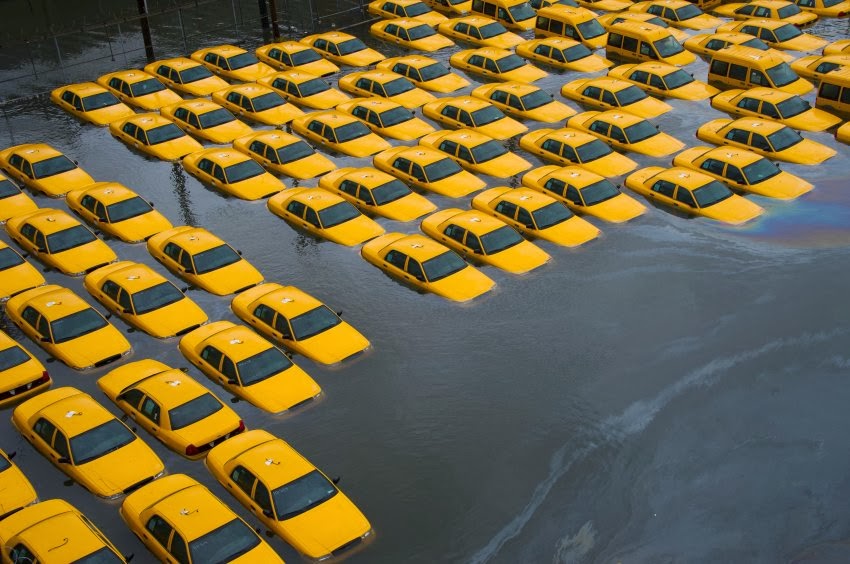
In October 2012, when Hurricane Sandy, dubbed a "Frankenstorm," struck the East Coast of the United States, Rockaway Beach was washed away, swallowed up by a raging storm surge.

What's left of the beach is now several meters below the coastal road, surrounded by sand bags. The boardwalk is gone. "It flew up into the air and, when it was all over, pieces of it were spread around the entire community," says White. The Rockaway community was flooded and littered with sand, overturned trees and utility poles with torn cables dangling from them. Residents were all but paralyzed. "We spent months just cleaning up," says White. "God, it was so discouraging."

She walks quickly along a makeshift wooden platform and looks down at the construction site on the beach, where workers are pounding planks into the sand. They're building a barrier designed to protect Rockaway Beach from being washed away by the next storm. In the coming months, the US Army Corps of Engineers will bring in 2.7 million cubic meters (95 million cubic feet) of sand, which will be piled up and secured with the help of protective walls, geotextiles and beach grass, so that Rockaway Beach can become a real beach again. But will it be enough?

Even before the storm hit, the majority of New Yorkers supported Mayor Michael Bloomberg's plans to transform their city of superlatives into the world's greenest metropolis. "But Sandy brought home to people what climate change really means," says White, "just as 9/11 showed New Yorkers what's at stake in the war against terror."

White concedes that a single storm cannot be directly attributed to climate change. But she also points to the models developed by the New York City Panel on Climate Change (NPCC), which indicate that by the end of the century, storms like Sandy will likely occur once every two years. In New York City alone, the storm killed 44 people, destroyed thousands of buildings and hundreds of thousands of cars, and caused $19 billion in total damage.

And as the sea level rises, the consequences of every storm surge will spread to larger areas and affect more and more people. About 400,000 New Yorkers live in flood-prone areas today, a figure the NPCC estimates will double by 2050.

Sandy also caused damage in North Carolina. The Outer Banks, a group of barrier islands and one of the state's most popular tourism destinations, were cut off from the mainland for a period of time. But residents are accustomed to storm damage and have gotten used to rebuilding destroyed houses instead of investing a lot of money in precautions to avert future damage.

In Tom Thompson's world, they call it faith in God. It's a world in which a government that provides for its citizens is not seen as a moral necessity, but as an immoral temptation that makes hardworking people lazy. And it's a world shaped by the fear of a nanny state that deprives citizens of their freedom.

In Thompson's worldview, only socialists and cowards prepare for the worst. Although North Carolina had a Democratic governor until the beginning of the year, and a majority voted for President Barack Obama in 2008, it remains a state that defends its lax gun laws, closes abortion clinics and where many people flatly refuse to believe in the existence of climate change.

And so North Carolina continues to plod along, blithely ignoring the warnings of the scientific community. When the law was passed in July 2012, then Governor Bev Perdue merely warned: "North Carolina should not ignore science when making public policy decisions." She was referring to climate change. Nevertheless, she refused to veto the law, which dictates to the sea how high it is permitted to rise off the coast of North Carolina. Perdue did point out that the issue would be revisited in four years.

"If we discover in 10 years that the sea level is truly rising at a faster pace, we can always start building roads at higher levels," says Thompson. "But why start now?"

Monday, December 9, 2013

Global Warming, Climate Change, Is It Our Fault? Can We Fix It?

I am not endorsing Professor Plimus' stand here, but he sure does raise some interesting points.

Ian Rutherford Plimer is an Australian geologist, professor emeritus of earth sciences at the University of Melbourne, professor of mining geology at the University of Adelaide, and the director of multiple mineral exploration and mining companies. He has published 130 scientific papers, six books and edited the Encyclopedia of Geology. 

These are his extensive credentials.

Born               12 February 1946 (age 67)
Residence       Australia
Nationality       Australian
Fields              Earth Science, Geology, Mining Engineering
Institutions       University of New England,University of Newcastle,University of Melbourne,University of Adelaide
Alma mater      University of New South Wales, Macquarie University
Thesis              The pipe deposits of tungsten-molybdenum-bismuth in eastern Australia (1976)
Notable awards Eureka Prize (1995, 2002),Centenary Medal(2003), Clarke Medal (2004)


Where Does the Carbon Dioxide Really Come From? 

Professor Ian Plimer's book in a brief summary.

PLIMER: "Okay, here's the bombshell. The volcanic eruption in Iceland . Since its first spewing of volcanic ash has, in just FOUR DAYS, NEGATED EVERY SINGLE EFFORT you have made in the past five years to control CO2 emissions on our planet - all of you.Of course, you know about this evil carbon dioxide that we are trying to suppress - it’s that vital chemical compound that every plant requires to live and grow and to synthesize into oxygen for us humans and all animal life. 

I know....it's very disheartening to realize that all of the carbon emission savings you have accomplished while suffering the inconvenience and expense of driving Prius hybrids, buying fabric grocery bags, sitting up till midnight to finish your kids "The Green Revolution" science project, throwing out all of your non-green cleaning supplies, using only two squares of toilet paper, putting a brick in your toilet tank reservoir, selling your SUV and speedboat, vacationing at home instead of abroad,nearly getting hit every day on your bicycle, replacing all of your 50 cent light bulbs with $10.00 light bulbs.....well, all of those things you have done have all gone down the tubes in just four days.

The volcanic ash emitted into the Earth's atmosphere in just four days - yes, FOUR DAYS - by that volcano in Iceland has totally erased every single effort you have made to reduce the evil beast, carbon. And there are around 200 active volcanoes on the planet spewing out this crud at any one time - EVERY DAY.

I don't really want to rain on your parade too much, but I should mention that when the volcano Mt Pinatubo erupted in the Philippines in 1991, it spewed out more greenhouse gases into the atmosphere than the entire human race had emitted in all its years on earth. 

Yes, folks, Mt Pinatubo was active for over One year - think about it.

Of course, I shouldn't spoil this 'touchy-feely tree-hugging' moment and mention the effect of solar and cosmic activity and the well-recognized 800-year global heating and cooling cycle, which keeps happening despite our completely insignificant efforts to affect climate change.

And I do wish I had a silver lining to this volcanic ash cloud, but the fact of the matter is that the bush fire season across the western USA and Australia this year alone will negate your efforts to reduce carbon in our world for the next two to three years. And it happens every year. 

Just remember that your government just tried to impose a whopping carbon tax on you, on the basis of the bogus 'human-caused' climate-change scenario.

Hey, isn’t it interesting how they don’t mention 'Global Warming' anymore, but just 'Climate Change' - you know why? 

It’s because the planet has COOLED by 0.7 degrees in the past century and these global warming bullshitartists got caught with their pants down.

And, just keep in mind that you might yet have an Emissions Trading Scheme - that whopping new tax - imposed on you that will achieve absolutely nothing except make you poorer.

It won’t stop any volcanoes from erupting, that’s for sure.

But, hey, .....go give the world a hug and have a nice day.

There is no question that the planet is warming. I have no idea where Professor Plimer came up with the idea that it has cooled by 0.7 deg. C in the past century, but I would love to know. 

That man's activities contribute to that warming is also not in question. What the question is is, how much are we contributing, and if we reduce carbon emissions, how much of an affect would it have on global warming. Professor Plimus is saying that the answers to both questions is, 1) 'not very much' and 2) 'not at all'. 

If he is right, then carbon trading and a whole bunch of other 'green' measures are nowhere close to being worth the effort or expense.

Sunday, November 17, 2013

My Response to an Atheist in the Manila Times

The following is my response to a columnist at the Manila Times. It is printed on their website today. The Times freely discusses spiritual themes from different points of view, unlike most newpapers/web sites which tend to avoid the subject as much as possible unless it's a defamatory story.

The columnist, Rigoberto Tiglao is an atheist and points out some interesting fact on how "Acts of God" affect people in terms of faith. Of course, he is referring to Super Typhoon Haiyan, called Yolande in the Philippines. He also quotes Epicurus, a 4th century Greek philosopher who dismissed God through his own logic. 

The entire article can be read at: http://manilatimes.net/do-acts-of-god-create-more-believers/53511/

Epicurus argument: “Is God willing to prevent evil, but not able? Then he is not omnipotent. Is he able, but not willing? Then, he is malevolent. Is he both able and willing? The why is there? Is he neither able nor willing? Then why call him God?”
The first Super Typhoon - the Biblical Flood

Responses to Do ‘Acts of God’ create more believers?
Gary Wm Myers says:
November 17, 2013 at 2:31 pm

Mr. Tiglao,

Thank you for that well-written and well thought out article. You make some excellent points. However there are some gaps in your logic. For instance, Epicurus’ reasoning is very limited; he does not understand that God gave man free will and authority over the earth. Free will means the freedom to choose good or evil. The freedom to choose evil must come with the freedom to do evil, otherwise it’s just an illusion.

If God were to intervene (for instance, to stop the sexual abuse of 100,000 children in the Philippines), then man would have no free will at all. Man must have the ability to choose good or evil in order to spend eternity with God. That is why we are here on this planet – to prepare for Eternity.

God can, and does intervene at times, but He takes His authority to do so from those who pray. To do otherwise is to usurp the very authority He gave man over the earth. Then you would call him a hypocrite.

Your article ignores the question of Who Jesus Christ was (is), and it assumes that God doesn’t exist, therefore all communication with God is one way and God has never proved His existence.

God has proved Himself to millions of Christians in many, many ways. He is not part of our imagination but a very real part of our lives. That you cannot communicate with Him is because you are not willing to believe. It’s always a question of will. Once you are willing, God can begin to open your eyes to the truth. Are you willing?

Friday, November 15, 2013

Typhoon Haiyan and Climate Change, What's the Connection?

Reported by Der Spiegel. 

Many at the climate conference in Warsaw and around the world see a link between global warming and the devastating typhoon in the Philippines. But several studies point to other causes -- and even more worrisome trends.

Typhoon Haiyan
 The UN climate conference got off to a deeply emotional start in Warsaw on Monday. "It's time to stop this madness," said Yeb Sano, the lead Filipino delegate, fighting tears over the death toll of an estimated 10,000 from the typhoon catastrophe, in an address to his counterparts from almost 200 countries. The world must finally reach an agreement, he continued, to drastically reduce greenhouse gas emissions in an effort to halt global warming.

"We refuse to accept that running away from storms, evacuating our families, suffering the devastation and misery, having to count our dead, become a way of life," Sano said.

Environmental organizations back Sano's stance. "While we can't yet say how much climate change influenced this monster typhoon, we do know that extreme weather events are becoming more extreme and frequent because of climate change," wrote Daniel Mittler, the political director of Greenpeace International, on Sunday. Like other environmental activists, Mittler believes governments "in cahoots with the fossil fuel industry" have helped cause such extreme weather events, which they expect to become more frequent.

Stefan Rahmstorf, a researcher at the Potsdam Institute for Climate Impact Research (PIK), outside Berlin, also agrees. "How can those who do all they can to fight climate-protection measures sleep in view of the images coming out of the Philippines?" he asks.

Typhoon Haiyan was one of the, if not the strongest hurricane to hit land.

Can the deadly typhoon really be attributed to man-made climate change? Statistics reveal other causal connections. For example, the way in which houses, dikes and settlements are built plays a decisive role in determining how many people will be hurt by a storm. In the United States, this has led to a steady decrease in hurricane-related deaths since 1900 despite significant rises in both the population densities and storm frequencies in at-risk areas. For Haiti, there are studies claiming that "urbanization in and migration into storm hazard prone areas could be considered as one of the major driving forces of (its) fragility" when affected by storms.

This is a causal connection? I don't think so. While it is a factor in the degree of damage done by storms, that has changed little in the past hundred years. That storms are getting more violent is a given. The reason they are getting more violent is because ocean temperatures are getting warmer.


As a result of such factors, storms even weaker than "Haiyan" could result in even extremer catastrophes.

For example, tropical cyclone "Nargis" killed almost 140,000 people in Burma when it struck in May 2008 even though it was two categories on the hurricane scale below "Haiyan" when it made landfall.

In March, the UN Intergovernmental Panel on Climate Change (IPCC) will publish its fifth and newest assessment report on the state of climate change. In the second part of a draft of the report, the organization stresses the importance of constructing more robust buildings that can better withstand storms. A richer world might be able to protect itself better: Measured in terms of global economic output, one study finds, increasing prosperity could cut storm-caused damage in half by the end of the century.

Duh? Increasing prosperity could solve a lot of problems. But they offer no suggestions as to how to accomplish this. Nor do they offer any probability of that happening. Frankly, I wouldn't hold my breath waiting for third world countries to become wealthy.

But that is only one side of the story. The other is the long-debated question of whether global warming can change the nature of storms. A lack of data makes analysis more difficult, and it wasn't until roughly 30 years ago that it became possible to make systematic observations based on satellite data. Before that, storms were appraised in large part based on data related to damage and sea level. And flights by courageous pilots into the eye of the storms.

In its most recent assessment on global warming, released in September, the IPCC stated that there were no identifiable long-term trends when it comes to tropical cyclones, which are also known as hurricanes or typhoons. However, there are fears that the strongest storms could grow even more destructive.
Map shows very warm water where Haiyan developed
Tropical storms draw their energy from warm water. But the equation "warmer oceans equals more storms" doesn't hold true. The phenomenon known as wind shear as well as airborne dust particles can weaken them. Indeed, some have posited that reductions in air pollution in the Western world since the late 1970s have contributed to an increase in hurricane activity over the Atlantic since then. This ignores a significant drop in tropical storms and hurricanes in the Atlantic in the past few years.

In 2012, researchers from the University of Copenhagen reported that hurricane activity in the Atlantic had been rising for decades and had now grown as strong as it was at the end of the 19th century. However, the World Meteorological Organization (WMO) states that this trend was broken in the Atlantic at the turn of the millennium. The 2013 storm season, which ends in November, has so far been especially mild, with only two hurricanes, especially considering all the pessimistic forecasts published at the beginning of the year.

The WMO also reports that, over the last decade, there has been below-average tropical storm activity. In fact, Ryan Maue, a climate researcher at Florida State University, wrote in 2011 that worldwide tropical storm activity has reached a low point. Another study, from 2012, calculates that the number of storms has been declining since 1872.

Nevertheless, there is still the question of where things will go from here. The IPCC states that simulations predict there will be fewer tropical storms as the global temperature rises. Brilliant, since that is what has been happening.

But the most unsettling finding is that the strongest storms could get even stronger. The consequences of this could be grave, writes Yale University researcher Robert Mendelsohn. According to his estimates, the strongest 1 percent of storms could cause more than half of the damage of all storm activity combined.

So there you have the reality. Hurricanes will be less frequent, but some will be much stronger than we have become used to.

However, since these giant storms come so infrequently, experts say it might be centuries before it is possible to actually measure the effects of climate change. Personally, I don't think they will be so infrequent in the coming decades. Just a year ago we had Superstorm Sandy, in 2005 Rita was the 4th strongest Atlantic hurricane on record, at the time.

For the Philippines, other changes in the earth's climate might prove much more worrisome. For example, there are hardly any other places where the sea level is rising as quickly, and storm floods there continue to get higher. What's more, climate researchers expect to see more precipitation in a warmer world, as milder air can retain more moisture. As a result, typhoons could trigger even greater flooding.

Monday, October 7, 2013

Sir Bob Geldof Predicts Apocalypse Before 2030

'We’re facing a mass extinction event,' claims Bob Geldof


Live Aid founder and activist Bob Geldof has warned that the human race may be extinct within 15 years because of climate change.

Perhaps Sir Bob is not keeping up with the latest trend in Global warming. See http://northwoodsministries.blogspot.com/2013/09/a-pause-in-global-warming.html

“The world can decide in a fit of madness to kill itself,” announced Bob Geldof at the launch of the One Young World summit in Johannesburg. “Sometimes progress may not be possible.

“We're in a very fraught time,” he added. “There will be a mass extinction event. That could happen on your watch. The signs are that it will happen and soon.”

Sir Bob, wearing his trademark sunglasses, addressed 8,000 One Young World delegates from 190 nations across the world in Soccer City, Johannesburg last night. He is a counsellor for the organisation, which hopes to inspire and create the next generation of global leaders.

The Live Aid founder and one-time Boomtown rat announced that his generation has let down the young people of today. “My generation has failed more than others. You cannot let your generation fail. The next war will not be a World War 1 or a World War 2, it will be the end.

Attendees shouted and blew on thousands of vuvuzelas as Sir Bob added: " We may not get to 2030. We need to address the problem of climate change urgently. What are you going to do about it? Get serious. Some of the nations that arrived here so proudly will not be there to meet us."

However, the singer tried to inject a note of positivism into his gloomy predictions. “Just because you may not believe that progress is possible, that should not prevent you from trying for it,” he said. “The alternative is finality.

“We need to be more human. Less Irish. Less Cameroonian. Less Chinese. Less Russian. More human.”
However, Sir Bob then disappeared down a philosophical route that baffled most of the audience, many of whom do not count English as a first language. “The ordinary trouble of ordinary days doesn't seem to matter much,” he sighed. “We are in the great existential age of our humanity. We somehow feel we've missed something's that’s greater than ourselves and we don't know what it is or how to find it.”

He finished his address apologizing for being "bloody miserable". "Just get on with it," he told delegates, before leaving the stage.

Sir Bob needs to spend more time with his friend and Live Aid partner Bono. Bono hasn't missed the bigger Something.

Sunday, October 6, 2013

Was the Sun too Weak for Life to Begin?

This very interesting post was written by another blogger named Ben Richmond. He does not appear to be a Christian, and the column is completely undocumented, nevertheless he makes an excellent point about how little evolutionists understand about the beginning of life and how often a new discovery or theory throws old theories right out the window.

You don’t have to be a creationist to know there are plenty of questions about the origin of life remaining to be answered. Even when an answer seems to be coming together, new evidence can undermine it, rule out a possible solution, and cloud what appeared to be clearing. That happened this week with the faint young Sun paradox, and it’s made the question of “how did life happen on Earth?” that much more daunting.

The faint young Sun paradox is this: Stars get warmer as they age, and the Sun is no exception. It used to be cooler, it’s getting hotter, and eventually the Sun is going to boil away our oceans.

Between 3.8 and 2.4 billion years ago, the Archean eon, life evolved on Earth. At the same time the Sun was only running at about 70 percent of what it does now. At that rate, the Earth shouldn't have had any liquid water, and consequently should not have had life. However, that’s not what the record shows.

“The Earth should have been permanently glaciated but geological evidence suggests there were no global glaciations before the end of the Archean and that liquid water was widespread," said Ray Burgess, from the University of Manchester. This is the paradox of the faint young Sun.

So how was the Earth wet wild and full of life, when the Sun was just a cool young star? Some believe that solar wind was stronger. Up until this last week, researchers believed that it was possible that greenhouse gases kept the Earth sufficiently warm enough to keep that primordial ooze flowing. But researchers from the University of Manchester and the Institut de Physique du Globe de Paris demonstrated, in a paper published in Science, why this wasn't the case.

"To counter the effect of the weaker Sun, carbon dioxide concentrations in the Earth's atmosphere would need to have been 1,000 times higher than present," said lead author Bernard Marty, from the CRPG-CNRS University of Lorraine. "However, ancient fossil soils—the best indicators of ancient carbon dioxide levels in the atmosphere—suggest only modest levels during the Archean. Other atmospheric greenhouse gases were also present, in particular ammonia and methane, but these gases are fragile and easily destroyed by ultraviolet solar radiation, so are unlikely to have had any effect."

But carbon dioxide isn't the only greenhouse gas. Marty and his team looked at old and “exceptionally well-preserved rocks,” from northern Australia to test for argon and nitrogen. If nitrogen levels were high enough it would amplify carbon dioxide’s effect. But there wasn't enough nitrogen in the Archean atmosphere for this to work either.

Their deductions from the argon and nitrogen tests did allow for higher levels of carbon dioxide that were “at odds with the estimates based on fossil soils,” according to Burgess, “which could be high enough to counteract the effects of the faint young Sun and will require further investigation."

So we don’t know as much as we thought we did, and we may not even know as much as we need to know how little that we know. Science marches on, pursuing how it is that, to paraphrase a great scientist, life found a way. Really?!!! that sounds scientific!

Sunday, September 22, 2013

A Pause in Global Warming?


The Intergovernmental Panel on Climate Change (IPCC) meets this week in Sweden to thrash out a critical report on global warming.

Scientists will underline, with greater certainty than ever, the role of human activities in rising temperatures.

But many governments are demanding a clearer explanation of the slowdown in temperature increases since 1998.

One participant told BBC News that this pause will be a "central piece" of the summary.

Researchers from all over the world work with the IPCC to pore over thousands of peer-reviewed studies and produce a summary representing the current state of climate science.

Governments are demanding a clear explanation of what are the possible causes of this factor”

Its previous report in 2007 was instrumental in helping the panel share the Nobel Peace Prize that year.

A new Summary for Policymakers on the physical sciences, the first of three parts that make up a report to be released over the next 12 months, will be published in Stockholm on Friday.

It will focus on the science underlying changes in temperature in the atmosphere, the oceans and at the poles.

New estimates will be given for the scale of global warming and its impact on sea levels, glaciers and ice sheets.


The top graph shows the slowdown in warming of the global temperature since 1998. The bottom graph indicates the temperature trend for the oceans which is intricately related to the air temperature. The scientific panel is calling this a pause in global warming. 15 years is a relatively short time in climatology and one should be hesitant to make any conclusions based on that short a term. If it continues for another 15 years, then the IPCC has a real credibility problem. Nevertheless, the panel will be hard-pressed to explain this 'pause' and we can expect some heated arguments before they come to a statement they can agree on, if they can find a statement they can agree on.

Saturday, September 8, 2012

Changing Climate


Norwegian scientists have documented a rapid melting of Arctic sea ice http://www.bbc.co.uk/news/world-europe-19508906. If it continues, it is liable to affect global weather patterns, and may already have. What might it mean for western Canada?

Researchers have determined that more and more sea ice is melting in the Arctic every summer, and some of the ice that is not melting is thinner than in decades past. Thinner ice – once the snow has melted – allows sunlight to get through to the water below where some of the energy is absorbed resulting in warming. That warming results in more thinning of the ice, which results in more warming, which results in… well, you get it.

Between the thinner ice and the ever increasing amount of open water, the Arctic waters are warming and are likely to continue warming at an accelerating pace. The consequence of this is that the temperature differential between the Arctic and the equatorial region is decreasing, at least during late summer and fall before the Arctic sea ice reforms.

Why is that important? Well, that difference in temperature is what produces the major jet streams of the northern hemisphere. Jet streams determine where weather systems travel and how fast, and they affect the development of storm systems. They also affect where a ridge of high pressure may form, how intense it may become, and how long it may last.

So what about western Canada’s climate? I’m very reluctant to hazard a guess as to the effects on high pressure ridges over western Canada although I suspect that we will see more ridges meaning warmer and drier weather in late summer and fall. Also, the decreasing temperature differential from the Arctic to the equator will mean weakening jet streams. Weakening jet streams should result in fewer and weaker storm hitting the coast of BC in the fall months.

While it is not unusual for storms to hit the BC coast every 24-36 hours in the fall (often with little or no break between), this frequency should slow down, as should the intensities, meaning less rain and longer breaks between storm systems.

For Alberta and the prairies it may mean a reduction in precipitation in the fall months. Since not a lot of precipitation falls on the prairies during the fall, it should not have a major effect.

These effects, however, are only for the months when the sea ice has melted or is thin. Consequently, by late fall or early winter conditions should return to normal.

In my observances of the climatology of BC, it appears that this effect has already been felt for some time. September and October have become warmer and drier than in decades past, and while November used to be the wettest month in southwest BC, in recent decades that has moved to December. I wouldn’t be surprised to see it move to January in the next few decades.