"I am the Way, the Truth, and the Life"

Father God, thank you for the love of the truth you have given me. Please bless me with the wisdom, knowledge and discernment needed to always present the truth in an attitude of grace and love. Use this blog and Northwoods Ministries for your glory. Help us all to read and to study Your Word without preconceived notions, but rather, let scripture interpret scripture in the presence of the Holy Spirit. All praise to our Lord and Saviour Jesus Christ.

Please note: All my writings and comments appear in bold italics in this colour

Saturday, July 23, 2022

European Politics > Farmers bring halt to Dutch food supply; Draghi Resigns to Chaos in Italy; Russia increases 'Unfriendly Country' List

..

Anger simmers for Dutch farmers who oppose pollution cuts

By MIKE CORDER
today

Protesting farmers block a drawbridge at locks in the Princess Margriet canal, preventing all ship traffic from passing in Gaarkeuken, northern Netherlands, Monday, July 4, 2022. Dutch farmers angry at government plans to slash emissions also used tractors and trucks Monday to blockade supermarket distribution centers, the latest actions in a summer of discontent in the country's lucrative agricultural sector. (AP Photo/Peter Dejong)


MAASLAND, Netherlands (AP)Bales of hay lie burning along Dutch highways. Supermarket shelves stand empty because distribution centers are blocked by farmers. Then, at dusk, a police officer pulls his pistol and shoots at a tractor.

Dutch farmers are embroiled in a summer of discontent that shows no sign of abating. Their target? Government plans to rein in emissions of nitrogen oxide and ammonia that they say threatens to wreck their agricultural way of life and put them out of business.

The reduction targets could radically alter the Netherlands’ lucrative agriculture sector, which is known for its intensive farming, and may also foreshadow similar reforms — and protests — in other European nations whose farmers also pump out pollutants.

That turmoil seems a long way off Friday at Jaap Zegwaard’s dairy farm, which occupies 80 hectares (200 acres) of grassland close to the port city of Rotterdam, whose chimneys and cranes form a backdrop to his fields.

Most of Zegwaard’s herd of 180 cattle, mostly black and white Holstein-Friesians, graze in meadows close to a traditional Dutch windmill and large white wind turbines. And even if the farm has been in Zegwaard’s family for five generations, some 200 years, he doesn’t know if he would recommend the farming life to his a 7-year-old daughter and 3-year-old twin boys.

“If you ask me now, I’d say, please don’t even think about it,” the 41-year-old said. “There are so many worries. Life’s much too beautiful to deal with what’s going on in the agriculture sector at the moment.”

“Ask the average farmer: it’s profoundly sad,” he said.

At the heart of the clash between farmers and the Dutch government are moves to protect human health and vulnerable natural habitats from pollution in the form of nitrogen oxides and ammonia, which are produced by industry, transport and in the waste of livestock.

The Netherlands, a nation of 17.5 million people inhabiting an area a little larger than Maryland, has 1.57 million registered dairy cattle and just over 1 million calves being raised for meat, statistics show. The country’s farms produced exports worth 94.5 billion euros in 2019.

Nitrogen oxides and ammonia raise nutrient levels and acidity in the soil, leading to a reduction in biodiversity. Airborne nitrogen leads to smog and tiny particles that are damaging to people’s health.

When the Council of State, the country’s top administrative court and legislative advisory body, ruled in 2019 that Dutch policies to rein in nitrogen emissions were inadequate, it forced the government to consider tougher measures.

Unveiling a map detailing nitrogen reduction targets last month, the Dutch government called it an “unavoidable transition.” It said the coming year would finally bring clarity for Dutch farmers, “whether and how they can continue with their business. The minister sees three options for farmers: become (more) sustainable, relocate or stop.”

The Dutch government aims to slash nitrogen emissions by 50% by 2030 and has earmarked an extra 24.3 billion euros ($25.6 billion) to fund the changes. Provincial authorities have one year to draw up plans for achieving the reductions.

Nitrogen expert Wim de Vries, a professor at Wageningen University and Research, doubts that deadline is realistic.

“It seems to be very fast and there is a legacy, already for 40 years, because the problem was much bigger in the 1980s. We then called it ‘acid rain,’” he said. “Considering that legacy, it doesn’t make so much difference if we do it in 7 or 10 or 12 years. We anyhow have to wait for decades for nature to improve seriously.”

Farmers have been protesting for years against the government’s nitrogen policies, but the emissions targets unleashed new demonstrations, with tractors clogging highways and supermarket distribution centers that led briefly to some shortages of fresh produce.

Farmers also clashed with police outside the home of the minister in charge of the government’s nitrogen policies. And this week an officer opened fire on a tractor driven by a 16-year-old. After initially being held on suspicion of attempted manslaughter, the young driver was released without charge.

The Dutch government has appointed a veteran political negotiator to act as a middleman, but the gesture was immediately rejected by activist farmers and the nation’s largest farming lobby group.

“The government does not offer any space to enter into a real conversation,” said the farming lobby group LTO. “Under these conditions, speaking with the mediator is pointless.”

The LTO, which represents about 30,000 farms — nearly a half of the Dutch total — described the nitrogen reduction target as “simply unfeasible.” Dutch farms produced exports worth 94.5 billion euros in 2019.

The group says the government is focused on reducing livestock and buying up farms and not paying enough attention to innovation and sustainable farming practices.

Environmentalists say now is the time to act.

“You rip a plaster off a wound in one go,” said Andy Palmen, director of Greenpeace Netherlands. “Painful choices are now necessary.”

And if you do it too soon, you will have to apply another plaster.

Zegwaard’s farm is in an area where the government is seeking only a 12% cut in emissions, yet he also demonstrates out of solidarity with others and supports the protests.

“The average person currently sees the Netherlands as a nitrogen polluter, while we are also a food producer. It seems like people have forgotten that,” he told The Associated Press.


Italy's Draghi urged to fix crisis as resignation refused

AFP - Yesterday 6:36 AM

Italy's teetering government was thrown a lifeline Thursday after the country's president refused to accept the resignation of Prime Minister Mario Draghi, insisting he address parliament in a bid to avoid snap elections.

Italy's coalition government teetered on the brink of collapse after the Five Star Movement refused to participate in a confidence vote in Italy's parliament


© Alice PALUSSIERE
Italy's parliament


Draghi had earlier vowed to resign after a party in his coalition government -- the Five Star Movement -- sat out a confidence vote, sending tremors through the eurozone's third largest economy.

Draghi said the "pact of trust" on which the government was based had been broken, and the conditions to carry on were "no longer there".

He said he had made "every effort" to "meet the demands that have been put to me", but the vote showed "this effort was not enough".

President Sergio Mattarella, a figurehead who takes on a key role in moments of political crisis, asked Draghi not to throw in the towel but instead "assess" the situation in parliament.

He was expected to address both the lower and upper houses on Wednesday.

"We now have five days to make sure parliament votes its confidence in the Draghi government," Enrico Letta, head of the centre-left Democratic Party (PD), said on Twitter.

The crisis comes as Italy battles raging inflation and races to push through key reforms required by the European Union in exchange for post-pandemic funds.

The Five Star Movement (M5S), headed by former premier Giuseppe Conte, has been haemorrhaging parliamentarians and support in the polls over policy U-turns and internal divisions.


Draghi’s fall is a win for Putin – and for the Italian far right


Italy’s progressive forces will need to change path to counter the rise of right-wing populism.


Vito Laterza is associate professor in development studies at the University of Agder, southern Norway.
Published On 23 Jul 2022
Al Jezeera

Italy's Prime Minister Mario Draghi reacts during the debate on the government crisis, at the Senate in Rome on July 20, 2022 [Andreas Solaro/ AFP]


Italy is once again in political turmoil. On Thursday, after key coalition partners – the post-ideological Five Star Movement, far-right League and centre-right Forza Italia – withdrew their support from his “national unity” government, Italy’s Prime Minister Mario Draghi announced his resignation.

The country is now left with a caretaker government until a snap general election scheduled for September 25, 2022 amid a growing energy crisis, rampant inflation, yet another COVID-19 wave, and an ever-deepening geopolitical conflict between the European Union and Russia on the back of the latter’s invasion of Ukraine.

Moreover, Draghi’s government was the authority Brussels relied upon to ensure the €210 billion ($214bn) allocated for Italy from the EU Next Generation Fund – the biggest recovery programme since the US Marshall Plan – would be efficiently managed. With Draghi gone, there are now serious concerns over delays in reimbursements and implementation.

Draghi’s cabinet is also credited with swiftly finding alternative sources of gas to reduce dependence on Russia. Since the beginning of the Russian invasion of Ukraine in February, Italy has secured increasing supplies of Algerian gas, which could also be moved further northwards to Germany, if needed. But with Draghi out of power, Italy’s energy future is once again in question.

Under Putin’s shadow

The dissolution of Italy’s government is a major win for Russia’s President Vladimir Putin. While Draghi has acted as a major curb to Putin’s influence in Italy and Europe, the three political leaders that are responsible for the government crisis all showed support for the Russian dictator in the past.

Giuseppe Conte, the head of what remains of the rapidly shrinking Five Star Movement (support for the group fell from 32 percent in the 2018 general election to two percent in local elections in June this year, for example), supported the removal of sanctions against Russia and called for Moscow’s return to the G8 in 2018. Five Star’s links to Russia are well documented and date back to the 2014 annexation of Crimea.

League leader Matteo Salvini’s support for Putin is also no secret: in 2017, under Salvini’s leadership, League signed a formal cooperation agreement with Putin’s party United Russia. In 2019, BuzzFeed News and Italy’s Espresso unearthed what they alleged to be a plot to funnel funds from Russia to the League involving men close to Salvini and Putin – a judicial inquiry for international corruption is ongoing.

Forza Italia’s head, Silvio Berlusconi, meanwhile, has been a long-term friend of Vladimir Putin. They visited each other in their holiday homes and were close allies on the international scene when Berlusconi was prime minister in the 2000s. The two leaders also have joint commercial interests.

After the invasion of Ukraine, Salvini released a vague statement condemning “all military aggressions”, and only after some criticism did he admit that “Russia is wrong”, but barely ever mentioned Putin by name since. Berlusconi kept quiet for a month and a half after the invasion before saying that he was “deeply disappointed and saddened by Vladimir Putin’s behaviour”. Conte’s condemnation of the Russian invasion has been unambiguous, but his recent position against sending more arms to Ukraine – linked to a similar sentiment among many Italians – has been interpreted by some as a sign of soft support for Russia.

Draghi’s exit undoubtedly favours Putin – but even more important for the Russian leader would be a victory in the ballot box of leaders and parties close to him.

Berlusconi’s legacy

The current electoral law is a mix of proportional representation and first-past-the-post electoral colleges. It favours electoral coalitions. The only coalition that formally exists at the moment is the right-wing alliance of League, Forza Italia and Brothers of Italy – the far-right party led by Giorgia Meloni.

The latter is first in opinion polls (23 percent), with the centre-left Democratic Party trailing shortly behind (22 percent). However, the Dems’ plans to form a broader alliance with the Five Star Movement are now in jeopardy – Democrats are resolutely pro-Draghi and disapprove of Five Star’s anti-Draghi U-turn. The Democratic Party is in talks with breakaway centrist factions that left the Dems recently, but it is unclear at this stage whether they will be able to form an electoral alliance.

When it comes to internal cohesion, the right-wing coalition is also experiencing problems. Disagreements have already stopped them from winning mayoral races in many cities in recent local elections, but the prospects of a landslide national victory if they manage to keep their alliance together until election day will probably act as a strong catalyst for unity.

While Berlusconi and Salvini feel threatened by Meloni’s rising star – Brothers of Italy is ahead of League (15 percent) and Forza Italia (seven percent) by several points – Meloni might indeed be the most presentable option for premiership in the eyes of national and international institutions because she took a decisive pro-Ukraine position since the invasion.

Even before her pro-NATO turn, she received significant endorsements from centrist quarters, raising fears that her skilful weaving of “respectability politics” with a fundamentally far-right platform might turn out to be more effective than the flamboyant “strongman” style of Salvini, who has been steadily losing votes and popularity.

The right-wing electoral alliance is a direct descendant of Berlusconi’s government coalitions of the 1990s and the 2000s: back in 1994, for example, Forza Italia was the largest partner in the ruling coalition, followed by National Alliance, which came out of the dissolution of the far-right Italian Social Movement and a formal rejection of their fascist roots. Back then, Northern League (which later became League) was rooted in the north of the country, limiting its national impact in the polls.

Today, Meloni’s party comes from a section of National Alliance that, despite its earlier rejection of fascism, has strong and close documented links with fascist supporters and backdoor political operatives.

In 1994, Berlusconi enabled the entry into national government of allegedly post-fascist political forces and the early populists of Northern League. Northern League started in the late 1980s as an anti-establishment movement that supported northern Italy’s independence from Italy, and blamed the Italian south for the country’s ills.

Nearly 30 years later, Berlusconi is playing a key role in supporting two openly far-right movements that now hold the vast majority of the coalition votes.

Setting aside their differences on Russia, Brothers of Italy and League share a militant anti-immigration agenda, and opposition to most EU policies and reforms demanded by Brussels in exchange for Next Generation EU money. They both deploy populist tactics and rhetoric.

If they realise their electoral ambitions in September, the right-left convergence of the populist government alliance of Five Star and League formed in 2018 would be replaced by a fully fledged far-right government with fascist inclinations.

This would mark the total failure of the strategy systematically pursued by the left and the centre left in recent years of trying to break populists into some kind of “right” and “left” fronts, as a way to contain the rise of the far right. Now, with the Five Star crumbling, League and Brothers of Italy have little competition in the populist camp.

Bleak days ahead

Progressive forces will need to drastically change their path if they want to block the electoral rise of the far right. The smaller left formations have been preoccupied with critiquing Draghi’s technocratic approach and are stuck on an interpretation of the current moment that dates back to the eurozone crisis of the early 2010s – in any event, the narrative of “technocracy vs the people” has been successfully hijacked by populists.

The centre-left Democratic Party has been very good in manoeuvring in the corridors of power of Italy’s representative democracy, and has played a prominent role in government for most of this legislature despite its 2018 electoral defeat. It is struggling to propose a forward-looking programme that goes beyond defensive – although admittedly valid – arguments that a government without it would put Italians in a worse spot than they already are. In the aftermath of Draghi’s demise, the Democratic leader Enrico Letta rightly indicated a social agenda for Italy as the main party platform for the elections, as it is the only OECD country where salaries have declined in real terms since 1990. The policy details are yet to be defined.

The biggest challenge for Democrats and the left remains how to attract those disaffected voters that have moved in recent years to populist formations such as Five Star or might not vote altogether – after all, a large number of voters are undecided or do not plan to vote in September.

Despite the hype about the Mélenchon model in France, the erratic and destructive actions of Five Star politicians are a clear sign that the idea of a “progressive populism” that would act as a viable alternative to the far right is a chimera that is best left to the annals of political history.

Progressives should rather focus on concrete social democratic measures that would benefit the whole of society, such as putting an end to the wild west of precarious contracts, increasing wages, raising spending on public health and family and labour welfare, and adopting inclusive citizenship laws for people of migrant and refugee background.

The writer, here, makes very little of migrants and refugees' effects on the next election. After the Lake Garda incident last weekend, and the sexual assault of half a dozen teen girls on the train to Milan, an effective refugee strategy would seem to be vital to any party planning on being in the government in October.

If they fail to come up with a new, more efficient and attractive electoral strategy, they cannot prevent a major victory by the far right, and Putin, in Italy.


Russia adds 5 more countries to join U.S., other nations on 'unfriendly' list


By Clyde Hughes

The Ukrainian Embassy is seen in Moscow, Russia. Ukraine is one of more than two dozen countries
 on Russia's "unfriendly" list. File Photo by Sergei Ilnitsky/EPA-EFE


July 22 (UPI) -- The Russian government on Friday added several countries to its "unfriendly" list for supposedly committing "acts against" Moscow's diplomatic and consular missions and being hostile to Russian companies and citizens.

The "unfriendly" list was created in March after Russia began its war with Ukraine, and the registry forces the blacklisted nations to limit their staffs at their respective embassies in Russia.

On Friday, officials said that five more countries have been added to the list -- Greece, Denmark, Slovakia, Slovenia and Croatia.

Nearly two dozen countries were already on the list -- including the United States, Britain, Ukraine, Australia, Canada, Japan and South Korea.

The American flag hangs from the main building of the U.S. Embassy in Moscow, Russia.
The U.S. and a number of other countries were already on Russia's "unfriendly" list
when it was first created four months ago. File Photo by Sergei Ilnitsky/EPA-EFE
Interesting shot with what appears to be an eagle flying past the American Embassy


Appearing on the "unfriendly" list also restricts entry into Russia for travelers of the blacklisted countries. Russian President Vladimir Putin came up with the list to punish countries that issued sanctions against Moscow over the Ukraine war.

"The list ... specifies the number of individuals in Russia, with whom diplomatic missions of unfriendly countries and their consular offices may conclude employment contracts," the Kremlin said according to the state-run TASS news agency.

Greece now has a limit of 34 employees at its embassy in Russia; Denmark's is 20 and Slovakia's is 16. The decree says Slovenia and Croatia can't hire employees for their diplomatic missions and consular institutions from Russia.

"The ambassador was handed a note, notifying that as a response measure, eight Greek diplomats were declared 'persona non grata,'" Greece's foreign ministry said according to the Greek Reporter.

Greece said it has summoned its ambassador to Russia Ekaterini Nassika.

Thursday, July 21, 2022

Corruption is Everywhere > In China it's visible; In Ukraine it's Ever-present; UK's Ecclestone hides £400million from Taxman

..

White-shirted group attacks protesters at China banking scandal demonstration


Victims of what could prove one of the country’s worst financial scandals had gathered
in Henan province to demand their frozen deposits be returned

Protesters say the unidentified men in white attacked them and dragged them away
while local police looked on

Phoebe Zhang
Published: 9:00am, 11 Jul, 2022

Groups of men in white appeared on the scene soon after the protests started. Photo: Handout


Victims of what could be one of China’s largest financial scandals were surrounded by local police and beaten by unidentified men during a protest in Henan province on Sunday.

An estimated 1,000 depositors gathered in front of the Zhengzhou sub-branch of the People’s Bank of China on Sunday morning, in a latest attempt to recover millions of yuan frozen in rural banks.

It's hard to believe this sort of thing is happening in 2022. It's about 100 years out of date in the rest of the world.


Bernie Ecclestone charged with fraud after ‘failing to declare

£400m in overseas assets’

Alex Winter, Mike Sullivan
18:43, 11 Jul 2022

BERNIE Ecclestone has been charged with fraud.

The tycoon, 91, is accused of failing to declare overseas assets worth more than £400million to the taxman.

Bernard Charles Ecclestone is a British business magnate. He is the former chief executive of the Formula One Group, which manages Formula One motor racing and controls the commercial rights to the sport, and part-owns Delta Topco, the previous ultimate parent company of the Formula One Group. - Wikipedia

The tycoon, pictured with daughters Petra and Tamara, will appear before magistrates in August
Credit: Getty


Chief crown prosecutor Andrew Penhale said this afternoon that the CPS authorised the charge "in respect of his failure to declare to HMRC the existence of assets held overseas".

“The Crown Prosecution Service reminds all concerned that criminal proceedings against this defendant are now active and that they have a right to a fair trial," he said.

"It is extremely important that there should be no reporting, commentary or sharing of information online which could in any way prejudice these proceedings.”

Simon York, director of HMRC's fraud investigation service, said: “We can confirm that a fraud by false representation charge has been authorised against Bernard Ecclestone.

"This follows a complex and worldwide criminal investigation by HMRC's Fraud Investigation Service.

(HMRC - Her Majesty's Revenue and Customs)

"The criminal charge relates to projected tax liabilities arising from more than £400m of offshore assets which were concealed from HMRC.

“HMRC is on the side of honest taxpayers and we will take tough action wherever we suspect tax fraud.

"Our message is clear – no one is beyond our reach.


Ukraine graft concerns resurface as Russia war goes on


By MATTHEW LEE and NOMAAN MERCHANT
yesterday

FILE - In this photo provided by the Ukrainian Presidential Press Office on July 8, 2022, Ukrainian President
Volodymyr Zelenskyy, attends a meeting with military officials during his visit the war-hit Dnipropetrovsk region.
(Ukrainian Presidential Press Office via AP, File)


WASHINGTON (AP)Ukrainian President Volodymyr Zelenskyy’s dismissal of senior officials is casting an inconvenient light on an issue that the Biden administration has largely ignored since the outbreak of war with Russia: Ukraine’s history of rampant corruption and shaky governance.

As it presses ahead with providing tens of billions of dollars in military, economic and direct financial support aid to Ukraine and encourages its allies to do the same, the Biden administration is now once again grappling with longstanding worries about Ukraine’s suitability as a recipient of massive infusions of American aid.

When has that ever been an issue? America has supported some monsters around the world who were far worse than Zelensky. Besides, NATO will not allow issues like morality and corruption to interfere with their destruction of Russia.

Those issues, which date back decades and were not an insignificant part of former President Donald Trump’s first impeachment, had been largely pushed to the back burner in the immediate run-up to Russia’s invasion and during the first months of the conflict as the U.S. and its partners rallied to Ukraine’s defense.

But Zelenskyy’s weekend firings of his top prosecutor, intelligence chief and other senior officials have resurfaced those concerns and may have inadvertently given fresh attention to allegations of high-level corruption in Kyiv made by one outspoken U.S. lawmaker.

It’s a delicate issue for the Biden administration. With billions in aid flowing to Ukraine, the White House continues to make the case for supporting Zelenskyy’s government to an American public increasingly focused on domestic issues like high gas prices and inflation. High-profile supporters of Ukraine in both parties also want to avoid a backlash that could make it more difficult to pass future aid packages.

U.S. officials are quick to say that Zelenskyy is well within his right to appoint whomever he wants to senior positions, including the prosecutor general, and remove anyone who he sees as collaborating with Russia.

Yet even as Russian troops were massing near the Ukrainian border last fall, the Biden administration was pushing Zelenskyy to do more to act on corruption — a perennial U.S. demand going back to Ukraine’s early days of independence.

“In all of our relationships, and including in this relationship, we invest not in personalities; we invest in institutions, and, of course, President Zelenskyy has spoken to his rationale for making these personnel shifts,” State Department spokesman Ned Price told reporters on Monday.

Price declined to comment further on Zelenskyy’s reasoning for the dismissals or address the specifics but said there was no question that Russia has been trying to interfere in Ukraine.

“Moscow has long sought to subvert, to destabilize the Ukrainian government,” Price said. “Ever since Ukraine chose the path of democracy and a Western orientation this has been something that Moscow has sought to subvert.”

Still, in October and then again in December 2021, as the U.S. and others were warning of the increasing potential for a Russian invasion, the Biden administration was calling out Zelenskyy’s government for inaction on corruption that had little or nothing to do with Russia.

Was this 'calling out' anything more than empty talk? Was Joe really interested in having his son, Hunter, investigated as part of Ukrainian corruption? I don't think so!

“The EU and the US are greatly disappointed by unexplained and unjustifiable delays in the selection of the Head of the Specialized Anti-Corruption Prosecutor Office, a crucial body in the fight against high-level corruption,” the U.S. Embassy in Kyiv said on Oct. 9.

“We urge the selection commission to resume its work without further delays. Failure to move forward in the selection process undermines the work of anti-corruption agencies, established by Ukraine and its international partners,” it said. That special prosecutor was finally chosen in late December but was never actually appointed to the position. Although there are indications the appointment will happen soon, the dismissal of the prosecutor general could complicate the matter.

The administration and high-profile lawmakers have avoided public criticism of Ukraine since Russia invaded in February. The U.S. has ramped up the weapons and intelligence it’s providing to Ukraine despite early concerns about Russia’s penetration of the Ukrainian government and existing concerns about corruption.

A Ukrainian-born congresswoman who came to prominence early in the war recently broke that unofficial silence.

Rep. Victoria Spartz, a first-term Republican from Indiana, has made half a dozen visits to Ukraine since the war began. And she was invited to the White House in May and received a pen used by President Joe Biden to sign an aid package for Ukraine even after she angrily criticized Biden for not doing more to help.

But in recent weeks, Spartz has accused Zelenskyy of “playing politics” and alleged his top aide Andriy Yermak had sabotaged Ukraine’s defense against Russia.

She’s also repeatedly called on Ukraine to name the anti-corruption prosecutor, blaming Yermak for the delay.

Ukrainian officials have hit back. A statement from Ukraine’s Foreign Ministry accused Spartz of spreading “Russian propaganda” and warned her to “stop trying to earn extra political capital on baseless speculation.”

U.S. officials gave Spartz a two-hour classified briefing on Friday in hopes of addressing her concerns and encouraging her to limit her public criticism. She declined to discuss the briefing afterward but told The Associated Press that “healthy dialogue and deliberation is good for Congress.”

“We’re not here to please people,” she said. “It’s good to deliberate.”

Hours later, Spartz gave a Ukrainian-language interview broadcast on YouTube in which she called again for the appointment of an independent prosecutor.

“This issue should be resolved as soon as possible,” she said in the interview. “This is a huge problem for the West, so I think your president should address this issue soon.”

Rep. Jason Crow, a Colorado Democrat who sits on the House Armed Services and Intelligence committees, said he had seen no evidence to support allegations that Zelenskyy’s inner circle was trying to help Russia. But as the war continues, part of the long-term American strategy in Ukraine will have to include addressing waste and mismanagement of resources, he said.

“There is no war in the history of the world that is immune from corruption and people trying to take advantage of it,” Crow said. “If there are concerns raised, we will address them.”

Igor Novikov, a Kyiv-based former adviser to Zelenskyy, called many of Spartz’s claims a mix of “hearsay and urban legends and myths.” Allegations against Yermak in particular have circulated for years going back to his interactions with Trump allies who sought derogatory information against Biden’s son Hunter.

“Given that we’re in a state of war, we need to give President Zelenskyy and his team the benefit of the doubt,” Novikov said. “Until we win this war, we have to trust the president who stayed and fought with the people.”


Wednesday, July 20, 2022

Islam - Current Day > The Taliban's Islam is not working any better for men than it is for women and girls

..

We all know that women and girls have a very difficult life in Taliban Afghanistan,


but the number of men addicted to drugs is very disturbing.

What does this say about the Taliban's version of Islam?


Despair and poverty fuel drug use in Afghanistan

By EBRAHIM NOROOZI

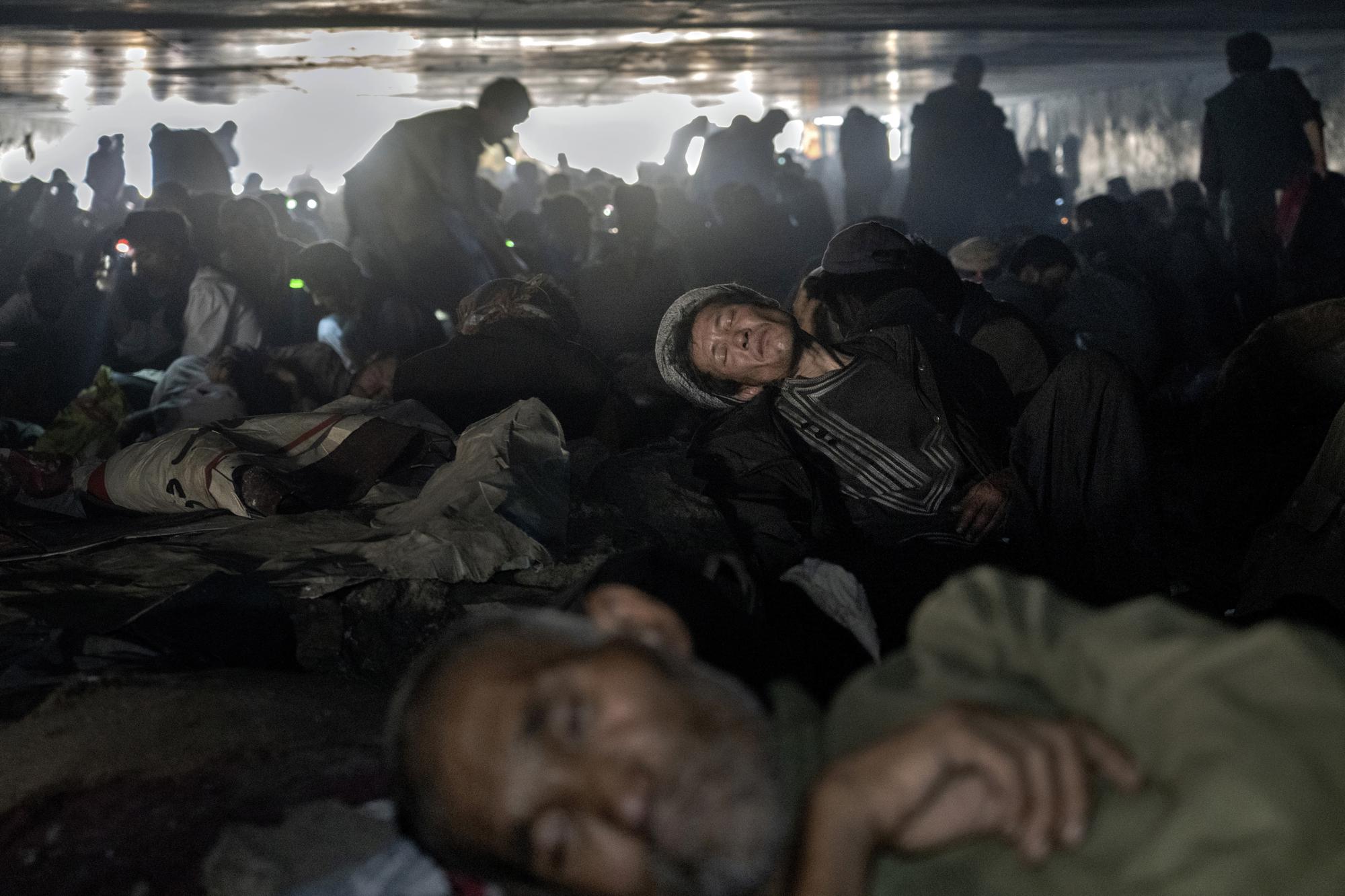
KABUL, Afghanistan (AP)Hundreds of men, strung out on heroin, opium and meth, were strewn over the hillside overlooking Kabul, some in tents, some lying in the dirt. Dogs skulked around because they sometimes give them drugs, and there were bodies of overdosed dogs amid the garbage. Men here as well slip, quiet and alone, across the line from oblivion and despair to death.

“There’s a dead man next to you,” someone told me as I picked my way among them, taking pictures. “We buried someone over there earlier,” another said further down.

An Afghan drug addict gives heroin to an addicted dog on the edge of a hill in the city of Kabul,
Afghanistan. (AP Photo/Ebrahim Noroozi)


The body of a dead addict lies covered by a shawl in an area inhabited by drug users under a bridge in Kabul, Afghanistan. (AP Photo/Ebrahim Noroozi)

One man lay face down in the mud, unmoving. I shook him by the shoulder and asked if he was alive. He turned his head a bit, just half out of the mud, and whispered that he was.

“You’re dying,” I told him. “Try to survive.”

“It’s fine,” he said, his voice exhausted. “It’s okay to die.”

He lifted his body a little. I gave him some water, and someone gave him a glass pipe of heroin. Smoking it gave him some energy. He said his name was Dawood. He had lost a leg to a mine about a decade ago during the war; after that he couldn’t work, and his life fell apart. He had turned to drugs to escape.

Hundreds of Afghan addicts gather under a bridge to consume drugs, mostly heroin and
methamphetamines in the city of Kabul, Afghanistan. (AP Photo/Ebrahim Noroozi)


Drug addiction has long been a problem in Afghanistan, the world’s biggest producer of opium and heroin and now a major source of meth. The ranks of the addicted have been fueled by persistent poverty and by decades of war that left few families unscarred.

It appears to only be getting worse since the country’s economy collapsed after the seizure of power by the Taliban in August last year and the subsequent halt of international financing. Families that were once able to get by found their livelihoods cut off, leaving many barely able to afford food. Millions have joined the ranks of the impoverished.

The growing numbers of addicts are found around Kabul, living in parks and sewage drains, under bridges, on open hillsides.

Afghans drug addicts gather under a bridge to smoke heroin, as the addicted and hungover dogs
have fallen on the ground, in the city of Kabul, Afghanistan, Tuesday, June 7, 2022.


Afghan drug addicts gather under a bridge to smoke heroin, as overdosed dogs lie on the ground,
in the city of Kabul, Afghanistan. (AP Photo/Ebrahim Noroozi)


An Afghan drug addict smokes heroin on the edge of a hill in the city of Kabul, Afghanistan.
(AP Photo/Ebrahim Noroozi)


A 2015 survey by the U.N. estimated that up to 2.3 million people had used drugs that year, which would have amounted to around 5% of the population at the time. Now, seven years later, the number is not known, but it’s believed to have only increased, said the head of the Drug Demand Reduction Department, Dr. Zalmel, who like many Afghans uses only one name.

The Taliban, who seized power nearly a year ago, have launched an aggressive campaign to eradicate poppy cultivation. At the same time, they inherited the ousted, internationally backed government’s policy of rounding up addicts and forcing them into camps.


Afghan drug addicts who were rounded up during a Taliban raid wait in a truck to be taken to
a drug treatment camp, in Kabul, Afghanistan. (AP Photo/Ebrahim Noroozi)


Afghan drug addicts who were rounded up during a Taliban raid wait in a truck to be taken to
a drug treatment camp, in Kabul, Afghanistan. (AP Photo/Ebrahim Noroozi)


On two nights earlier in the summer, Taliban fighters stormed two areas where addicts gather — the one on the hillside and another under a bridge. In total, they collected some 1,500 people, according to officials in charge of registering them. They were herded into trucks and cars and taken to the Avicenna Medical Hospital for Drug Treatment, a former U.S. military base that in 2016 was converted into a drug treatment center.

It’s the biggest of a number of addict treatment camps around Kabul. There, the addicts were shaved and kept in barracks for 45 days. They receive no treatment or medication as they go through withdrawal. Since the Taliban seizure of power, the international funding on which the Afghan government relied has been cut off, so the camp barely has enough funding to feed its inmate-patients.


Drug addicts detained during a Taliban raid wait to have their heads shaved in a drug addiction treatment camp in Kabul, Afghanistan. (AP Photo/Ebrahim Noroozi)


But the camps do little to break addiction.

A week after the raids, I went back to both locations, and both were once again full of hundreds of people.

On the hillside, I saw a man who was clearly not an addict. In the darkness, he wandered among the men, shining a feeble flashlight on each. He was searching for his brother, who became addicted years ago and left home. He goes from site to site, through Kabul’s netherworld. “I hope one day I can find him,” he said.


An Afghan searches for his drug addicted brother among other addicts under a bridge in Kabul, Afghanistan. (AP Photo/Ebrahim Noroozi)


At the site under the bridge, the stench of sewage and garbage was overwhelming. One man, Nazer, in his 30s, seemed to be respected among his fellow addicts; he broke up fights among them and negotiated disputes.

He told me he spends most of his days here under the bridge but goes to his house every once in a while. Addiction has spread throughout his family, he said.

When I expressed surprised that the den under the bridge had filled up again, Nazir gave a smile. “It’s normal,” he said. “Every day, they become more and more ... it never ends.”


Tuesday, July 19, 2022

Covid-19 > FBI Inquiry into Wuhan Lab as Possible Source of Covid -19

..

Some things are so blatantly obvious, but with American money involved,

it is much more likely that the truth will be covered up rather than revealed.


An aerial view shows the P4 laboratory at the Wuhan Institute of Virology in Wuhan in China's
central Hubei Province on April 17, 2020. (Hector Retamal/AFP via Getty Images)


FBI Launched Inquiry Into NIH Funding of Wuhan Lab, Emails Show


By Eva Fu July 15, 2022 Updated: July 16, 2022 
INSIDE CHINA

The Federal Bureau of Investigation (FBI) launched an inquiry into the National Institutes of Health (NIH) funding of bat research in the Wuhan Institute of Virology, newly released emails show.

The interest from the top U.S. intelligence agency adds to the international scrutiny on the Wuhan facility, which houses one of China’s highest-level biosecurity labs that has been considered a possible source of the COVID-19 pandemic.

“In preparation for our call on Tuesday, Erik [Stemmy] (cc’d) has provided responses to your initial questions below (also attached),” wrote Ashley Sanders, an investigation officer at the NIH’s division of program integriy, in an email (pdf) dated May 22, 2020 with the subject “Grant Questions – FBI Inquiry,” and directed to FBI agent David Miller.

The email was obtained by government transparency watchdog Judicial Watch through a Freedom of Information Act lawsuit, which asked for records of communications, contracts, and agreements with the Wuhan Institute of Virology (WIV).

The scope of the inquiry is unclear because the rest of the email correspondence, five pages in total, are entirely redacted. But the name of the email attachment “SF 424 AI110964-06 (received date 11/05/2018),” corresponds to the NIH grant “Understanding the Risk of Bat Coronavirus Emergence.”

The project in question is headed by Peter Daszak of EcoHealth Alliance, which then funnels money to the lab in Wuhan. From 2014 to 2019, the New York nonprofit received six yearly grants totaling $3,748,715 from the National Institute of Allergy and Infectious Diseases under the NIH to fund the project, which was expected to end in 2026.

The FBI inquiry had focused on at least two of the grants, in 2014 and 2019 respectively, the email subject line suggests.

The 2014 grant aimed to “understand what factors increase the risk of the next CoV emerging in people by studying CoV diversity in a critical zoonotic reservoir (bats), at sites of high risk for emergence (wildlife markets) in an emerging disease hotspot (China),” according to the project description. Specifically, the researchers would assess the coronavirus spillover potential, develop predictive models of bat coronavirus emergence risk, and use virus infection experiments as well as “reverse genetics” to test the virus’s transmission between species.


WHO team member Peter Daszak leaves his hotel after the World Health Organization (WHO) team wrapped up its investigation into the origins of the COVID-19 coronavirus in Wuhan in China’s central Hubei province on February 10, 2021. (Hector Retamal/AFP via Getty Images)


In the project summary for the 2019 grant, EcoHealth stated that they had found that “bats in southern China harbor an extraordinary diversity of SARSr-CoVs,” and some of those viruses can “infect humanized mouse models causing SARS-like illness, and evade available therapies or vaccines.”

Recently disclosed documents show that, under one grant, the WIV had conducted an experiment that resulted in a more potent version of a bat coronavirus.

In the project that took place under the fifth grant, from June 2018 to May 2019, the researchers infected two groups of laboratory mice, one of which with a modified version of a bat coronavirus already existing in nature, and another with the original virus.

Those infected with the modified version became sicker, Lawrence Tabak, a principal deputy director at the NIH, wrote in a letter in response to a Congressional inquiry. (not sure if we need to specify who it’s from)

“As sometimes occurs in science, this was an unexpected result of the research, as opposed to something that the researchers set out to do,” wrote Tabak. He acknowledged that EcoHealth had violated the grant terms by failing to notify the NIH “right away” about the finding.

Security personnel keep watch outside the Wuhan Institute of Virology during the visit by the World Health Organization (WHO) team tasked with investigating the origins of the coronavirus disease (COVID-19), in Wuhan, Hubei Province, China, on Feb. 3, 2021. (Thomas Peter/Reuters)


The experiment appears to fit the definition of gain-of-function research regardless of its intentions, according to some experts.

“The genetic manipulation of both MERS and the SARS conducted in Wuhan clearly constituted gain-of-function experiments,” Jonathan Latham, executive director of The Bioscience Research Project, previously told The Epoch Times. He said the NIH’s wording choice “unexpected” was “absurd,” “when clearly these experiments were expressly designed to detect increased pathogenicity.”

An April 2020 memo (pdf) reveals that the State Department assessed lab leak as the most likely origin of COVID-19.

“The Wuhan labs remained the most likely yet least probed. All other possible places of virus’ origin have been proven false,” the memo stated, citing circumstantial evidence such as safety standard lapses, experiments on bats by WIV researchers, and the lab’s role in a “deliberate coverup, especially destruction of any evidence of leaks and disappearance of its employees as Patient Zero.”

The Epoch Times has reached out to the FBI for comments.


Ozzone 6-25 > Have you been through the fires of sorrow? You will need to in order to be of real value to the Lord and His Kingdom.


Suffering is required to grow as a Christian. We are expected to identify with Jesus Who suffered horribly. Paul and Silas praised God for the privilege of suffering for Him.

But we have many otherwise good Christians who refuse to believe that many of us will go through the Great Tribulation before being raptured. It is the theory that God will rescue His people before the real suffering begins. This is unfortunate and Unbiblical. Jesus was rescued out of His sufferings, not from His sufferings. Why should we expect any better treatment? Is there an example in the Bible of God rescuing His people before suffering began? I can’t find one.

On the other hand, the Israelites were protected during the ten plagues of Egypt, but were not rescued until the plagues were complete, that’s when they fled Egypt. And, in fact, they weren’t completely rescued until they were within minutes of being slaughtered by Pharoah’s Army.

If you expect anything less terrifying than that, you are not ready for the End Times. - GWM


Sunday, July 17, 2022

Islam - Current Day > Bulldozer justice in India; Jordan man beats daughters to death; Iranian crack-down on head-coverings; Muslim mobs ransack Christians in Egypt

..

India's 'bulldozer justice' flattens Muslim dissent

AFP - 5 July 2022, 11:22 PM

After two nights in police custody, Indian teenager Somaiya Fatima was released in time to watch live footage of an excavator claw smashing into the walls of her childhood home.

Scores of dwellings and businesses have been flattened by wrecking crews this year, in a campaign authorities
 have promoted as a battle against illegal construction and a firm response to criminal activity
© Sanjay KANOJIA

The residence is among scores of dwellings and businesses flattened by wrecking crews this year, in a campaign authorities have promoted by turns as a battle against illegal construction and a firm response to criminal activity. 

Indian teenager Somaiya Fatima was released in time from jail to watch live footage of an excavator claw
smashing into the walls of her childhood home. © Sanjay KANOJIA


But rights groups have condemned "bulldozer justice" as an unlawful exercise in collective punishment by India's Hindu nationalist government, and many of the campaign's victims have one thing in common. 

"We are Muslims and that's why we are being targeted," Fatima told AFP.

The 19-year-old was arrested along with her family after her father was accused of masterminding a large public protest in the northern city of Allahabad last month.

It was one of several rallies across India last month condemning a ruling party spokeswoman whose provocative comments about the Prophet Mohammed during a televised debate sparked anger across the Muslim world.

The day Fatima was released, she was sitting in a relative's living room when she came across footage of her home's destruction on her phone. 

She said the demolition was a lesson for Muslims tempted to "speak up" against the government.

"They've instilled fear in an entire community," she said. "Everyone now looks at their home and thinks that if it happened to us, it can happen to them also."

Prayagraj (Allahabad) India


Jordan: Man arrested for beating 2 daughters to death


Investigations revealed that the man used to constantly beat up his four children


Published:  July 05, 2022 15:02
Khitam Al Amir, Chief News Editor
 
Sali and Ghazal, 12 and 9, who were beaten to death in Jordan by their father.
Image Credit: Supplied


Dubai: Jordanian security forces arrested a man for beating his two daughters to death in Ramtha, in the northwest of Jordan, local media reported.

The suspect has been allegedly accused of beating to death his daughters, Sali and Ghazal, 12 and 9, before he buried one of them in the vicinity of their house.

The spokesperson for the Public Security Directorate said an Arab woman lodged a complaint saying her ex-husband, who suffers from mental illness, brutally beat her four children continuously, two daughters and two sons. In her complaint, the mother said she fears for her children’s lives.

Police went to the house and arrested the suspect. While searching for the four children, only two boys were found and confirmed that their father had beaten them constantly. They also said that he killed their two sisters, 9 and 12 years old, after violently beating them.

During investigation, the father confessed that 10 days ago he had beaten one of his daughters, which led to her death and buried her in the vicinity of the house. Days later, he beat the other one to death, and threw her body into a pit next to the house. The spokesperson confirmed that the public prosecutor and the forensic doctor were immediately informed and summoned, and the bodies of the two girls were dug out and transferred to forensic medicine.

The two boys were sent to hospital to check on their physical and psychological conditions. According to a report by the UN International Children’s Emergency Fund (Unicef), 75 per cent of Jordanian children subject to physical violence.

Being physically violent against one's children is a Muslim right and expectation. Mental illness is no excuse because, as Syrian psychiatrist Wafa Sultan stated: “I came to the absolute conviction that it is impossible…impossible…for any human being to read the biography of Mohammed and believe in it, and then emerge a psychologically and mentally healthy person.” 


Metro ban for women without head coverings in Iran’s second city


Three coffee shops in Qom shut due to female customers not wearing head coverings


Published:  July 06, 2022 18:52
AFP
  
A bazaar in Tehran. Since the country’s 1979 Islamic revolution, Iranian law requires all women, regardless of nationality or religious belief, to wear a hijab that covers the head and neck while concealing the hair.
Image Credit: Shutterstock


TEHRAN: Women in Iran’s second-largest city will be banned from taking the Mashhad metro if they are not wearing a head covering, local media reported on Wednesday.

Since the country’s 1979 Islamic revolution, Iranian law requires all women, regardless of nationality or religious belief, to wear a hijab that covers the head and neck while concealing the hair.

But many have pushed the boundaries over the past two decades by allowing their head coverings to slide back and reveal more hair, especially in Tehran and other major cities.

Mashhad’s deputy prosecutor wrote to the city’s governor “demanding he ban women not wearing an Islamic head covering from accessing the metro”, said the Young Journalists Club (YJC), a news agency linked to state television, publishing a copy of the June 26 letter.

If officials do not enforce the ban by July 6 “they will be prosecuted”, the letter said.

Mashhad, the capital of northeastern Razavi Khorasan province and home to more than three million people, is the site of the Imam Reza shrine, which honours one of the most revered figures in Shiite Islam.

“The letter from Mashhad’s deputy prosecutor is in accordance with the law,” Iran’s attorney general Mohammad Jafar Montazeri told the YJC, confirming the note’s authenticity.

On Tuesday, local media said authorities had closed three coffee shops in the city of Qom due to female customers not wearing head coverings.

Last month, police arrested several girls in the southern city of Shiraz after they removed their head coverings during a skateboarding event, along with organisers.


Mobs attack Christians’ homes, businesses after church's legal recognition

By Anugrah Kumar, 
Christian Post Contributor

Egypt Coptic church bombing
Reuters/Amr Abdallah Dalsh


Outraged over the newly received formal legal recognition of a church in Egypt, Muslims in large crowds attacked and damaged the homes, shops and vehicles of many area Coptic Christians, according to a persecution watchdog.

The U.S.-based group, International Christian Concern, reported this week that Muslim mobs vandalized properties of Christians surrounding the Church of Michael the Archangel.

In the June 23 violence, Muslim mobs hurled rocks through the windows of homes and set fire to buildings and vehicles despite the presence of security personnel deployed in the area to protect the church, ICC said.

The local Christians had been waiting for years for the legal approval of the church, which was originally built in 2003.

“Throughout the process, Muslims in the area have rejected the legitimacy of the new church, asserting that the construction or restoration of a church contradicts Islamic law. The Conditions of Omar, thought to have been written by Caliph Omar I, is one Islamic text that they refer to. The text dictates that no churches should ever be built or repaired, and that Christians must make do with pre-existing churches only,” ICC said.

The Committee for the Legalization of Unlicensed Churches, which was formed in January 2017 comprising the ministers of justice, parliamentary affairs, and local development and housing, as well as representatives of local authorities and Christian communities, has legalized more than 1,600 churches in the Muslim-majority country.

However, opposition to churches by local Muslims remains.

The Copts, who make up about 10% of Egypt’s population, are the descendants of a long line of ancient Egyptians who later converted to Christianity in the early first century, according to Encyclopedia Britannica.

According to the persecution watchdog group Open Doors USA, Egypt is among the 20 worst persecutors of Christians in the world.

Incidents of Christian persecution in Egypt vary from Christian women being harassed while walking in the street to Christian communities being driven out of their homes by extremist mobs, the group says on its website, adding that Christians are typically treated as second-class citizens.

Egypt’s government speaks positively about the Egyptian Christian community. Still, the lack of serious law enforcement and the unwillingness of local authorities to protect Christians leave them vulnerable to all kinds of attacks, especially in Upper Egypt, it explains.

“Due to the dictatorial nature of the regime, neither church leaders nor other Christians are in a position to speak out against these practices.”

Churches and Christian nongovernmental organizations are restricted in their ability to build new churches or run social services, it adds.

“The difficulties come both from state restrictions, as well as from communal hostility and mob violence.”